I used to think you had to pick a lane — either you go full mid century modern living with its clean lines and warm wood, or you go glam with mirrored everything and crystal light fixtures, but never both. Then I saw a friend’s apartment where a walnut credenza sat under a brass sunburst mirror next to a low-slung tufted sofa, and it clicked. A mid century glam living room isn’t a compromise between two styles. It’s the best parts of both, and once you see it done right, the “pick one” mindset feels a little silly. Table of Contents Toggle What a Mid Century Glam Living Room Actually Looks LikeThe Furniture Pieces That Make Mid Century Modern Living Feel RichLighting Is Where Mid Century Glam Really Earns Its NameA Mid Century Glam Living Room Lighting Formula That WorksColor and Material Choices for a Mid Century Aesthetic Interior DesignArt Deco Touches: Building a Mid Century Art Deco Living Room Without Overdoing ItRugs, Textiles, and Texture Layering for Mid Century Modern InteriorsSmall-Space Tricks for a Mid Century Glam Living RoomMistakes That Break the Mid Century Glam LookYour Mid Century Glam Living Room Game Plan What a Mid Century Glam Living Room Actually Looks Like Here’s the thing that trips people up: mid century design, on its own, is famously restrained. Clean silhouettes, tapered wood legs, a “form follows function” attitude that Danish designers basically built a whole movement around. Glam, on the other hand, is about drama — shine, contrast, a little bit of “look at me.” Mixing them shouldn’t work on paper. In practice, it’s genuinely one of the best-looking combinations in interior design right now, because the restraint of mid century shapes gives the glam elements something calm to stand out against. A true mid century glam living room usually has three ingredients working together: warm wood furniture with those signature angled legs, metallic accents (brass over chrome, almost always — chrome reads more 70s office than warm retro glam), and one or two plush, high-contrast textiles like a velvet throw pillow or a boucle chair. Skip any one of those three and the room drifts toward being purely mid century modern living or purely glam, rather than the blend you’re actually after. If you want a deeper foundation before layering in the glam side, mid century modern living room design essentials covers the color palettes and furniture choices that make the base style work, which matters because glam touches only look intentional when the bones underneath are solid. The Furniture Pieces That Make Mid Century Modern Living Feel Rich Furniture is where most people start, and honestly, it’s the right place to start. A single well-chosen piece can carry the whole “mid century glam” identity of a room even before you touch lighting or accessories. A walnut or teak credenza with brass hardware — even if the rest of the piece is dead simple, brass pulls instantly signal “elevated” instead of “vintage thrift find.” Expect to pay anywhere from $400 for a reproduction to well over $1,500 for a genuine vintage piece, depending on condition and where you’re shopping. A low, tufted sofa in a jewel tone — emerald, deep rust, or a dusty mustard — rather than the more common mid century neutral. The tufting itself is a glam signal; combined with tapered wood legs, it bridges both aesthetics in one piece. An accent chair with a curved back and brass or gold-finished legs. This is genuinely the easiest single swap if your current furniture is already mid century modern and you just want to nudge it toward glam. I made this exact swap in my own living room a couple years back — replaced a plain oak accent chair with a curved velvet one that had slim brass legs, same footprint, same spot in the room. It changed the whole feel of the space in an afternoon, no other furniture moved. That’s the kind of low-effort, high-impact change I always point people toward first, because a full furniture overhaul for mid century modern interiors gets expensive fast, and it’s rarely necessary. For more specific furniture picks that hold up well to this exact blend, mid century modern living room furniture essentials is a solid reference. Lighting Is Where Mid Century Glam Really Earns Its Name Okay, so I’ll be honest — lighting is my favorite part of this whole style, and it’s also the part people underinvest in the most. A flat overhead fixture kills the “glam” half of mid century glam instantly. No amount of good furniture recovers a room lit like a dentist’s office. A Mid Century Glam Living Room Lighting Formula That Works Here’s the layering approach I actually use, and it’s not complicated: One statement fixture — a sputnik chandelier or a brass arc floor lamp — as the visual anchor. This is the single most “glam” object in the room, and it should be a little bit too fabulous for a purely mid century room. That’s the point. Two smaller ambient sources — table lamps with a mid century tapered wood or ceramic base, warm bulbs (2700K, always) — placed at different heights so the light bounces around the room rather than pooling in one spot. A dimmer switch, if you can swing it. This single $15 hardware swap does more for “mood” than almost anything else on this list, and it means the same fixture can go from bright entertaining light to moody evening glow without buying a second lamp. For a genuinely thorough breakdown of fixture placement (including how high to hang a pendant over a low mid century coffee table, which trips people up constantly), the mid century modern living room lighting guide is worth reading before you buy anything. Color and Material Choices for a Mid Century Aesthetic Interior Design If you’re building a mid century aesthetic interior design from scratch, color does a lot of quiet work. Classic mid century palettes lean warm and earthy — mustard, burnt orange, olive, walnut brown. Glam wants richness and a bit of contrast — jewel tones, black accents, metallic shine. The overlap between the two, conveniently, is warm and saturated color, which is why this combination reads as so cohesive rather than clashing. My honest opinion: skip pastel and skip anything too cool-toned (icy blues, pale grays) if you’re going for this look — they read more Scandinavian-minimal than mid century glam, and they’ll fight with the brass and walnut tones you’re trying to build around. Stick to a warm base (walnut floors or furniture, a cream or warm taupe wall) and add your jewel-tone and metallic accents as the “glam” layer on top of that foundation, rather than trying to make a cool-toned room warmer after the fact. It’s a lot easier to add drama to a warm room than to fix undertones you didn’t plan for. Materials matter just as much as color here. Look for lacquered wood finishes (they catch light in a way matte wood doesn’t), smoked or fluted glass on side tables, and marble or terrazzo accents on smaller surfaces like a side table top or a tray. None of these need to dominate — a single fluted glass vase on an otherwise plain shelf does plenty of work. Art Deco Touches: Building a Mid Century Art Deco Living Room Without Overdoing It This is where things get a little tricky, because art deco and mid century modern are genuinely different eras with different rules, and mixing them badly reads as confused rather than intentional. A mid century art deco living room borrows deco’s geometric patterns, mirrored surfaces, and a slightly more ornate sense of glamour, layered over mid century’s simpler furniture shapes. The way I’d approach it (and the way I actually did it in my own space): keep the furniture itself mid century — simple, tapered, warm wood — and let art deco show up only in flat, two-dimensional details. A geometric rug with a repeating fan or chevron pattern. A mirrored tray with a scalloped edge. A piece of wall art with strong deco-style linework. Keep it to one or two moments, though. Deco patterns are bold enough that three or four competing geometric elements in one room turns into visual noise fast, and that’s really the only real risk with this particular mashup. Rugs, Textiles, and Texture Layering for Mid Century Modern Interiors A room can have all the right furniture and lighting and still feel flat without texture variety, and this is honestly the step people skip most often because it feels like an afterthought rather than a design decision. A wool or wool-blend area rug in a warm tone, geometric or subtly patterned rather than solid — solid rugs tend to disappear under mid century furniture with clean lines, and you lose an opportunity for visual interest at floor level. A velvet or boucle throw pillow or two, mixed with a linen one rather than matched — this is the same texture-mixing trick that works in almost any glam-adjacent room, and it keeps things from feeling like a showroom display. A woven or leather pouf as an occasional seat, which adds a texture note that neither “mid century” nor “glam” alone typically brings to the table. If you’re shopping for the rug specifically, sizing and pattern scale trip people up more than color does — the mid century modern living room rug buying guide walks through both in more detail than I have room for here. Small-Space Tricks for a Mid Century Glam Living Room Small apartment, big mid century glam ambitions? It’s genuinely doable, you just have to be more selective. In a tight space, pick one furniture statement piece (the credenza, or the accent chair, not both if space is really limited) and let lighting carry more of the glam weight, since a great fixture takes up almost no floor space while doing a lot of visual work. Mirrored surfaces earn their keep twice as hard in a small room — they add the glam shine you want and bounce light around to make the space feel bigger, so a mirrored side table or a brass-framed mirror is a genuinely efficient choice rather than just a stylistic one. And go easy on rug size; a rug that’s slightly undersized in a large room reads as a mistake, but in a small room, a well-proportioned smaller rug actually helps define a seating area without visually shrinking the whole floor. For apartment-scale layouts specifically built around this exact blend, mid century modern living room apartment ideas for stylish small spaces has some genuinely clever space math worth borrowing. Mistakes That Break the Mid Century Glam Look I’ll admit I’ve made a couple of these myself, so consider this the “learn from my slightly embarrassing missteps” section. Going too gold. One brass fixture and a few metallic accents is glam. Gold trim on every single surface tips into something closer to a hotel lobby circa 2011, and not in a good way. Mixing too many wood tones. Mid century relies on warm wood as a unifying thread — walnut console, oak floor, teak side table all in slightly different shades reads as mismatched rather than collected, unless you’re very deliberate about it. Forgetting the “livable” part. A room this considered can tip into feeling untouchable if you’re not careful — no real books, no blanket that’s actually been used, nothing with any wear on it. Add at least one genuinely lived-in object once the design elements are in place. Overdoing the deco geometry, which I mentioned above but it bears repeating because it’s the single most common overcorrection I see once people discover how good deco patterns look in photos. Your Mid Century Glam Living Room Game Plan If this all feels like a lot at once, here’s the order I’d actually tackle it in, starting this weekend rather than waiting for the “perfect” moment to begin: Swap one lamp for a warmer bulb and add a dimmer if your fixture allows it — cheapest, fastest mood change available. Add one brass or gold accent (a tray, a mirror frame, drawer pulls) to an existing piece of furniture you already own. Introduce one jewel-tone textile — a pillow or throw — to break up a neutral sofa. If you’re ready for a bigger move, shop for one true statement piece: a sputnik chandelier, a curved velvet chair, or a walnut credenza with brass hardware. I still think about that friend’s apartment sometimes — the walnut credenza, the brass sunburst mirror, the low tufted sofa that somehow made a fairly small room feel like a boutique hotel lounge. You don’t need all of it at once, and you definitely don’t need to buy it all this month. Pick one piece, get the lighting right, and let the mid century glam living room build itself out gradually from there. Save this pin for when you’re ready for the next step — this is very much a style you layer in over time, not one you finish in a weekend.
I used to think you had to pick a lane — either you go full mid century modern living with its clean lines and warm wood, or you go glam with mirrored everything and crystal light fixtures, but never both. Then I saw a friend’s apartment where a walnut credenza sat under a brass sunburst mirror next to a low-slung tufted sofa, and it clicked. A mid century glam living room isn’t a compromise between two styles. It’s the best parts of both, and once you see it done right, the “pick one” mindset feels a little silly.
Here’s the thing that trips people up: mid century design, on its own, is famously restrained. Clean silhouettes, tapered wood legs, a “form follows function” attitude that Danish designers basically built a whole movement around. Glam, on the other hand, is about drama — shine, contrast, a little bit of “look at me.” Mixing them shouldn’t work on paper. In practice, it’s genuinely one of the best-looking combinations in interior design right now, because the restraint of mid century shapes gives the glam elements something calm to stand out against.
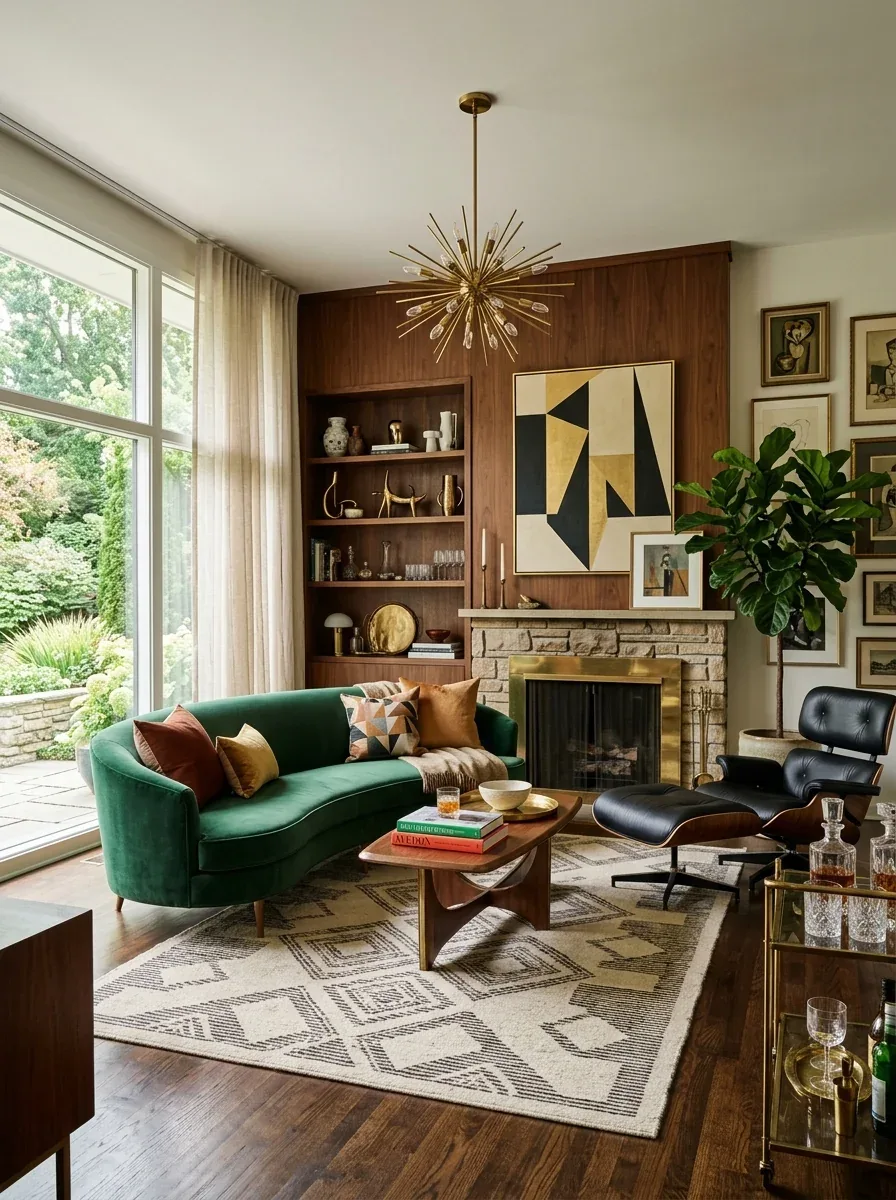
A true mid century glam living room usually has three ingredients working together: warm wood furniture with those signature angled legs, metallic accents (brass over chrome, almost always — chrome reads more 70s office than warm retro glam), and one or two plush, high-contrast textiles like a velvet throw pillow or a boucle chair. Skip any one of those three and the room drifts toward being purely mid century modern living or purely glam, rather than the blend you’re actually after.
If you want a deeper foundation before layering in the glam side, mid century modern living room design essentials covers the color palettes and furniture choices that make the base style work, which matters because glam touches only look intentional when the bones underneath are solid.
The Furniture Pieces That Make Mid Century Modern Living Feel Rich
Furniture is where most people start, and honestly, it’s the right place to start. A single well-chosen piece can carry the whole “mid century glam” identity of a room even before you touch lighting or accessories.
A walnut or teak credenza with brass hardware — even if the rest of the piece is dead simple, brass pulls instantly signal “elevated” instead of “vintage thrift find.” Expect to pay anywhere from $400 for a reproduction to well over $1,500 for a genuine vintage piece, depending on condition and where you’re shopping.
A low, tufted sofa in a jewel tone — emerald, deep rust, or a dusty mustard — rather than the more common mid century neutral. The tufting itself is a glam signal; combined with tapered wood legs, it bridges both aesthetics in one piece.
An accent chair with a curved back and brass or gold-finished legs. This is genuinely the easiest single swap if your current furniture is already mid century modern and you just want to nudge it toward glam.
I made this exact swap in my own living room a couple years back — replaced a plain oak accent chair with a curved velvet one that had slim brass legs, same footprint, same spot in the room. It changed the whole feel of the space in an afternoon, no other furniture moved. That’s the kind of low-effort, high-impact change I always point people toward first, because a full furniture overhaul for mid century modern interiors gets expensive fast, and it’s rarely necessary. For more specific furniture picks that hold up well to this exact blend, mid century modern living room furniture essentials is a solid reference.
Lighting Is Where Mid Century Glam Really Earns Its Name
Okay, so I’ll be honest — lighting is my favorite part of this whole style, and it’s also the part people underinvest in the most. A flat overhead fixture kills the “glam” half of mid century glam instantly. No amount of good furniture recovers a room lit like a dentist’s office.
A Mid Century Glam Living Room Lighting Formula That Works
Here’s the layering approach I actually use, and it’s not complicated:
One statement fixture — a sputnik chandelier or a brass arc floor lamp — as the visual anchor. This is the single most “glam” object in the room, and it should be a little bit too fabulous for a purely mid century room. That’s the point.
Two smaller ambient sources — table lamps with a mid century tapered wood or ceramic base, warm bulbs (2700K, always) — placed at different heights so the light bounces around the room rather than pooling in one spot.
A dimmer switch, if you can swing it. This single $15 hardware swap does more for “mood” than almost anything else on this list, and it means the same fixture can go from bright entertaining light to moody evening glow without buying a second lamp.
For a genuinely thorough breakdown of fixture placement (including how high to hang a pendant over a low mid century coffee table, which trips people up constantly), the mid century modern living room lighting guide is worth reading before you buy anything.
Color and Material Choices for a Mid Century Aesthetic Interior Design
If you’re building a mid century aesthetic interior design from scratch, color does a lot of quiet work. Classic mid century palettes lean warm and earthy — mustard, burnt orange, olive, walnut brown. Glam wants richness and a bit of contrast — jewel tones, black accents, metallic shine. The overlap between the two, conveniently, is warm and saturated color, which is why this combination reads as so cohesive rather than clashing.
My honest opinion: skip pastel and skip anything too cool-toned (icy blues, pale grays) if you’re going for this look — they read more Scandinavian-minimal than mid century glam, and they’ll fight with the brass and walnut tones you’re trying to build around. Stick to a warm base (walnut floors or furniture, a cream or warm taupe wall) and add your jewel-tone and metallic accents as the “glam” layer on top of that foundation, rather than trying to make a cool-toned room warmer after the fact. It’s a lot easier to add drama to a warm room than to fix undertones you didn’t plan for.
Materials matter just as much as color here. Look for lacquered wood finishes (they catch light in a way matte wood doesn’t), smoked or fluted glass on side tables, and marble or terrazzo accents on smaller surfaces like a side table top or a tray. None of these need to dominate — a single fluted glass vase on an otherwise plain shelf does plenty of work.
Art Deco Touches: Building a Mid Century Art Deco Living Room Without Overdoing It
This is where things get a little tricky, because art deco and mid century modern are genuinely different eras with different rules, and mixing them badly reads as confused rather than intentional. A mid century art deco living room borrows deco’s geometric patterns, mirrored surfaces, and a slightly more ornate sense of glamour, layered over mid century’s simpler furniture shapes.
The way I’d approach it (and the way I actually did it in my own space): keep the furniture itself mid century — simple, tapered, warm wood — and let art deco show up only in flat, two-dimensional details. A geometric rug with a repeating fan or chevron pattern. A mirrored tray with a scalloped edge. A piece of wall art with strong deco-style linework. Keep it to one or two moments, though. Deco patterns are bold enough that three or four competing geometric elements in one room turns into visual noise fast, and that’s really the only real risk with this particular mashup.
Rugs, Textiles, and Texture Layering for Mid Century Modern Interiors
A room can have all the right furniture and lighting and still feel flat without texture variety, and this is honestly the step people skip most often because it feels like an afterthought rather than a design decision.
A wool or wool-blend area rug in a warm tone, geometric or subtly patterned rather than solid — solid rugs tend to disappear under mid century furniture with clean lines, and you lose an opportunity for visual interest at floor level.
A velvet or boucle throw pillow or two, mixed with a linen one rather than matched — this is the same texture-mixing trick that works in almost any glam-adjacent room, and it keeps things from feeling like a showroom display.
A woven or leather pouf as an occasional seat, which adds a texture note that neither “mid century” nor “glam” alone typically brings to the table.
If you’re shopping for the rug specifically, sizing and pattern scale trip people up more than color does — the mid century modern living room rug buying guide walks through both in more detail than I have room for here.
Small-Space Tricks for a Mid Century Glam Living Room
Small apartment, big mid century glam ambitions? It’s genuinely doable, you just have to be more selective. In a tight space, pick one furniture statement piece (the credenza, or the accent chair, not both if space is really limited) and let lighting carry more of the glam weight, since a great fixture takes up almost no floor space while doing a lot of visual work.
Mirrored surfaces earn their keep twice as hard in a small room — they add the glam shine you want and bounce light around to make the space feel bigger, so a mirrored side table or a brass-framed mirror is a genuinely efficient choice rather than just a stylistic one. And go easy on rug size; a rug that’s slightly undersized in a large room reads as a mistake, but in a small room, a well-proportioned smaller rug actually helps define a seating area without visually shrinking the whole floor.
I’ll admit I’ve made a couple of these myself, so consider this the “learn from my slightly embarrassing missteps” section.
Going too gold. One brass fixture and a few metallic accents is glam. Gold trim on every single surface tips into something closer to a hotel lobby circa 2011, and not in a good way.
Mixing too many wood tones. Mid century relies on warm wood as a unifying thread — walnut console, oak floor, teak side table all in slightly different shades reads as mismatched rather than collected, unless you’re very deliberate about it.
Forgetting the “livable” part. A room this considered can tip into feeling untouchable if you’re not careful — no real books, no blanket that’s actually been used, nothing with any wear on it. Add at least one genuinely lived-in object once the design elements are in place.
Overdoing the deco geometry, which I mentioned above but it bears repeating because it’s the single most common overcorrection I see once people discover how good deco patterns look in photos.
If this all feels like a lot at once, here’s the order I’d actually tackle it in, starting this weekend rather than waiting for the “perfect” moment to begin:
Swap one lamp for a warmer bulb and add a dimmer if your fixture allows it — cheapest, fastest mood change available.
Add one brass or gold accent (a tray, a mirror frame, drawer pulls) to an existing piece of furniture you already own.
Introduce one jewel-tone textile — a pillow or throw — to break up a neutral sofa.
If you’re ready for a bigger move, shop for one true statement piece: a sputnik chandelier, a curved velvet chair, or a walnut credenza with brass hardware.
I still think about that friend’s apartment sometimes — the walnut credenza, the brass sunburst mirror, the low tufted sofa that somehow made a fairly small room feel like a boutique hotel lounge. You don’t need all of it at once, and you definitely don’t need to buy it all this month. Pick one piece, get the lighting right, and let the mid century glam living room build itself out gradually from there. Save this pin for when you’re ready for the next step — this is very much a style you layer in over time, not one you finish in a weekend.
Listen to this article 10 10 0:00 / 0:00 Speed 0.75×1×1.25×1.5×2× You want a living room rug that lifts your space and ties together furniture, color, and texture with a clear mid-century modern vibe. This article helps you find seven strong mid-century modern rugs and shows how to pick and style the right one for your room. You’ll…
Listen to this article 10 10 0:00 / 0:00 Speed 0.75×1×1.25×1.5×2× There’s a version of “elegant modern” that looks great in a photo and terrible to actually live in — all hard edges, no texture, nowhere comfortable to put your feet up. Real elegant modern living room inspiration should hold up under normal use: a…
Listen to this article 10 10 0:00 / 0:00 Speed 0.75×1×1.25×1.5×2× The best mid century modern living room ideas share one goal: a space that feels warm and considered without looking staged. This style leans on tapered wood, low-profile seating, and a restrained color palette, so a room reads as calm even when it includes…
Listen to this article 10 10 0:00 / 0:00 Speed 0.75×1×1.25×1.5×2× A colorful living room can go two ways: it either feels like a room you want to sink into, or it feels like a room that’s trying too hard. The difference usually isn’t the colors themselves — it’s how much restraint you use around…
Listen to this article 10 10 0:00 / 0:00 Speed 0.75×1×1.25×1.5×2× Most “rustic living room inspiration” boards show you the finished photo and skip the part where someone had to decide what to buy first. That’s the actual hard part. Rustic done well feels warm and collected over time; rustic done badly looks like a…
Listen to this article 10 10 0:00 / 0:00 Speed 0.75×1×1.25×1.5×2× You want a living room that feels timeless and calm, yet shows off your style. This article guides you through eight midcentury modern decor ideas that help you mix classic pieces, warm woods, clean lines, and a few bold accents to shape a balanced,…