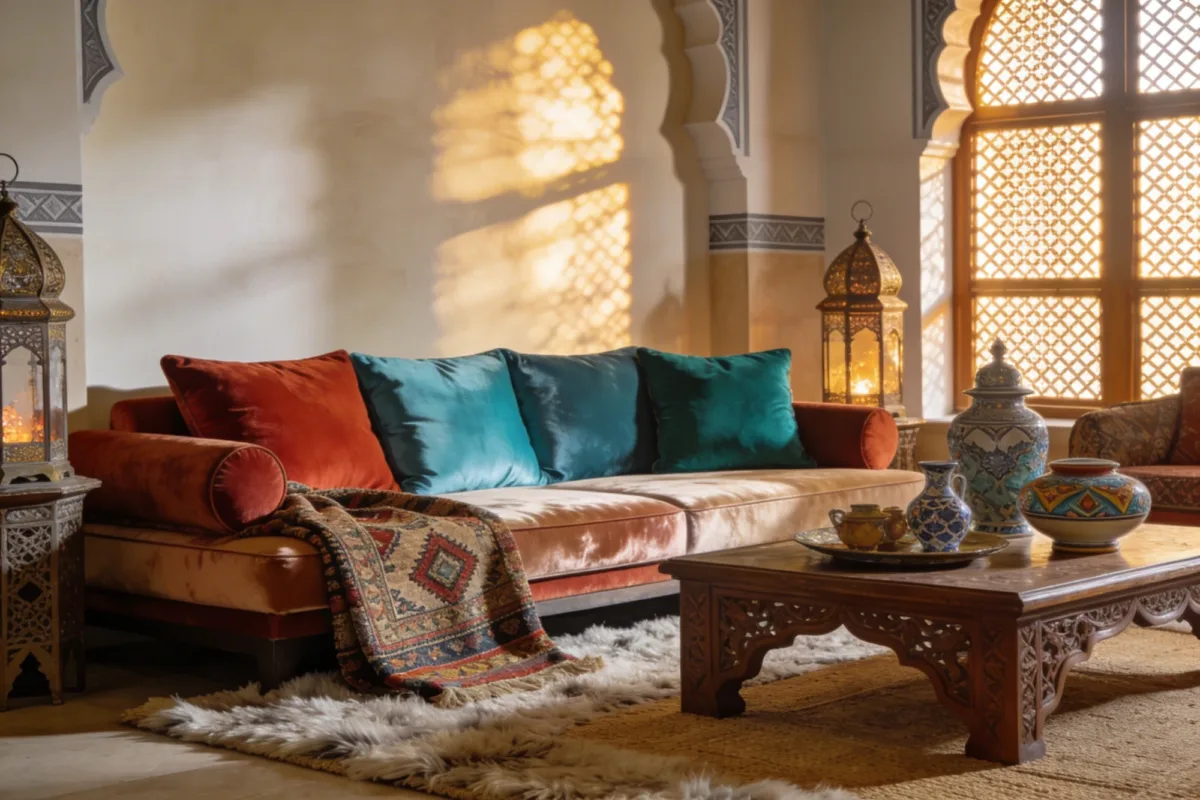
8 Elegant Moroccan Living Room Decor: Luxe Ideas for Wow-Worthy Spaces
Elegant Moroccan living room decor has a narrow line to walk — go too far and the room reads as a themed rental rather than a home; hold back too much and you lose the warmth that makes the style worth doing in the first place. The style shares real DNA with Moorish interior design and broader Middle Eastern decor traditions, but a living room doesn’t need to reference all of them at once to feel authentic. For a wider look at mixing patterns and eras the way this style calls for, our eclectic living room ideas guide covers some of the same layering principles.
Here are eight layers, roughly in the order I’d add them, starting with the one that costs the least and does the most.
Quick Takeaways
- Texture is the cheapest, fastest way to start — cushions, throws, and a layered rug before any furniture changes.
- A neutral base (cream, dune, graphite) with two or three accent colors reads as curated; five or more competing colors reads as costume.
- One statement rug should anchor the room — it’s the piece worth spending the most on.
- Personal, non-matching objects (souvenirs, mismatched ceramics) are what keep the room from feeling like a themed rental.
1. Start With Texture, Not Furniture
Moroccan style living room decor lives or dies on texture more than any single object. Low-pile silk or velvet cushions in jewel tones — emerald, sapphire, amethyst — layered with a woven kilim throw and a shaggy rug over a jute base gets you most of the visual richness before you’ve bought a single piece of furniture.
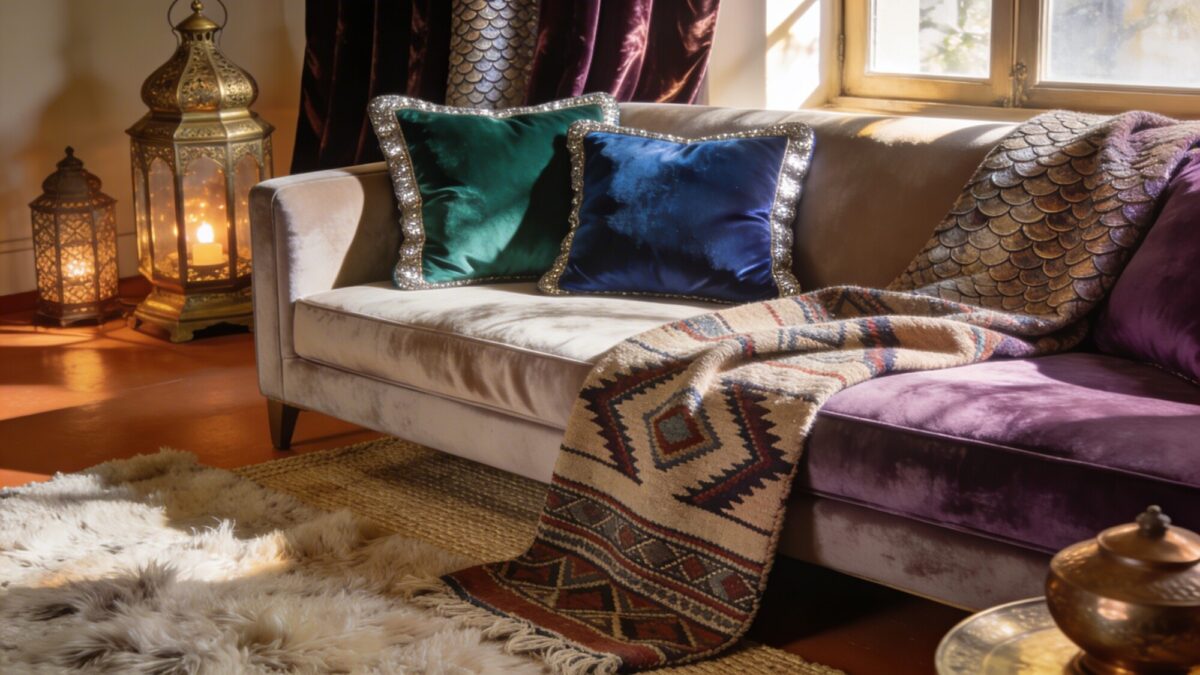
Vary pattern scale deliberately — a large-scale kilim next to smaller-scale embroidered cushions reads as intentional; several patterns at the same scale start to blur into visual noise. This is the same principle that makes a Moroccan bohemian decor room feel curated instead of cluttered.
💡 Pro Tip: Buy the rug and cushions before the lanterns or metalwork. Textiles are the cheapest way to test whether a full Moroccan-inspired direction is right for your room, and they’re easy to change if you decide to pull back later.
2. Build a Calibrated Color Palette, Not a Full Spectrum
The biggest misconception about Moroccan interior design living room styling is that it needs to be saturated everywhere. It works better as a neutral base — cream, dune, or graphite — with two or three accent colors layered in through textiles and ceramics: paprika, turquoise, emerald.
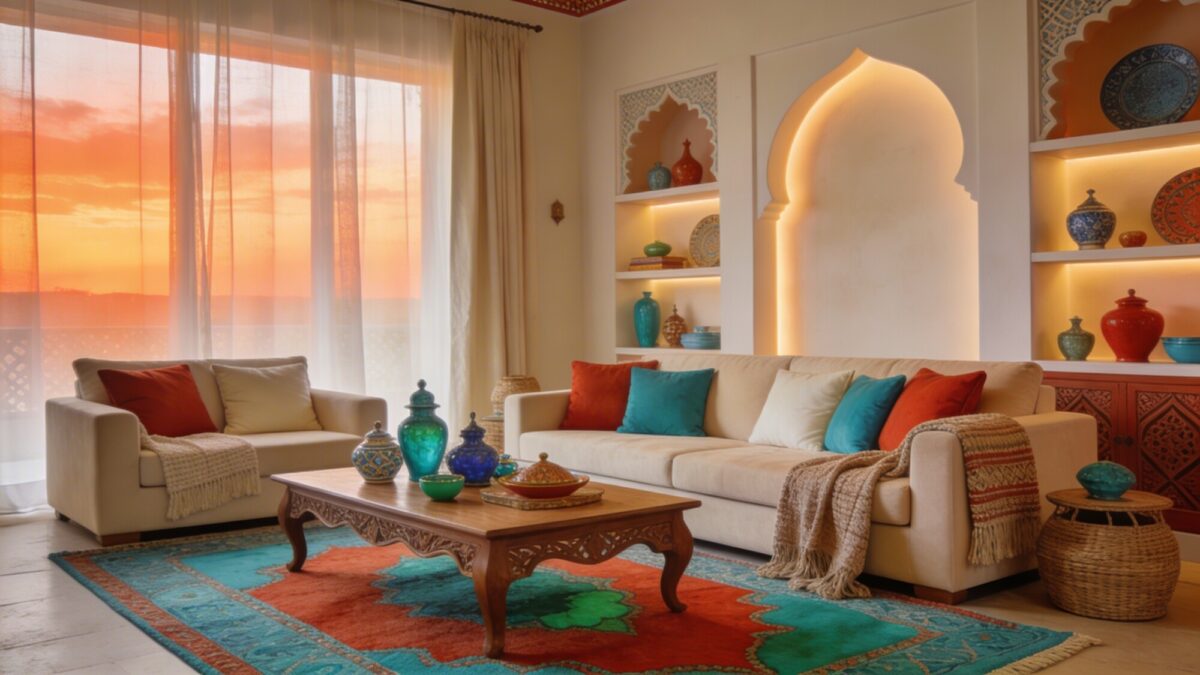
Limiting yourself to two or three accent colors, repeated across cushions, rugs, and ceramics, is what separates a curated Moroccan style apartment from one that looks like a souk display. Pick your palette before shopping, not after you’ve already bought pieces in five different colors.
3. Bring in Lantern-Style Lighting for After Dark
An ornate metal lantern with intricate cutouts does something no other fixture in this style does — it casts patterned shadows across the walls, which is a large part of what makes Arabesque interior lighting feel different from a standard lamp.
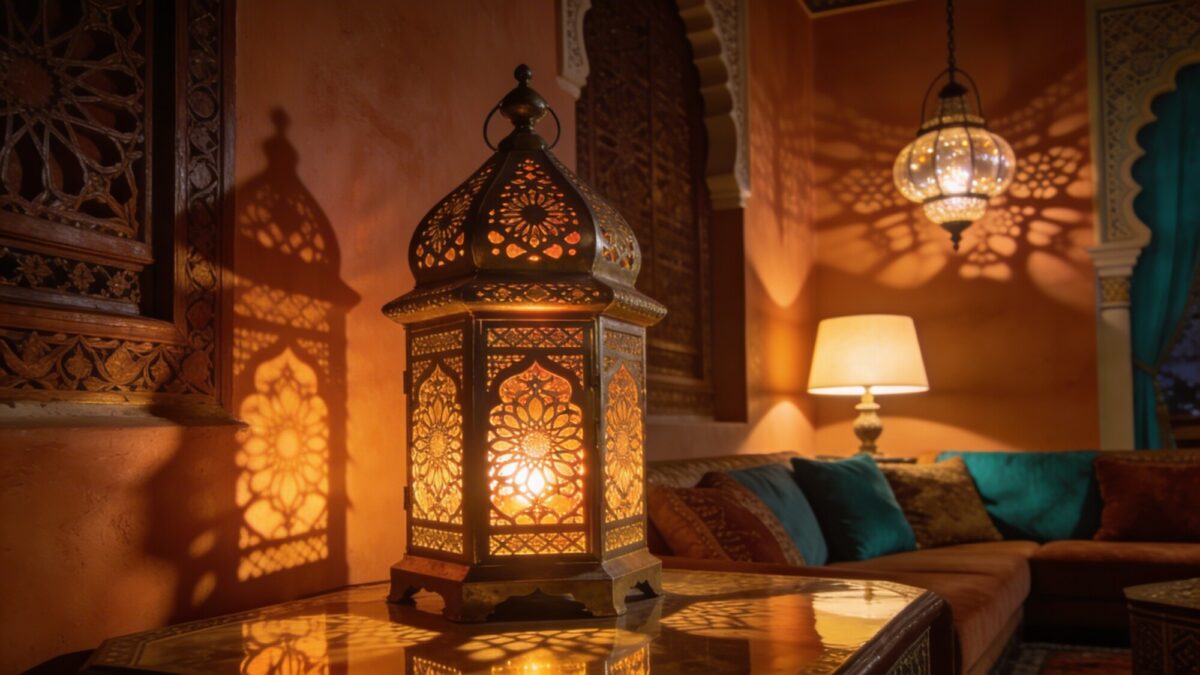
Warm LED bulbs (2700K–3000K) matter more here than in most lighting styles, since a cool-toned bulb through metal filigree looks harsh rather than warm. One or two statement lanterns, supplemented by a softer secondary lamp, is enough — more than that and the shadow patterns start competing with each other on the walls.
4. Anchor the Room With One Statement Rug
If there’s one piece worth spending real money on, it’s the rug. A bold kilim or over-dyed design with geometric latticework does the job a plain area rug can’t — it becomes the room’s visual anchor and its most obvious point of craftsmanship.
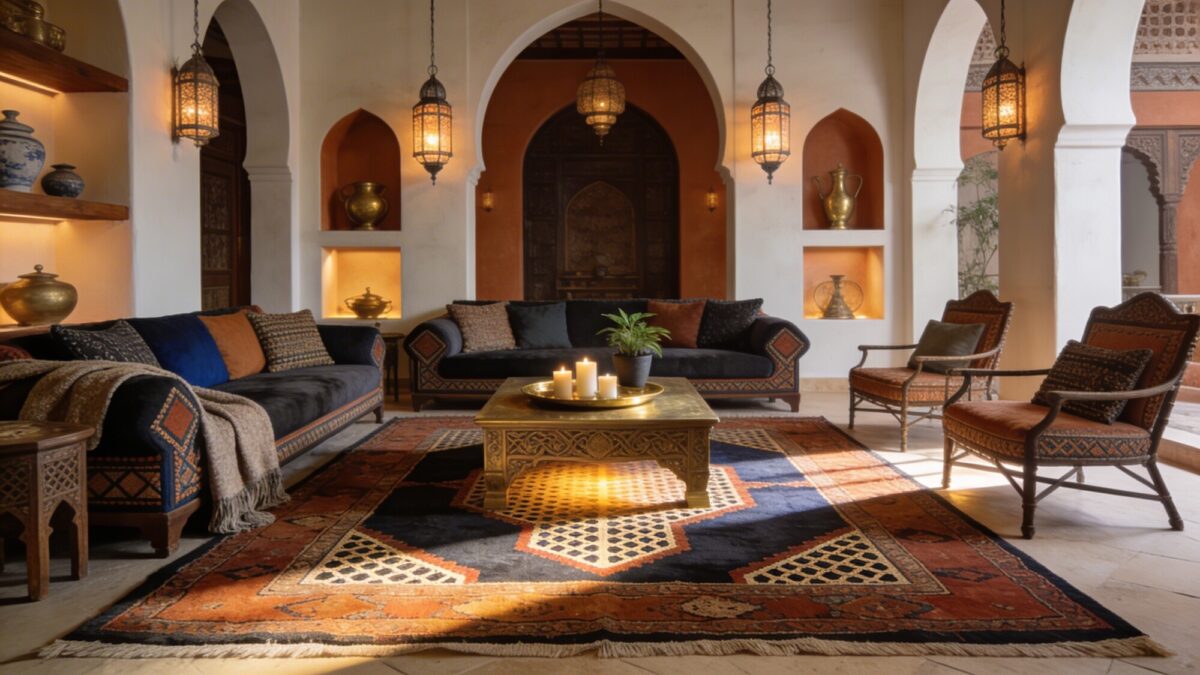
Size it to your actual seating arrangement, not to the room. The rug should extend under at least the front legs of your seating; a smaller rug placed decoratively in the middle of the floor undercuts the “grounding” effect that’s the whole point of this piece. For more on pairing a bold rug with the rest of the room, our patterned living room decor guide covers balancing a strong pattern against calmer surroundings.
💡 Pro Tip: If you can only afford one authentic, higher-cost piece for the whole room, make it the rug rather than the lantern. It covers more visual real estate and anchors everything else you add around it.
5. Add Handcrafted Ceramics for Tactile Detail
Blue and white mezze bowls, a glazed tagine repurposed as decor, or a cluster of mottled terracotta vases bring in artisanal texture without requiring a full room redo. Group them on a console or shelf rather than scattering them individually — a clustered display reads as a considered collection; scattered single pieces read as afterthoughts.
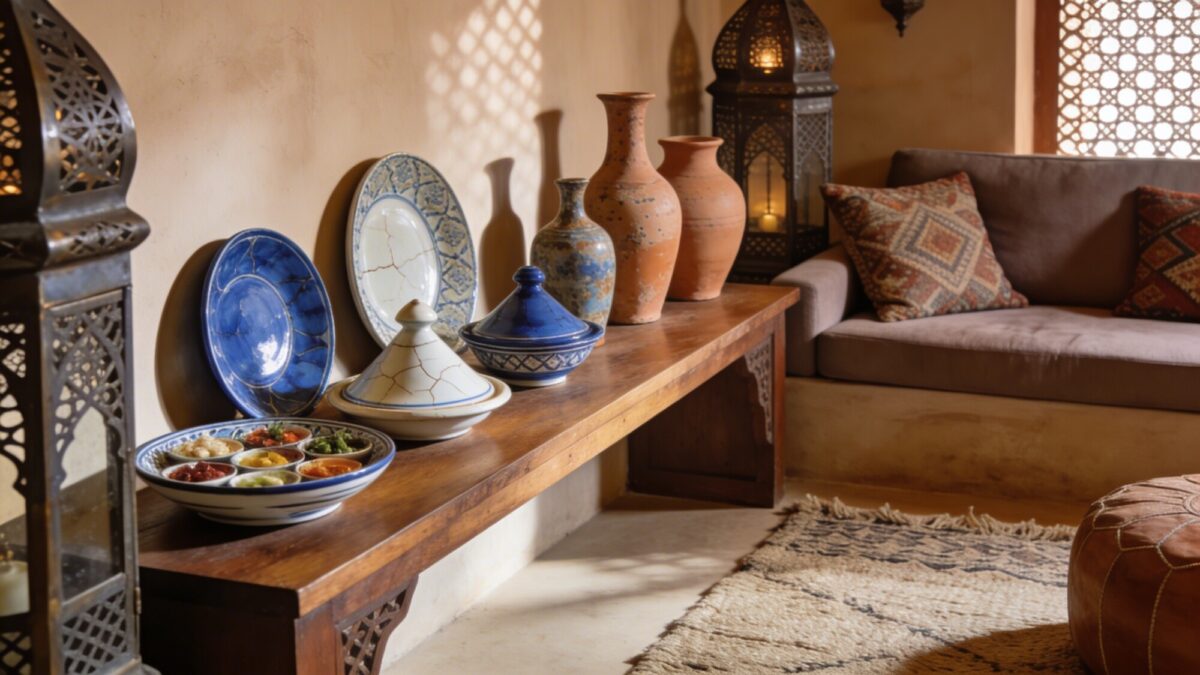
Ceramics are also the easiest piece to rotate seasonally or swap out if your palette shifts, since they’re smaller and lower-commitment than furniture or a rug.
6. Consider Low, Social Seating
Marrakech-style seating — floor cushions, leather poufs, low modular sofas — trades formal furniture for something built around lounging and conversation. It’s a bigger commitment than the layers above, and it’s worth thinking through whether it fits how you actually use the room before going all in.
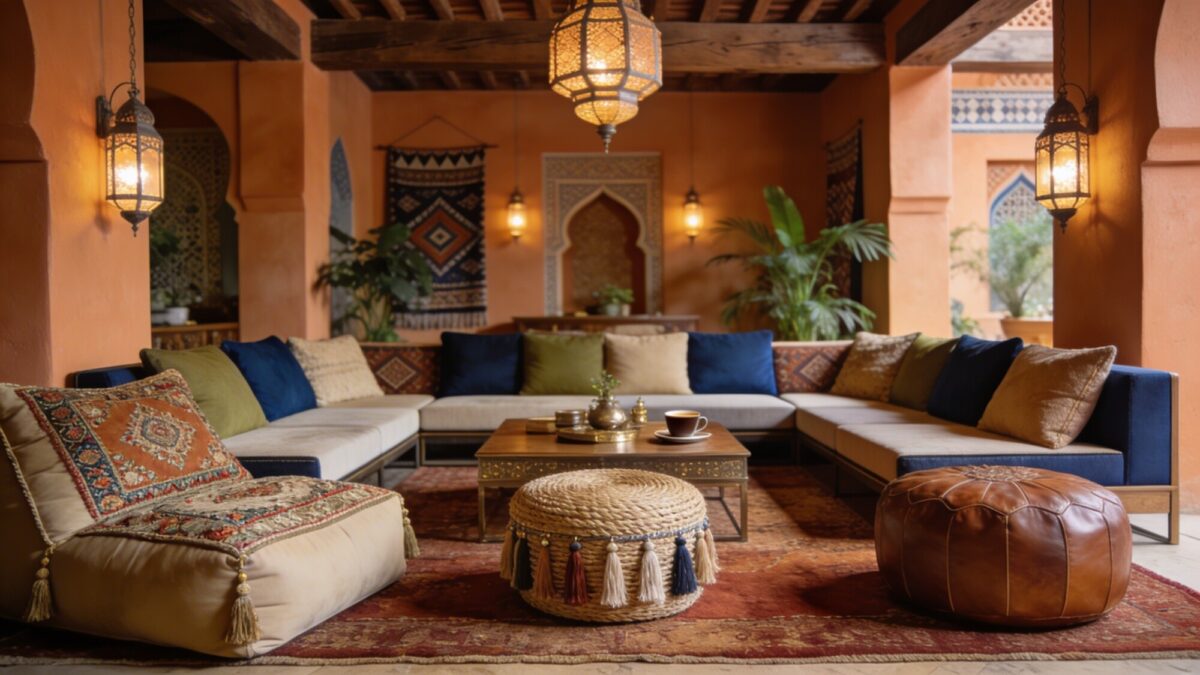
If a full low-seating overhaul feels like too much, poufs alone are a lower-risk way to bring in the same relaxed, social quality without replacing your existing sofa.
7. Layer in Metalwork and Carved Wood
Carved wood screens with geometric lattice patterns, brass or wrought-iron fixtures, and a coffee table with a latticework base give the room the architectural detail that separates Moroccan interiors from other maximalist styles. These pieces work as focal accents rather than background — one carved screen or one standout coffee table is usually enough.
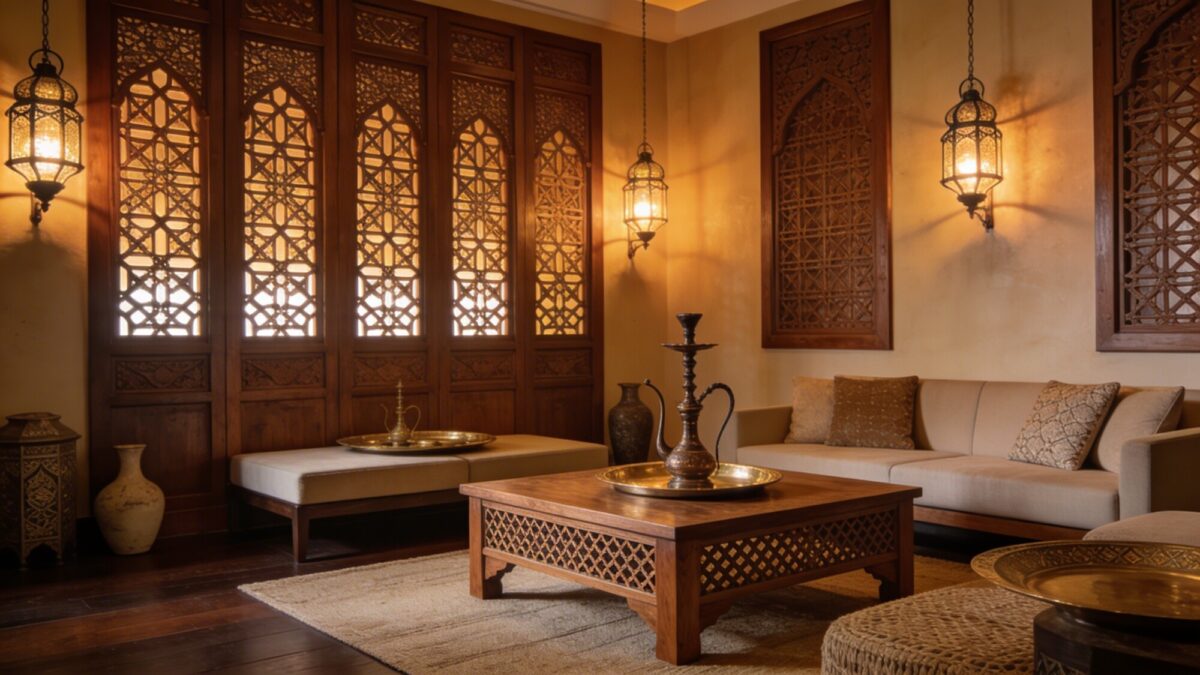
Mixing this level of ornamentation with otherwise modern, neutral furniture is actually the easier path for most rooms — it keeps the metalwork and carving from competing with itself.
8. Finish With Personal, Non-Matching Details
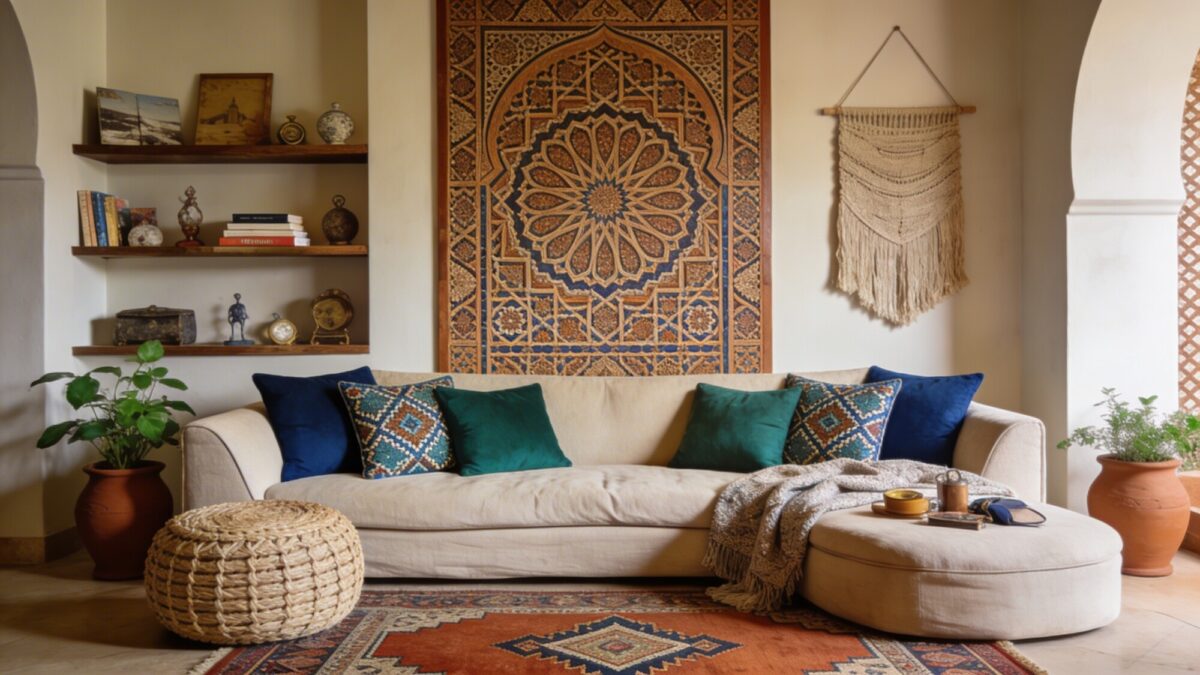
The layer that separates an elegant Moroccan living room from a themed one is the stuff that doesn’t match anything else on purpose — a travel souvenir, a mismatched cushion you actually love, a wall hanging with no relation to the rest of the palette. These are what make the room feel lived in rather than assembled from a single catalog.
Things to Consider Before You Start
- Have you picked a neutral base and limited yourself to two or three accent colors, rather than shopping color by color?
- Is your rug sized to your actual seating arrangement, with furniture legs resting on it?
- Are your lantern or metalwork pieces functioning as focal accents, not scattered evenly across every surface?
- Does the room include at least one or two objects that don’t perfectly match the palette — the personal touches that keep it from feeling staged?
Frequently Asked Questions
Is Moroccan style the same as general Middle Eastern decor?
No — Moroccan design is a specific regional tradition (zellij tilework, kilim weaving, carved cedar) within the broader family of Middle Eastern and Arabesque interior styles, which also includes distinct Persian, Ottoman, and Levantine traditions. They share motifs like geometric patterning and rich textiles, but the specific colors, materials, and techniques differ by region.
How many colors should I use in a Moroccan living room?
Two or three accent colors against a neutral base is the number that tends to read as curated. Once you’re past four or five saturated colors competing for attention, the room usually starts to feel more costume than considered.
Do I need a Moroccan lantern to make the style work?
It helps but isn’t required. If you’re not ready to commit to a statement lantern, warm-toned lamps and a couple of brass accents get you a meaningful part of the effect for less money and commitment.
Is low, floor-level seating necessary for this style?
No — it’s one option among the eight layers here, and it’s a bigger commitment than most of the others. Plenty of elegant Moroccan-inspired rooms keep a standard sofa and bring in the style through textiles, color, and lighting instead.
Our Take
Start with texture and color — they’re the cheapest, most reversible layers, and they’ll tell you fast whether the style is one you want to keep building on. The rug is the one piece worth spending real money on; everything else here can be added gradually as you find pieces you actually like rather than ones that just fit the theme.
If bold, mixed-pattern rooms in general are more your interest than Moroccan specifically, our colorful boho living room ideas guide covers a related but broader direction worth comparing against.