You can make a small bedroom feel airy, functional, and stylish without sacrificing comfort or purpose. This article shows seven modern ideas that help you maximize floor space, add clever storage, and create a calm, contemporary look so your room works harder for you. You’ll find practical approaches that focus on layout, lighting, furniture choices, and color so you can tailor solutions to your space and routine. Expect straightforward guidance on freeing floor space, integrating work and storage, and using color and mirrors to amplify a compact room. SNSLXH 5 Pack Stackable Closet Storage Basket, Multifunctional & … closet organizer 【Versatile & Stylish】The folding closet organizers are a comprehensive storage and categorization solution that is perfe… 【Stackable & Space-Saving】This 5 pack closet organizers and storage is designed to be easily stacked upon one another,Ac… $35.99 Buy on Amazon Table of Contents1) Use floating shelves to free up floor space and add storage2) Opt for a low-profile platform bed to create an open feel3) Incorporate built-in desks or wall-mounted workspaces4) Choose light, neutral paint colors for a spacious effect5) Install soft, layered lighting for ambiance and function6) Select multi-functional furniture like storage ottomans7) Use large mirrors to visually expand the roomPrinciples of Modern Small Bedroom DesignMaximizing Natural LightIncorporating Minimalist DecorColor and Texture StrategiesChoosing a Cohesive PaletteUtilizing Visual Contrast 1) Use floating shelves to free up floor space and add storage Floating shelves lift storage off the floor, giving you more visible floor area and a cleaner layout. You can place them above a desk, bed, or dresser to keep essentials within reach without crowding the room. Choose shelves that match your room’s scale and style; narrow shelves work well for small rooms, while deeper shelves suit heavier items. Mix closed containers with open display to control clutter and keep the visual plane light. Install shelves at varying heights to use vertical space efficiently and create visual interest. Securely anchor into studs or use proper wall anchors to support books, plants, or decorative objects safely. Use a consistent color or material to make the arrangement feel intentional and cohesive. Keep frequently used items at eye level and rotate decor seasonally to maintain a fresh, uncluttered look. BAYKA Floating Shelves for Wall, Set of 3, 22.5 Inch Rustic Wood … Modern & Minimalist Style: Featuring clean lines and a rustic finish, these wall-mounted shelves 𝐚𝐝𝐝 𝐚 𝐦𝐨𝐝𝐞𝐫𝐧 𝐭𝐨𝐮𝐜𝐡 to a… Strong Load Capacity: Made from durable engineered wood and reinforced with sturdy brackets, 𝐞𝐚𝐜𝐡 𝐬𝐡𝐞𝐥𝐟 𝐦𝐚𝐱 𝐬𝐮𝐩𝐩𝐨𝐫𝐭𝐬 𝐮𝐩 … Protection Sealing, prevent warping: Each shelf is 𝐭𝐫𝐞𝐚𝐭𝐞𝐝 𝐰𝐢𝐭𝐡 𝐚 𝐩𝐫𝐨𝐭𝐞𝐜𝐭𝐢𝐯𝐞 𝐬𝐞𝐚𝐥𝐚𝐧𝐭 𝐭𝐨 𝐩𝐫𝐞𝐯𝐞𝐧𝐭 𝐰𝐚𝐫𝐩𝐢𝐧𝐠 𝐨𝐫 𝐝𝐚𝐦𝐚𝐠𝐞, ensur… $59.99 Buy on Amazon 2) Opt for a low-profile platform bed to create an open feel Choose a low-profile platform bed to visually lower the room’s center of gravity and make ceilings feel higher. The reduced height clears sightlines and opens up wall and floor space, which helps a small room read as larger. Pick simple lines and minimal detailing to keep the bed from dominating the room. A solid wood or upholstered frame in a neutral tone anchors the space without adding visual clutter. You can pair the bed with low, slim bedside tables or floating shelves to maintain the airy effect. Built-in or under-bed storage can add functionality without raising the profile. Keep bedding light in color and texture to reinforce the open look, and avoid heavy, overstuffed headboards. Small adjustments—like slimmer legs or recessed bases—add the same spacious impact with little cost. Allewie Queen Size Platform Bed Frame with Fabric Upholstered Hea… Quality Advantage: Queen bed frame made of high-quality metal and wood; heavy-duty support feet with plastic plugs to ca… Minimalist & Noise-Free: Bed frame queen size with a padded upholstered headboard, suitable for various decors; EVA mute… No Box Spring Needed: Designed with solid wood slats and simple assembly; mattress does not slide; suitable for memory f… $148.94 Buy on Amazon 3) Incorporate built-in desks or wall-mounted workspaces A built-in desk or wall-mounted workspace saves floor space and gives your small bedroom a clean, purposeful look. You can place it beneath a window for natural light or tuck it into an unused corner to keep traffic flow open. Choose a floating desk or a slim wall-mounted unit to maintain an airy feel; these options keep legs and cleaning access clear. Add a narrow shelf or recessed cubbies above the desk for vertical storage without crowding the room. Keep the surface uncluttered by limiting items to essentials: laptop, task lamp, and one tray for papers. Use cable management and a slim chair or stool that tucks completely under the desk when not in use. If you need occasional privacy, consider a sliding panel or curtain that closes the workspace off from the rest of the room. Built-ins can be painted or veneered to match surrounding walls, helping the desk blend in and making the space feel larger. 4) Choose light, neutral paint colors for a spacious effect Choose pale neutrals like soft whites, warm creams, or light grays to reflect more light and make your room feel airier. These tones reduce visual clutter and create a calm backdrop that lets furniture and textiles stand out. Keep the ceiling and trim in a slightly lighter shade than the walls to enhance vertical height. That subtle contrast draws the eye upward and gives the impression of more volume without adding color complexity. If you want gentle depth, pick a neutral with a cool or warm undertone that complements your natural light. Test paint swatches on different walls at different times of day to confirm the undertone reads well in your space. Reserve stronger colors for accents — a headboard, pillows, or a single feature wall — so you maintain an open feel while injecting personality. This balance keeps the room feeling modern, intentional, and comfortably spacious. 5) Install soft, layered lighting for ambiance and function Create three light layers: ambient, task, and accent. Ambient light gives overall illumination, task light supports reading or dressing, and accent light highlights texture or artwork. Choose warm-color LEDs (2700–3000K) to keep the room calming and true to color. Dimmable fixtures let you adjust brightness for different activities and times of day. Use wall sconces or pendant lights to free bedside surface space and maintain a clean, modern look. LED strip lights under shelves or the bed add subtle glow without clutter. Position task lights near the bed and workspace to reduce eye strain. Directable fixtures or adjustable swing-arm lamps give flexible, focused light when you need it. Layering prevents harsh contrast and makes a small room feel larger by creating depth. Control groups with smart switches or dimmers so you can change mood and function in a single touch. 6) Select multi-functional furniture like storage ottomans Choose pieces that do double duty to free up floor space and reduce visual clutter. A storage ottoman provides seating, a surface for trays or books, and hidden space for linens or seasonal clothes. Pick compact designs with clean lines so the piece feels intentional, not bulky. Materials like upholstered fabric, leather, or woven textures can tie into your room’s palette while remaining practical. Place the ottoman at the foot of the bed or beside a window to create a small seating nook. You can also use it as a temporary bedside table when needed. Look for durable hinges and compartments that open easily; reliable hardware keeps the piece useful for years. Consider modular options that stack or convert, giving you flexibility as your needs change. 7) Use large mirrors to visually expand the room Place a large mirror on a wall opposite a window to bounce natural light and make the room feel brighter. This simple move increases perceived depth without structural changes. Lean a full-length mirror against a wall if you prefer a casual look; it creates vertical lines that draw the eye upward. Mounting a mirror above a low dresser also reflects more of the room and helps break up solid surfaces. Choose a frame that matches your style—sleek metal for modern, thin wood for warmth—so the mirror adds to the decor rather than competing with it. Keep surrounding clutter minimal so the reflection enhances space instead of amplifying mess. If you lack wall space, use multiple slim mirrors arranged as a single panel to simulate one large reflective surface. Mirrors are a low-cost, low-effort tool to make a small bedroom feel more open and intentionally designed. Principles of Modern Small Bedroom Design Focus on light, storage, and clean lines that make the room feel larger and more functional. Choose finishes and furniture that serve more than one purpose and reduce visual clutter. Maximizing Natural Light Place the bed and major furniture to keep window areas clear so light travels across the room. Use sheer or low-profile window treatments—roller shades or thin linen curtains—to preserve privacy while allowing daylight. Select wall and ceiling colors in the same light family; off-white, pale gray, or warm beige reflect light better than saturated hues. Add a large mirror opposite or adjacent to the window to double incoming light and create depth. Keep window trim and sills simple and paint them the same color as the walls to avoid interrupting light flow. If privacy or street noise is an issue, layer with a thin sound-damping fabric or cellular shade that still transmits light. Incorporating Minimalist Decor Choose furniture with slim profiles and raised legs to expose floor area and make the room feel airier. Prioritize multi-functional pieces—a platform bed with drawers, a wall-mounted desk, or a narrow dresser that doubles as a nightstand. Limit decorative items to a short, deliberate list: one large artwork or a small gallery of uniform frames, a single plant, and two functional accessories such as a lamp and clock. Use a restrained palette—two neutral base tones plus one accent color—to keep visual noise low. Organize visible storage with uniform baskets or boxes and hide bulkier items behind cabinet doors. Keep textiles simple: solid or subtly textured bedding, one throw, and two coordinating pillows to maintain a calm, modern look. Color and Texture Strategies Use color to control perceived scale and texture to add depth without clutter. Select a small set of colors and two or three tactile materials to keep the room deliberate and calm. Choosing a Cohesive Palette Pick a dominant neutral, a mid-tone accent, and one high-contrast accent color. For example: soft warm gray (walls), muted teal (accent wall or bedding), and matte black (lighting or hardware). This trio keeps the space feeling larger while still offering personality. Apply the dominant neutral to the largest surfaces—walls and ceiling—to visually expand the room. Reserve the mid-tone for textiles and a single focal wall. Use the high-contrast accent sparingly: a lamp, picture frame, or narrow shelf. Consider undertones. If your flooring is warm oak, favor warm grays and olive greens. For cool-toned floors or tiles, choose blues, cool grays, or soft lavenders. Match paint undertones to major finishes to avoid visual clashes. Utilizing Visual Contrast Use contrast to define areas without bulky furniture. Contrast between matte and glossy finishes, or between smooth and textured fabrics, creates separation while preserving openness. Create contrast with scale and pattern too. A large, low-contrast rug anchors the bed; add one small geometric cushion or a slim-striped throw for a focal point. Keep patterns limited to one or two items so they read as intentional, not busy. Employ texture strategically: a woven headboard, linen bedding, and a metal bedside table work together. Textural contrast—soft linens against hard metal—adds interest without taking up visual space. Use lighting to highlight texture: a directional sconce emphasizes weave and grain.
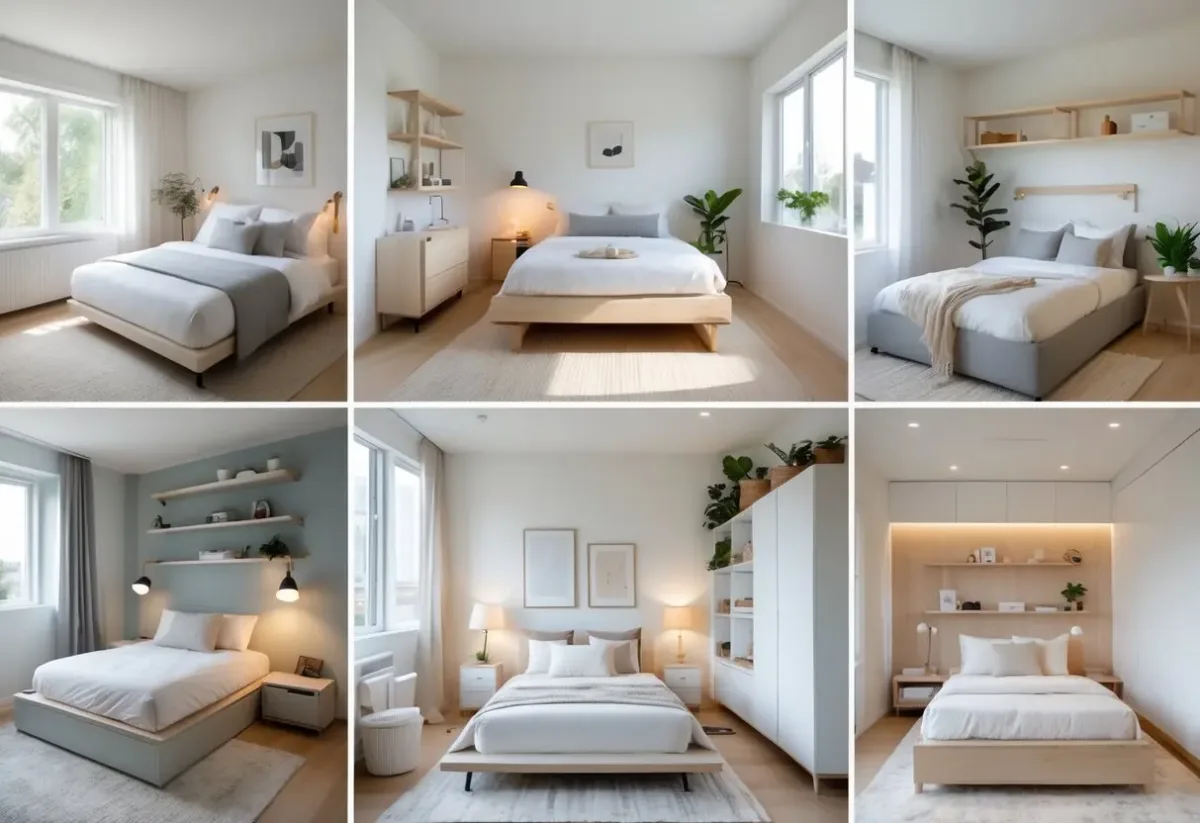
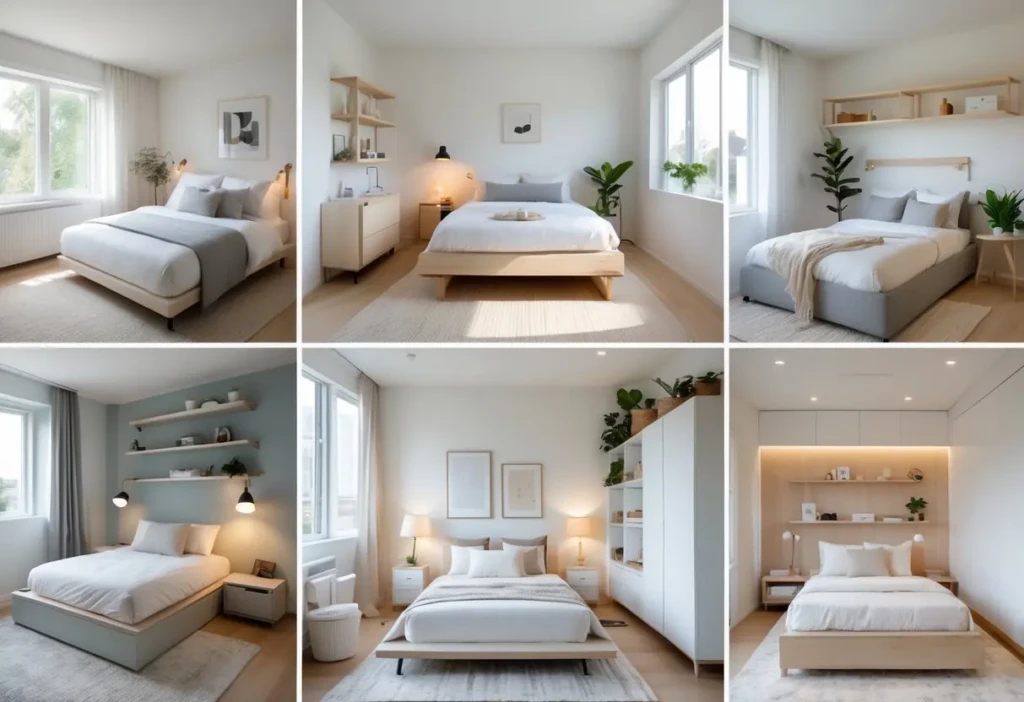
You can make a small bedroom feel airy, functional, and stylish without sacrificing comfort or purpose. This article shows seven modern ideas that help you maximize floor space, add clever storage, and create a calm, contemporary look so your room works harder for you.
You’ll find practical approaches that focus on layout, lighting, furniture choices, and color so you can tailor solutions to your space and routine. Expect straightforward guidance on freeing floor space, integrating work and storage, and using color and mirrors to amplify a compact room.
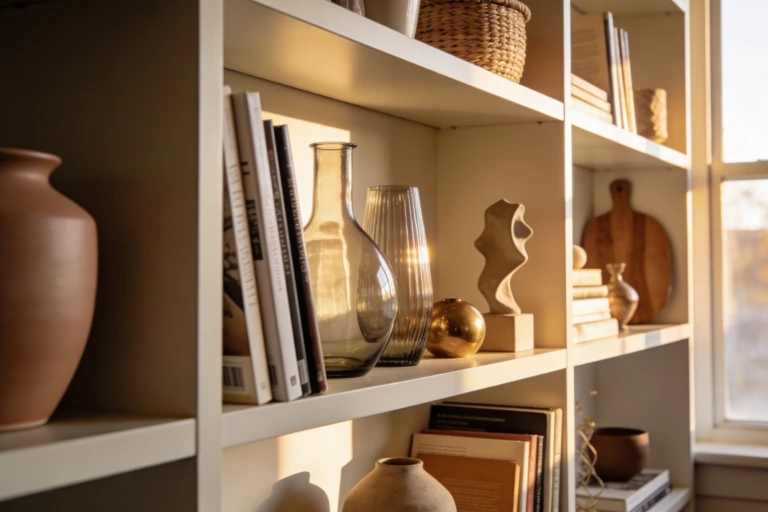
Floating shelves lift storage off the floor, giving you more visible floor area and a cleaner layout. You can place them above a desk, bed, or dresser to keep essentials within reach without crowding the room.
Choose shelves that match your room’s scale and style; narrow shelves work well for small rooms, while deeper shelves suit heavier items. Mix closed containers with open display to control clutter and keep the visual plane light.
Install shelves at varying heights to use vertical space efficiently and create visual interest. Securely anchor into studs or use proper wall anchors to support books, plants, or decorative objects safely.
Use a consistent color or material to make the arrangement feel intentional and cohesive. Keep frequently used items at eye level and rotate decor seasonally to maintain a fresh, uncluttered look.
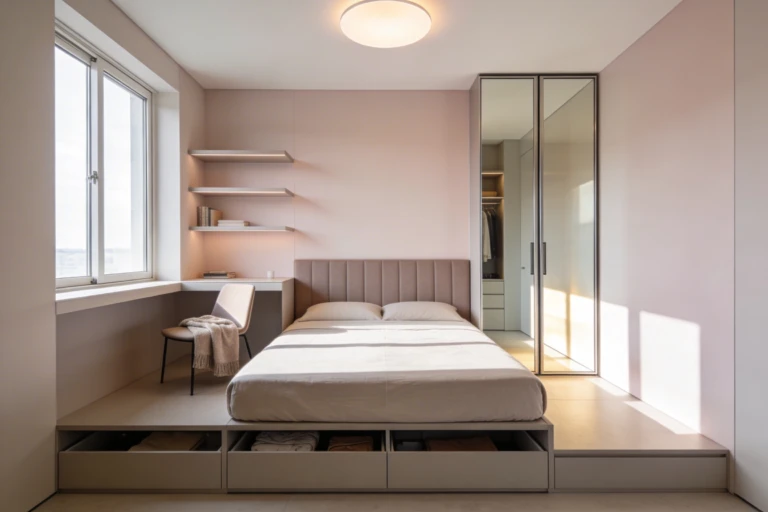
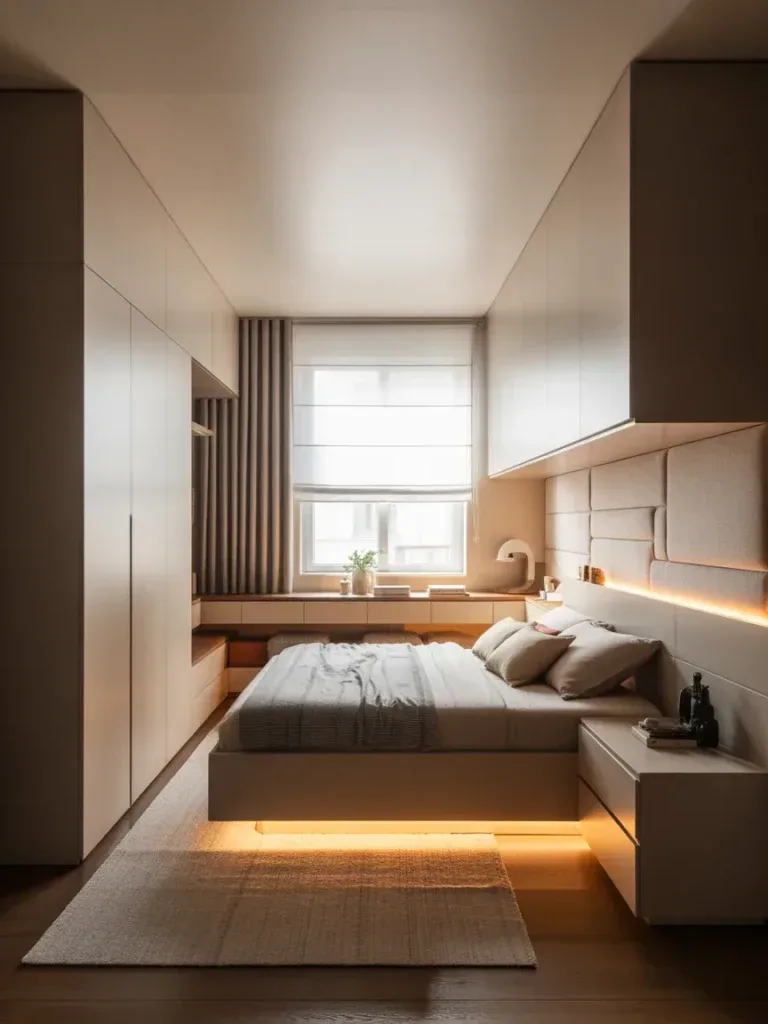
Choose a low-profile platform bed to visually lower the room’s center of gravity and make ceilings feel higher. The reduced height clears sightlines and opens up wall and floor space, which helps a small room read as larger.
Pick simple lines and minimal detailing to keep the bed from dominating the room. A solid wood or upholstered frame in a neutral tone anchors the space without adding visual clutter.
You can pair the bed with low, slim bedside tables or floating shelves to maintain the airy effect. Built-in or under-bed storage can add functionality without raising the profile.
Keep bedding light in color and texture to reinforce the open look, and avoid heavy, overstuffed headboards. Small adjustments—like slimmer legs or recessed bases—add the same spacious impact with little cost.
A built-in desk or wall-mounted workspace saves floor space and gives your small bedroom a clean, purposeful look. You can place it beneath a window for natural light or tuck it into an unused corner to keep traffic flow open.
Choose a floating desk or a slim wall-mounted unit to maintain an airy feel; these options keep legs and cleaning access clear. Add a narrow shelf or recessed cubbies above the desk for vertical storage without crowding the room.
Keep the surface uncluttered by limiting items to essentials: laptop, task lamp, and one tray for papers. Use cable management and a slim chair or stool that tucks completely under the desk when not in use.
If you need occasional privacy, consider a sliding panel or curtain that closes the workspace off from the rest of the room. Built-ins can be painted or veneered to match surrounding walls, helping the desk blend in and making the space feel larger.
4) Choose light, neutral paint colors for a spacious effect
Choose pale neutrals like soft whites, warm creams, or light grays to reflect more light and make your room feel airier. These tones reduce visual clutter and create a calm backdrop that lets furniture and textiles stand out.
Keep the ceiling and trim in a slightly lighter shade than the walls to enhance vertical height. That subtle contrast draws the eye upward and gives the impression of more volume without adding color complexity.
If you want gentle depth, pick a neutral with a cool or warm undertone that complements your natural light. Test paint swatches on different walls at different times of day to confirm the undertone reads well in your space.
Reserve stronger colors for accents — a headboard, pillows, or a single feature wall — so you maintain an open feel while injecting personality. This balance keeps the room feeling modern, intentional, and comfortably spacious.
5) Install soft, layered lighting for ambiance and function
Create three light layers: ambient, task, and accent. Ambient light gives overall illumination, task light supports reading or dressing, and accent light highlights texture or artwork.
Choose warm-color LEDs (2700–3000K) to keep the room calming and true to color. Dimmable fixtures let you adjust brightness for different activities and times of day.
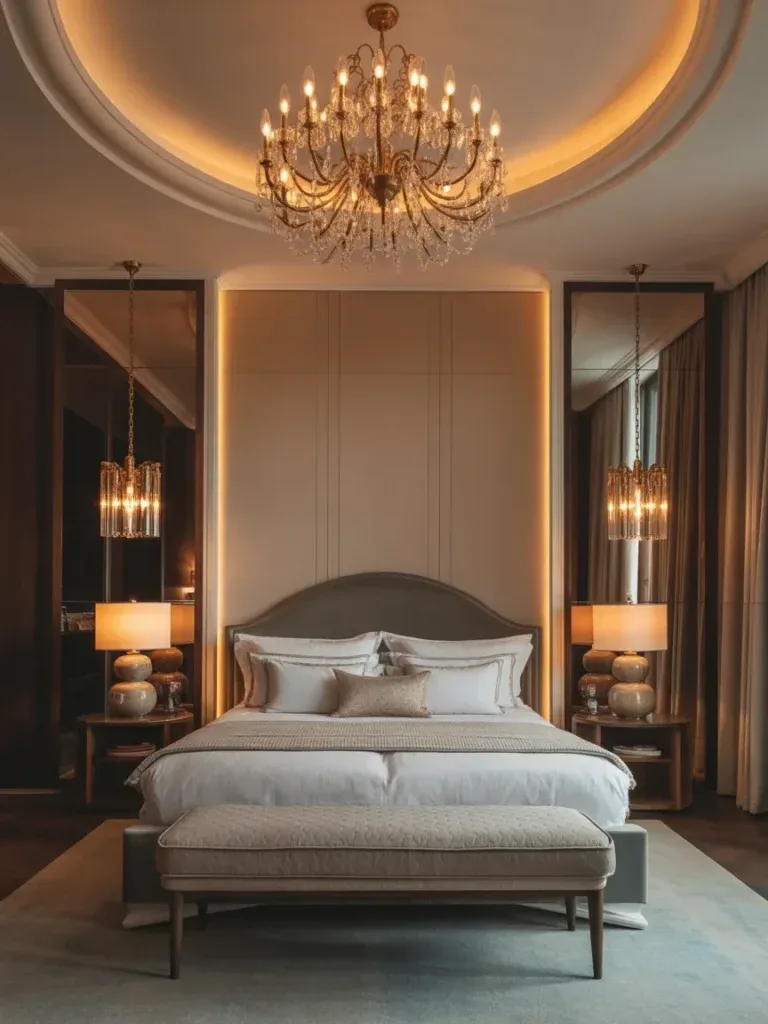
Use wall sconces or pendant lights to free bedside surface space and maintain a clean, modern look. LED strip lights under shelves or the bed add subtle glow without clutter.
Position task lights near the bed and workspace to reduce eye strain. Directable fixtures or adjustable swing-arm lamps give flexible, focused light when you need it.
Layering prevents harsh contrast and makes a small room feel larger by creating depth. Control groups with smart switches or dimmers so you can change mood and function in a single touch.
6) Select multi-functional furniture like storage ottomans
Choose pieces that do double duty to free up floor space and reduce visual clutter. A storage ottoman provides seating, a surface for trays or books, and hidden space for linens or seasonal clothes.
Pick compact designs with clean lines so the piece feels intentional, not bulky. Materials like upholstered fabric, leather, or woven textures can tie into your room’s palette while remaining practical.
Place the ottoman at the foot of the bed or beside a window to create a small seating nook. You can also use it as a temporary bedside table when needed.
Look for durable hinges and compartments that open easily; reliable hardware keeps the piece useful for years. Consider modular options that stack or convert, giving you flexibility as your needs change.
Place a large mirror on a wall opposite a window to bounce natural light and make the room feel brighter. This simple move increases perceived depth without structural changes.
Lean a full-length mirror against a wall if you prefer a casual look; it creates vertical lines that draw the eye upward. Mounting a mirror above a low dresser also reflects more of the room and helps break up solid surfaces.
Choose a frame that matches your style—sleek metal for modern, thin wood for warmth—so the mirror adds to the decor rather than competing with it. Keep surrounding clutter minimal so the reflection enhances space instead of amplifying mess.
If you lack wall space, use multiple slim mirrors arranged as a single panel to simulate one large reflective surface. Mirrors are a low-cost, low-effort tool to make a small bedroom feel more open and intentionally designed.
Principles of Modern Small Bedroom Design
Focus on light, storage, and clean lines that make the room feel larger and more functional. Choose finishes and furniture that serve more than one purpose and reduce visual clutter.
Maximizing Natural Light
Place the bed and major furniture to keep window areas clear so light travels across the room. Use sheer or low-profile window treatments—roller shades or thin linen curtains—to preserve privacy while allowing daylight.
Select wall and ceiling colors in the same light family; off-white, pale gray, or warm beige reflect light better than saturated hues. Add a large mirror opposite or adjacent to the window to double incoming light and create depth.
Keep window trim and sills simple and paint them the same color as the walls to avoid interrupting light flow. If privacy or street noise is an issue, layer with a thin sound-damping fabric or cellular shade that still transmits light.
Incorporating Minimalist Decor
Choose furniture with slim profiles and raised legs to expose floor area and make the room feel airier. Prioritize multi-functional pieces—a platform bed with drawers, a wall-mounted desk, or a narrow dresser that doubles as a nightstand.
Limit decorative items to a short, deliberate list: one large artwork or a small gallery of uniform frames, a single plant, and two functional accessories such as a lamp and clock. Use a restrained palette—two neutral base tones plus one accent color—to keep visual noise low.
Organize visible storage with uniform baskets or boxes and hide bulkier items behind cabinet doors. Keep textiles simple: solid or subtly textured bedding, one throw, and two coordinating pillows to maintain a calm, modern look.
Color and Texture Strategies
Use color to control perceived scale and texture to add depth without clutter. Select a small set of colors and two or three tactile materials to keep the room deliberate and calm.
Choosing a Cohesive Palette
Pick a dominant neutral, a mid-tone accent, and one high-contrast accent color. For example: soft warm gray (walls), muted teal (accent wall or bedding), and matte black (lighting or hardware). This trio keeps the space feeling larger while still offering personality.
Apply the dominant neutral to the largest surfaces—walls and ceiling—to visually expand the room. Reserve the mid-tone for textiles and a single focal wall. Use the high-contrast accent sparingly: a lamp, picture frame, or narrow shelf.
Consider undertones. If your flooring is warm oak, favor warm grays and olive greens. For cool-toned floors or tiles, choose blues, cool grays, or soft lavenders. Match paint undertones to major finishes to avoid visual clashes.
Utilizing Visual Contrast
Use contrast to define areas without bulky furniture. Contrast between matte and glossy finishes, or between smooth and textured fabrics, creates separation while preserving openness.
Create contrast with scale and pattern too. A large, low-contrast rug anchors the bed; add one small geometric cushion or a slim-striped throw for a focal point. Keep patterns limited to one or two items so they read as intentional, not busy.
Employ texture strategically: a woven headboard, linen bedding, and a metal bedside table work together. Textural contrast—soft linens against hard metal—adds interest without taking up visual space. Use lighting to highlight texture: a directional sconce emphasizes weave and grain.
Listen to this article 10 10 0:00 / 0:00 Speed 0.75×1×1.25×1.5×2× Shelf styling fails for a predictable reason: most people either fill every inch or leave the shelf so bare it looks unfinished. Neither extreme reads as intentional. The middle ground — a handful of grouped objects with real negative space around them — is…
Listen to this article 10 10 0:00 / 0:00 Speed 0.75×1×1.25×1.5×2× An ordinary-sized bedroom can feel cramped, but a few clever tweaks turn it into a luxe, restful retreat. Let’s ditch clutter and embrace clever design that makes every square inch count. Ready to transform your tiny sanctuary without breaking the bank? Let’s dive in….
Listen to this article 10 10 0:00 / 0:00 Speed 0.75×1×1.25×1.5×2× Lighting can make a gorgeous bedroom look designer-level—or make it feel like a sad rental with one overhead bulb doing its absolute worst. If you want your bedroom to feel polished, expensive, and a little bit “yes, I absolutely stay at boutique hotels for…
Listen to this article 10 10 0:00 / 0:00 Speed 0.75×1×1.25×1.5×2× Tiny bedroom? Cool, you’re about to make it work harder than a studio apartment in a rom-com. The secret isn’t more space—it’s smarter layouts, clever furniture, and a little design confidence. These ideas prove you can have style, comfort, and storage without sacrificing your…
Listen to this article 10 10 0:00 / 0:00 Speed 0.75×1×1.25×1.5×2× Your front door sets the tone for all the spooky fun inside. Nail the entrance, and you’ve basically won Halloween before anyone rings the bell. These ideas are bold, budget-friendly, and seriously eye-catching—no advanced witchcraft required. Ready to make trick-or-treaters gasp (and neighbors low-key…
Listen to this article 10 10 0:00 / 0:00 Speed 0.75×1×1.25×1.5×2× Your backyard doesn’t need a five-figure renovation to feel like an outdoor oasis. With a little creativity, a modest budget, and one free weekend, you can turn that sad patch of grass—or dusty concrete slab—into a space you actually want to hang out in….