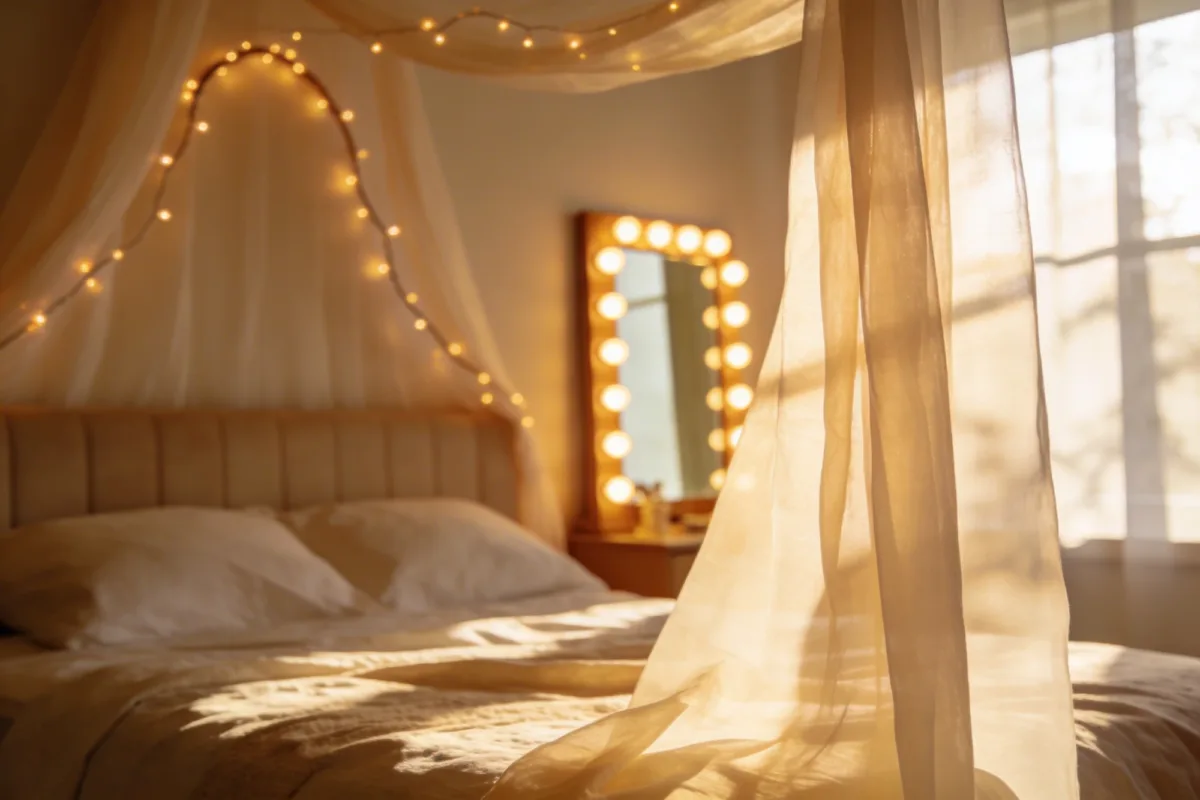
6 Small Cozy Bedroom Ideas Fairy Lights Room Decor That Glow Inside
A small bedroom has one advantage a big one doesn’t: you don’t need much light to fill it. A single 20-foot strand of fairy lights can wrap a whole headboard, mirror, or shelf in a tight room, where the same strand would barely dent a master suite. That’s the whole logic behind good small cozy bedroom ideas fairy lights room decor — work with the size instead of fighting it. If you want more layout-specific inspiration once you’ve got the lighting sorted, our small space decorating guide covers furniture placement for rooms under 100 square feet.
Below are six placements that hold up in real use, not just in photos — plus the setup details, trade-offs, and mistakes that usually show up after the first week (the cord sagging, the battery dying at 2am, the glare in your eyes when you’re trying to sleep). If you want a broader roundup of styles first, our fairy lights bedroom ideas post is a good companion piece.
At a Glance: What to Know Before You String a Single Light
- Warm white (2700K–3000K) reads as cozy; anything above 4000K reads as sterile, office-hallway light.
- Battery packs are the least reliable long-term — plan on swapping batteries every few weeks if the lights run nightly.
- USB-powered strands plugged into a cheap timer solve the “forgot to turn it off” problem for good.
- One dense strand (100 LEDs) does more for a small room than three thin ones spread out.
- Command hooks hold fairy lights fine — but only the ones rated for the actual weight of the strand plus the cord.
1. Fairy Light Bed Canopy: The Halo Effect Over Your Headboard
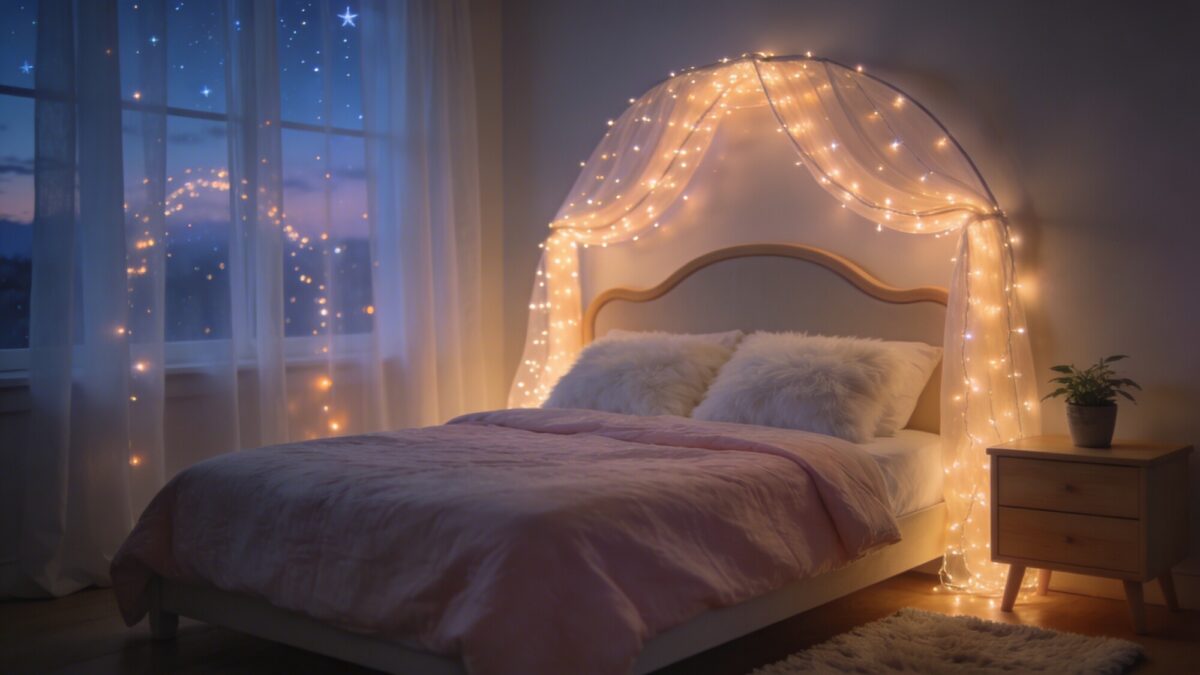
This is the placement people picture first when they hear “fairy lights bedroom aesthetic,” and it earns the reputation. You’re draping a strand above and around the headboard so it forms a loose halo over the pillows rather than a straight line across the wall.
Skip the grid pattern. A taut, evenly-spaced grid looks like a string light display at a garden center, not a bedroom. Instead, let the strand sag naturally between anchor points — two or three loose curves read as intentional, where a perfectly straight line reads like you ran out of patience halfway through.
- Mount on a simple curtain rod above the headboard, or run adhesive clips directly on the wall if you’re renting.
- Battery-operated strands avoid running a cord down behind the mattress, which is the single most annoying part of this setup.
- Sheer curtains behind the strand diffuse the light instead of letting individual bulbs glare — this is the difference between “cozy” and “can’t fall asleep.”
💡 Pro Tip: Use LED strands, not the older incandescent mini-bulbs, for anything draped near fabric or bedding for hours at a time. LEDs run cool to the touch; incandescent mini-lights build up noticeable heat over a long night, and fabric brushing against them isn’t worth the risk.
2. String Lights Around Your Mirror: Better Light Than Your Overhead Fixture
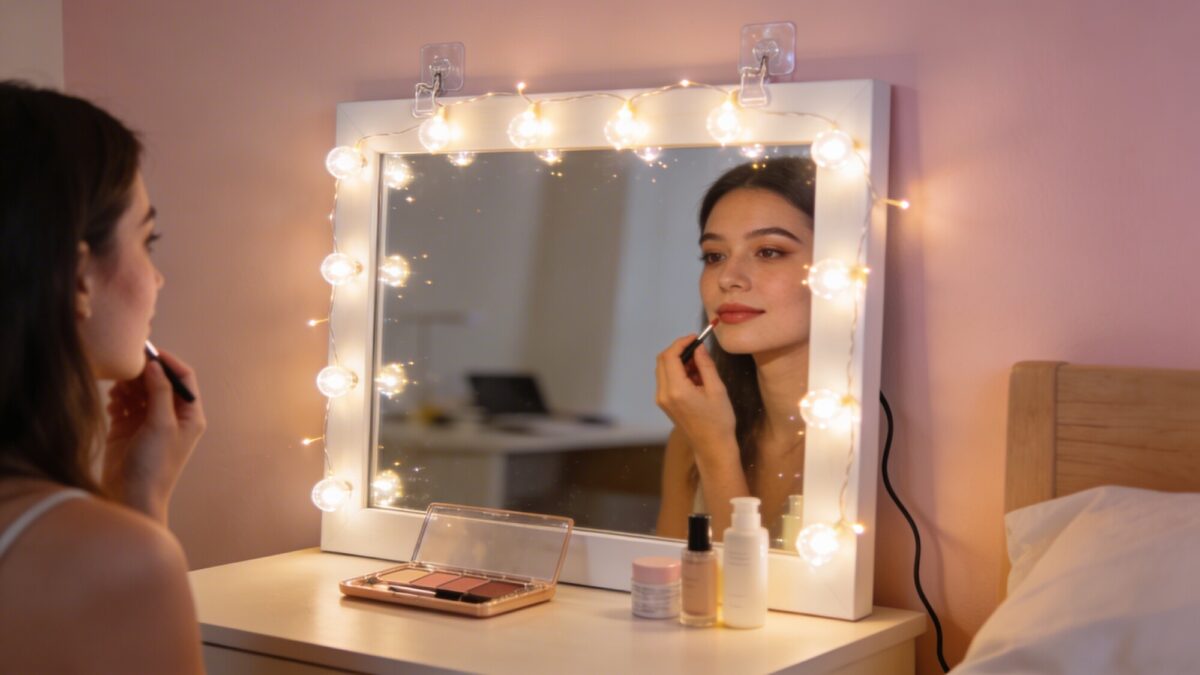
Overhead lighting casts shadows under your eyes and chin — it’s the least flattering angle in the house. Lighting from the side, which is what a mirror frame of fairy lights gives you, is closer to what a makeup artist would actually set up. This is a small change with an outsized payoff if you get ready in your room.
Space the bulbs roughly 2–3 inches apart around the frame. Closer than that and you get uneven hot spots reflected in the glass; farther apart and you lose the even wash of light that makes this placement worth doing in the first place.
- Warm white keeps skin tones natural; color-changing LEDs are fun for the rest of the room but not ideal directly at face height.
- Clear removable hooks or adhesive clips keep the frame damage-free — check the weight rating if the mirror frame is thin or lightweight.
- Route the cord behind the mirror and down the wall rather than looping it visibly across the front — it’s a five-second fix that makes the whole setup look finished instead of half-done.
💡 Pro Tip: If your mirror sits above a desk or dresser with an outlet nearby, skip batteries entirely and use a plug-in strand on a cheap mechanical outlet timer. It’s one less thing to remember and one less trip to the store for AAs.
3. Ceiling Constellation: A Softer Alternative to Your Overhead Light
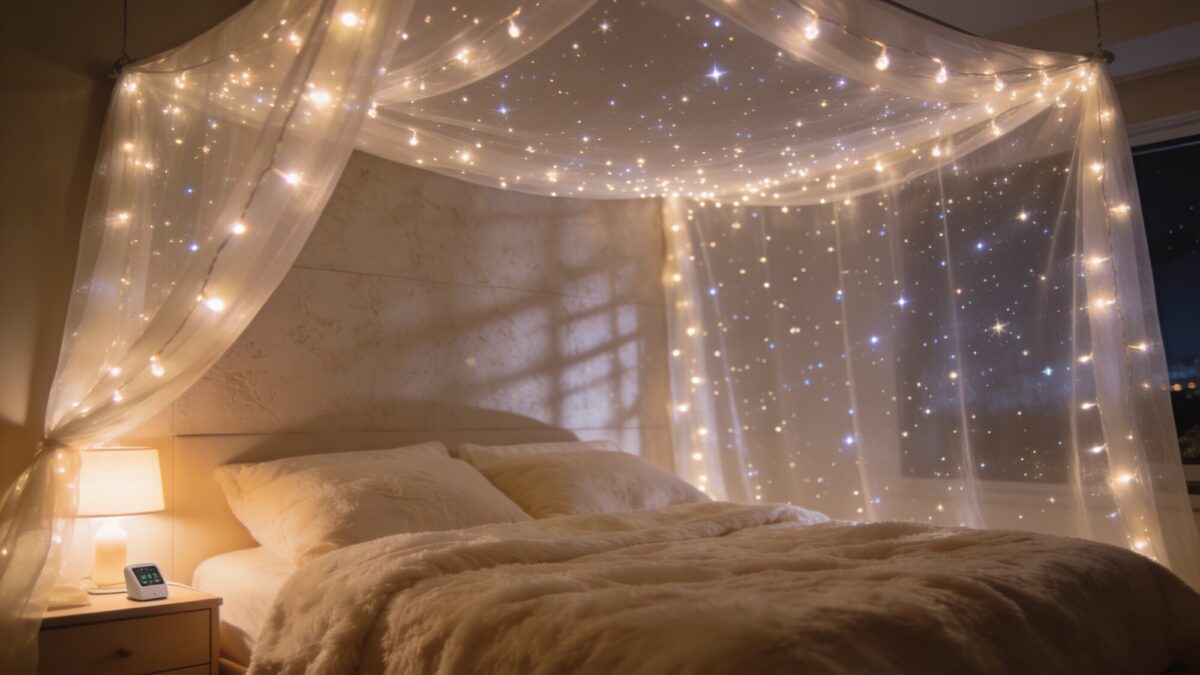

This is the highest-effort idea on the list, and it’s worth being honest about that upfront. You’re either running a lightweight strand across the ceiling in scattered clusters (not a grid — real constellations aren’t evenly spaced) or stretching a sheer fabric canopy under the ceiling and threading lights behind it for a diffused glow. Both take longer than the other five setups here, closer to an hour than fifteen minutes.
The payoff is real: a ceiling like this replaces your main overhead light on nights when you don’t want full brightness, which cuts down on how often you’re squinting at a bare bulb fixture before bed. If you’re in a rented apartment and can’t run anything into the ceiling itself, our guide on fairy lights on bedroom walls covers renter-friendly mounting that gets a similar effect without touching the ceiling.
💡 Pro Tip: If you’re using a fabric canopy, buy the lights and canopy separately rather than a pre-made kit. Pre-made canopy-and-light kits are almost always dimmer than expected once the fabric is diffusing the glow — a slightly denser strand than you think you need compensates for the light the fabric absorbs.
4. Bedside Frame Accents: A Small Detail That Reads as Intentional
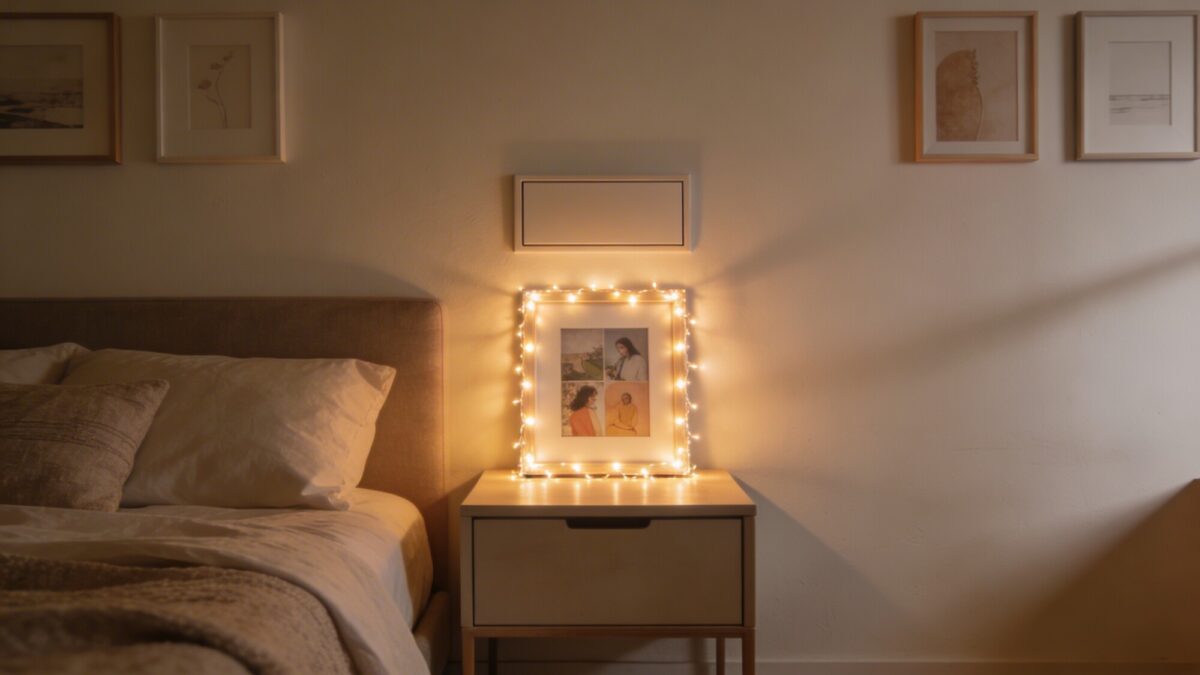
This is the lowest-commitment idea here, and honestly the easiest to get wrong by overdoing it. One or two framed prints or photos, each outlined with a single loop of lights, is enough. More than that and the nightstand starts looking cluttered instead of curated — the whole point is a small glow you notice, not a wall of light competing with the rest of the room.
- Wrap one strand around the outer edge of a lightweight frame or a small wall panel.
- Match the warm white tone to whatever else is lit in the room — mixing warm and cool white in the same sightline looks unfinished.
- Keep it to one or two frames max on a small nightstand wall; this is an accent, not a feature.
5. Cozy Reading Nook With a Halo: The Corner You’ll Actually Use
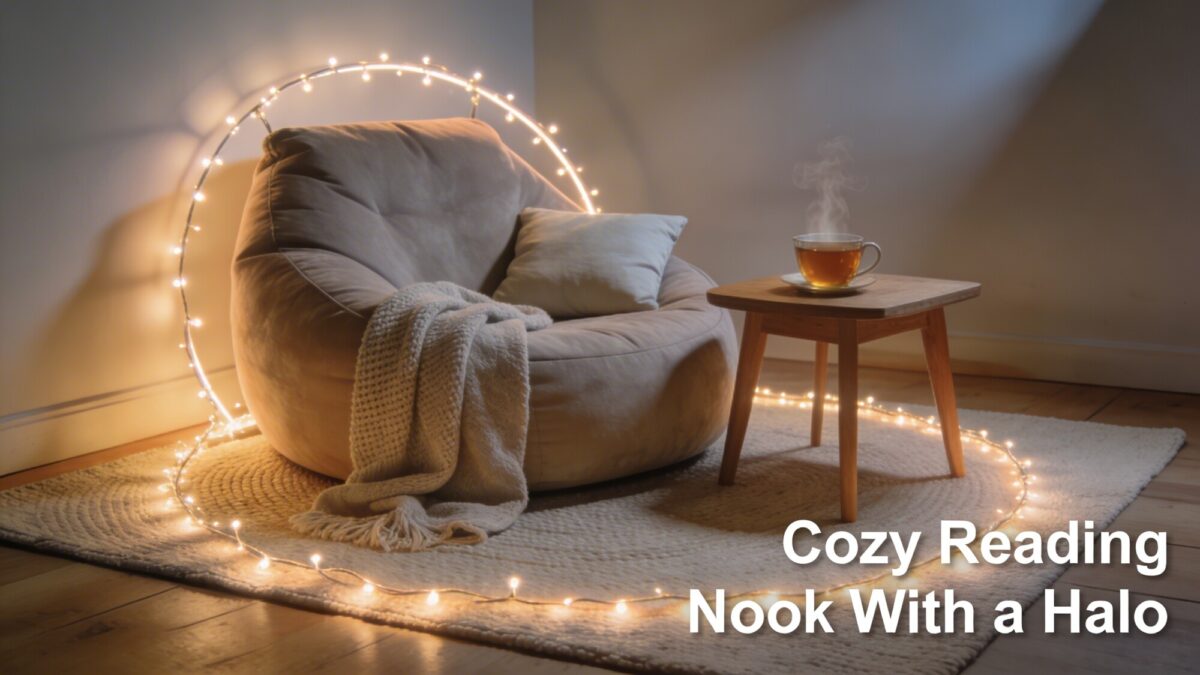
Most “reading corners” in small bedrooms end up as a chair nobody sits in because it’s lit the same flat way as the rest of the room. Wrapping a strand around the chair back and along the floor edge gives that one spot its own light source, separate from the overhead fixture — which is what actually makes people use it. It’s a psychological cue as much as a lighting one: the light change tells you “this is the spot for sitting still,” the same way a lamp does in a living room.
A floor chair or bean bag works better than a full armchair in a genuinely small room — it takes up floor space without eating vertical space, and it’s easy to fold or slide under a desk when you need the floor back. For more corner-specific layouts, our bedroom corner decor ideas post has options sized for exactly this kind of space.
- Add a throw blanket, a small side table, and a rug to anchor the corner visually — the lights alone won’t do that work.
- Loop the strand along the floor edge, not just the chair back, so the glow reads as a contained pool of light rather than a single bright line.
- A dimmable strand is worth the extra cost here if you use the nook for both reading and unwinding — one setting is rarely right for both.
💡 Pro Tip: Test the nook lighting before you commit to the layout — sit where you’d actually read for ten minutes with only the fairy lights on. If you’re squinting at a page, add a small clip-on reading lamp; fairy lights set the mood but rarely give enough direct light to read comfortably by themselves.
6. Floating Shelves With Light Accents: Layered Glow Without a Ceiling Project
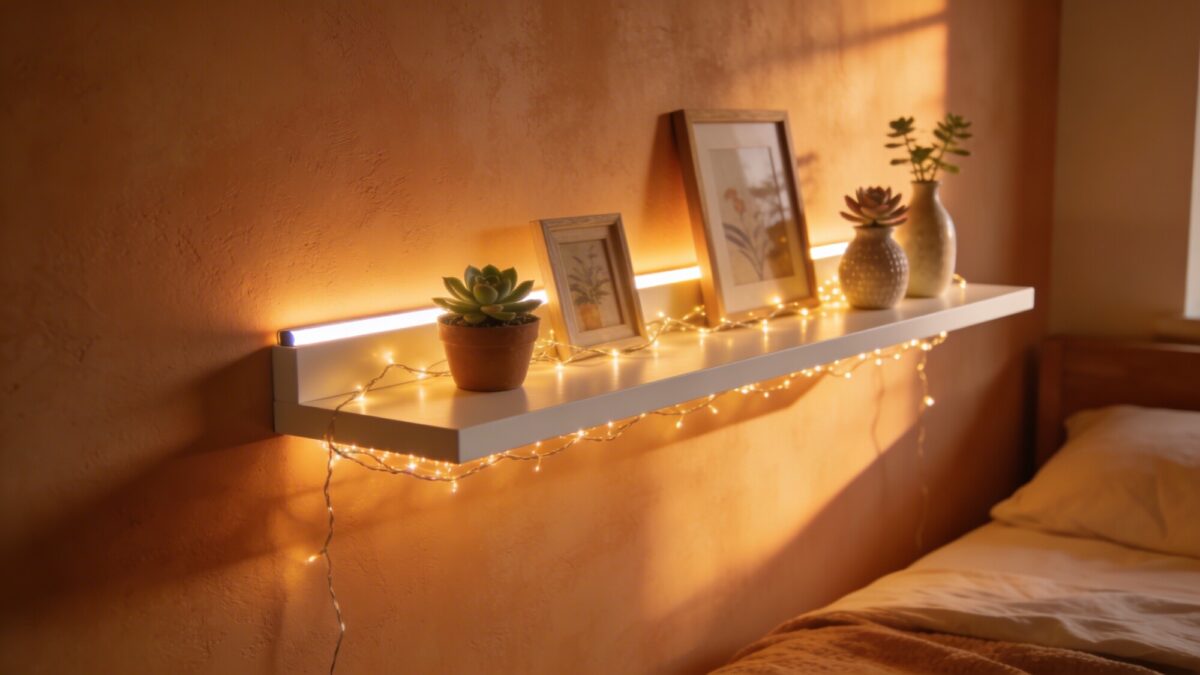
Floating shelves solve two problems in a small room at once: storage without a bulky dresser, and a place to run lights that isn’t the bed or the ceiling. Weave a slim LED strip or a thin fairy light strand along the underside or behind a few decor pieces — plants, small frames, a vase — and you get layered depth instead of one flat wash of light across the wall. This pairs well with the mirror and frame ideas above if you want a whole wall that reads as a cohesive, lit display; see our cozy bedroom aesthetic ideas with fairy lights for more combinations that work together rather than competing.
- Run the strip behind the decor items, not in front — you want to see the glow, not the cord or the individual diodes.
- Two or three items per shelf (a plant, a frame, a small vase) keeps it from reading as cluttered.
- A cheap plug timer means the shelves glow at dusk without you doing anything — useful if this is the first light you see when you walk in.
💡 Pro Tip: Use adhesive cord clips (not tape) to route the strip along the back edge of the shelf. Tape residue on a rented wall or shelf is one of the most common regrets with this setup, and clips peel off clean.
Battery vs. USB vs. Plug-In: Which Power Source Actually Fits Your Setup
This decision matters more than the placement itself, because it determines how much maintenance the whole project takes six months from now.
| Power Source | Best For | Trade-Off |
|---|---|---|
| Battery-operated | Bed canopies, ceiling runs — anywhere a cord would be visible or awkward | No outlet needed anywhere, but batteries need regular replacing if used nightly |
| USB-powered | Mirrors, shelves, nightstands near an outlet or phone charger | Steady power with no battery cost, but you’re tied to cord placement |
| Plug-in (wall outlet) | Longer runs, ceiling canopies, anywhere you want a timer | Most reliable and cheapest to run long-term, but least flexible for placement |
Things to Consider Before You Buy Fairy Lights for a Small Bedroom
- Measure the actual run length you need before ordering — a 10-foot strand looks short once it’s stretched around a full headboard.
- Check the color temperature listed on the packaging; “warm white” isn’t standardized, so 2700K–3000K is the range to look for specifically.
- Confirm whether the strand is dimmable before you buy — very few standard strands are, and it’s not something you can add after the fact.
- If you have pets or small kids in the room, battery packs with covered compartments are worth the small extra cost.
- Check the mounting hardware weight rating against your wall type — plaster, drywall, and rental-friendly adhesive strips all hold different amounts of weight.
Our Verdict
If you’re only doing one of these, the bed canopy or the mirror frame gives the best payoff for the least effort — both take under fifteen minutes and use a single battery-operated strand. The ceiling constellation looks the best in photos but is the one project people abandon halfway through, so don’t start there if this is your first time working with fairy lights. Start with the canopy, live with it for a week, then decide if the room needs a second layer like the shelves or the reading nook.
Frequently Asked Questions
How many fairy lights do I need for a small bedroom?
For a single accent — a mirror frame or a headboard canopy — a 10 to 20 foot strand (roughly 100 LEDs) is usually enough. If you’re doing more than one placement, buy strands separately for each rather than one long strand you split up; splitting a single strand often leaves you short on both ends.
Do fairy lights use a lot of electricity?
LED fairy lights draw very little power compared to older incandescent strands, which is part of why they’re safe to leave on for hours. If you’re concerned about cost, a plug-in timer is a better fix than turning them off manually every night — it’s easy to forget.
Are fairy lights safe to sleep with on all night?
LED strands run cool and are generally fine left on overnight, but check that the strand isn’t draped directly against fabric or bedding for extended periods, and avoid daisy-chaining more strands together than the packaging recommends.
What’s the difference between fairy lights and string lights?
In practice the terms are used interchangeably for thin wire strands with small LED bulbs. “String lights” sometimes refers to larger bulb sizes (like patio string lights), while “fairy lights” usually means the thinner, denser strands used for indoor decor.
Will fairy lights damage my rental walls?
Not if you use removable adhesive hooks or clips rated for the weight of the strand — check the packaging for a weight limit and stick to it. Avoid tape directly on paint or wallpaper, since it’s more likely to peel finish off when removed.
Next Step
Once the lighting is in place, the rest of the room tends to fall together faster — a rug, a throw, and a couple of textured pillows do most of the remaining work. If you want the full layout plan rather than just the lighting piece, our guide to a cozy bedroom aesthetic at night walks through pairing this kind of lighting with the rest of the room.