6 Modern Victorian Bedroom Ideas You’Ll Love
Most attempts at a Victorian bedroom go wrong in one of two directions. Either the room ends up looking like a museum exhibit — heavy, dark, and a little stiff — or it gets so watered down that all you’re left with is a beige box with one gold picture frame. Good modern Victorian bedroom ideas sit in the middle: a handful of period-inspired moves (a curved silhouette, a rich color, a bit of tufting) paired with the simplicity of a contemporary layout. You don’t need a full room restoration to get there. You need three or four deliberate choices and the discipline to stop before it tips into costume territory.
Below are seven ways to bring that classic luxury bedroom feel into a modern space, in the order I’d actually tackle them if I were starting from a blank room.
Quick Takeaways
- Start with the headboard or the bedding — not the wallpaper. Big-ticket, high-visibility pieces set the tone; everything else follows.
- One dominant jewel tone (emerald, sapphire, burgundy) plus a neutral does more for a Victorian bedroom than five “vintage” accessories.
- Curved furniture legs and arched silhouettes read as classic without adding ornate carving you have to dust every week.
- Layered lighting (ambient, task, accent) matters more than any single statement fixture.
- Pattern belongs on one surface at a time — wall, bedding, or rug. Rarely all three.
1. Layer Textures Like a Victorian Pro (Without the Upkeep)
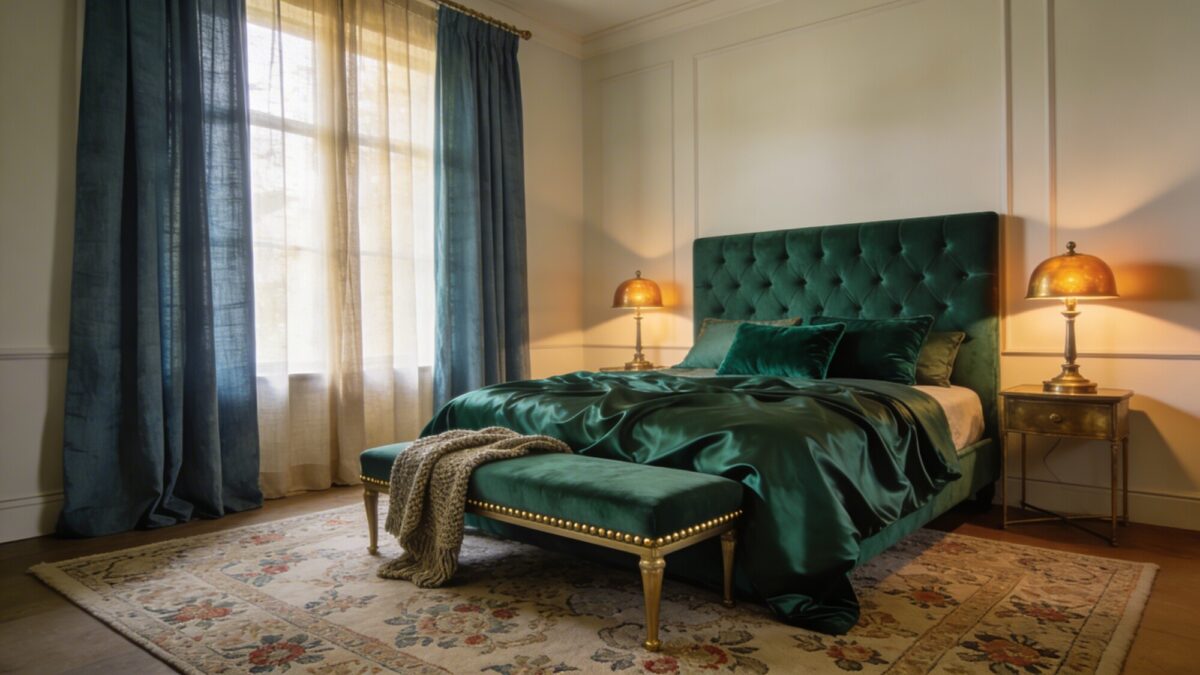
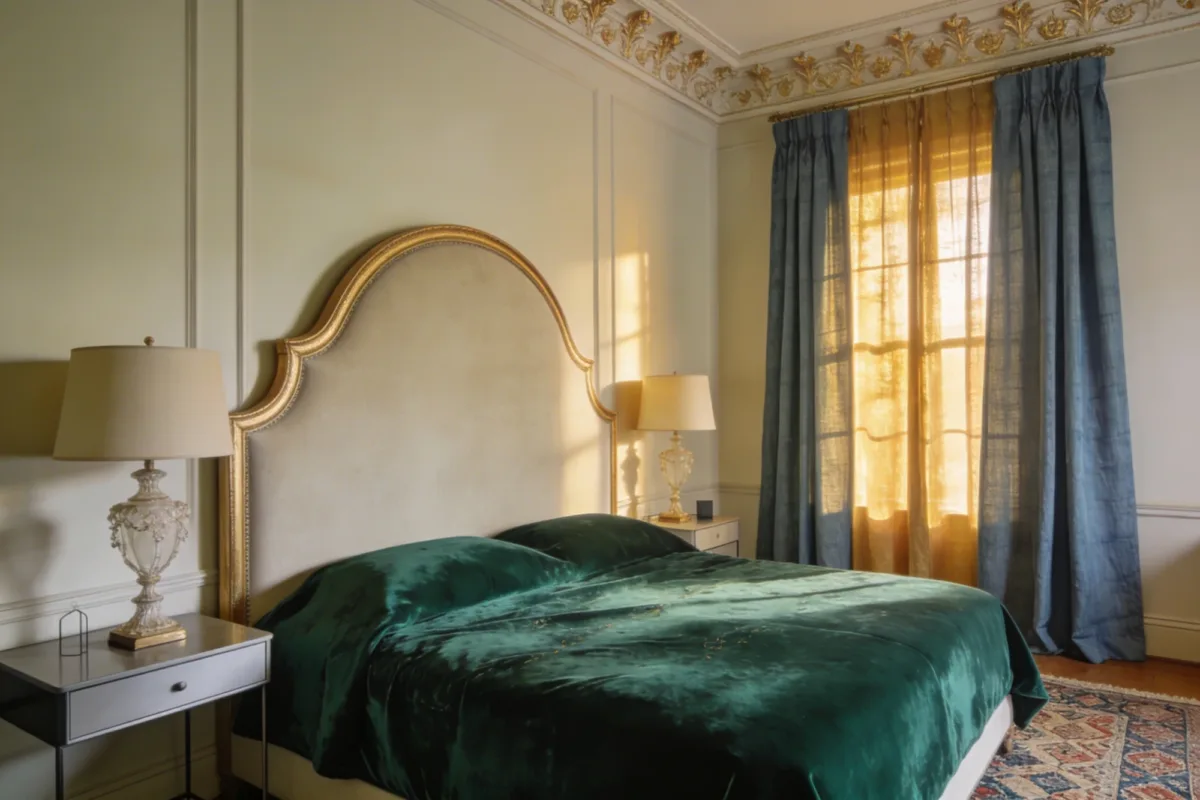
Victorian interiors were built on texture — velvet, damask, fringe, tassels. You can borrow that richness without the maintenance headache of the originals by picking two or three fabrics and stopping there. A crushed-sateen or velvet bedspread in a deep emerald or forest green does most of the work on its own; it catches light differently than cotton and reads as more considered the moment you walk in.
Where people overdo it: piling on every texture at once — velvet pillows, a fringed throw, a damask rug, and brocade curtains in the same room. That’s how a Victorian bedroom tips into “theme room.” Pick one hero fabric (usually the bedspread or headboard) and let the rest — linen curtains, a plain wool rug — stay quiet by comparison.
- Velvet or crushed-sateen bedspread for the anchor piece
- Linen or chambray curtains to soften and diffuse the light rather than block it
- A rug with a subtle, tonal pattern instead of a busy print, so it grounds the room without competing with the bed
A cohesive palette does more than any single fabric choice. Deep emerald, muted gold, and warm ivory is a reliable combination because it reads as a classic royal bedroom design rather than a garage-sale mix of “vintage-looking” pieces bought separately.
2. Build a Statement Headboard That Anchors the Room
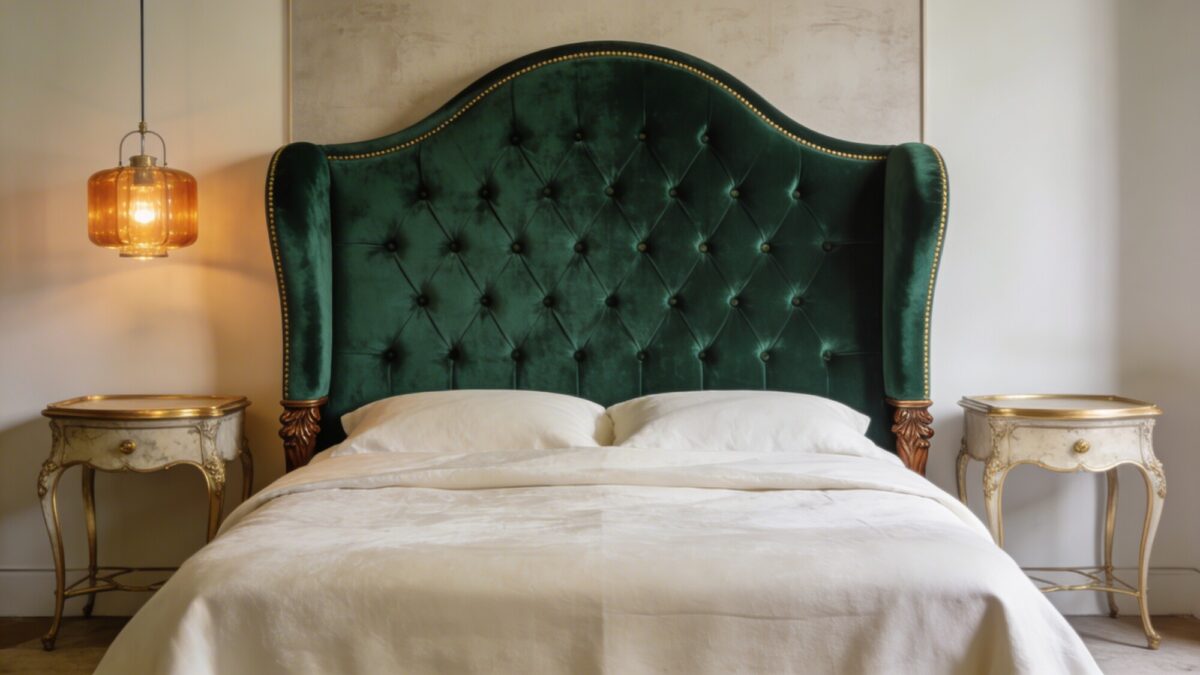
If I had to pick one upgrade that does the most for a modern Victorian bedroom, it’s the headboard. It’s the first thing your eye lands on, and it sets the scale and mood for everything else in the room. You don’t need a custom upholsterer for this — tall, curved, button-tufted headboards are widely available now from mid-range furniture retailers, not just antique dealers.
The trade-off worth knowing about: taller headboards (55 inches and up) make a bigger visual statement but can overwhelm a room with low ceilings or a narrow layout. In a smaller bedroom, a wide, lower arched headboard usually reads as more classic-luxury than a tall one crammed against an 8-foot ceiling.
What to Look For
- A curved silhouette upholstered in velvet, boucle, or linen blend
- Gilded trim or carved wood legs peeking out at the base — small doses go further than a fully carved frame
- Button-tufting for texture, but skip deep diamond-tufting if you want something closer to a modern classic bedroom luxury look than a fully period one
Keep the bedding simpler once the headboard is in — crisp white or cream linens let the headboard do the talking instead of competing with it. If you’re weighing a full suite versus just the headboard, our luxury master suite bedroom guide has more on building the rest of the room around one anchor piece.
3. Soften Sharp Angles With Curvilinear Furniture
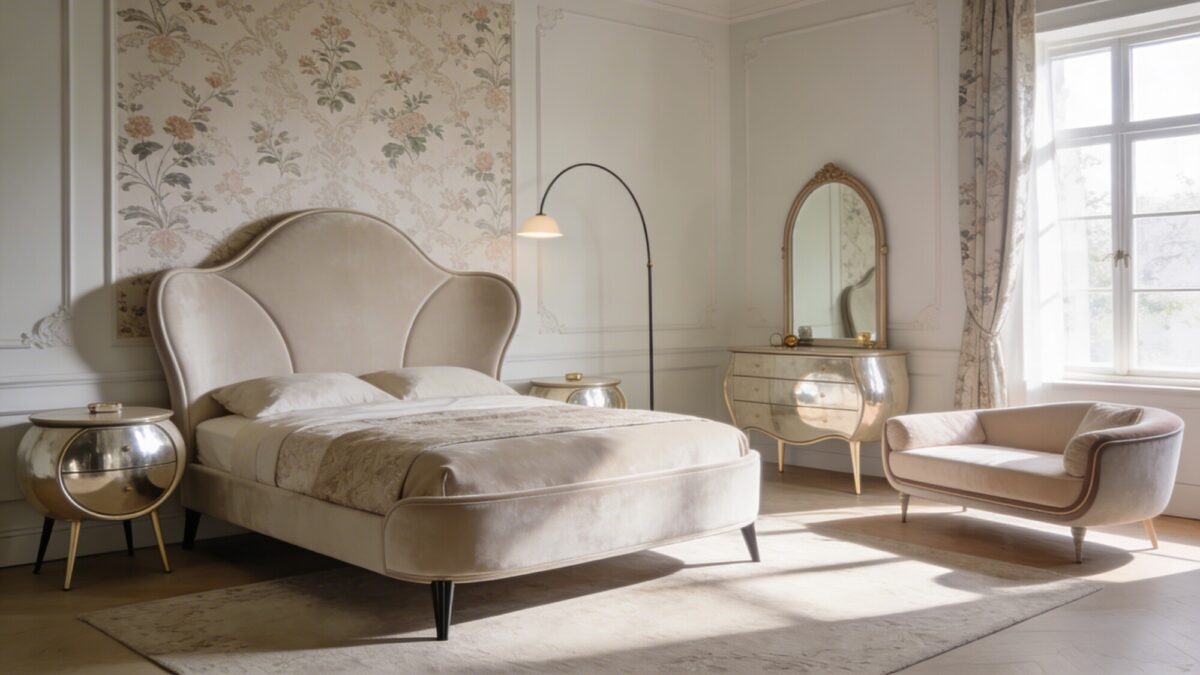
Victorian furniture wasn’t built on straight lines, and that’s actually the easiest part of the style to bring into a modern room. An arched dresser, rounded nightstands, or a chaise with soft edges does more to establish a Victorian bedroom mood than any single accessory — and unlike ornate carving, curved shapes tend to read as timeless rather than dated once the trend cycle moves on.
A common mistake is buying one curved piece and surrounding it with everything else boxy and modern. The room ends up looking like the curved piece doesn’t belong. Aim for at least two curved elements in the same sightline — say, a rounded nightstand on each side of the bed, or an arched mirror above a curved dresser — so the eye reads it as a deliberate choice rather than a mismatch.
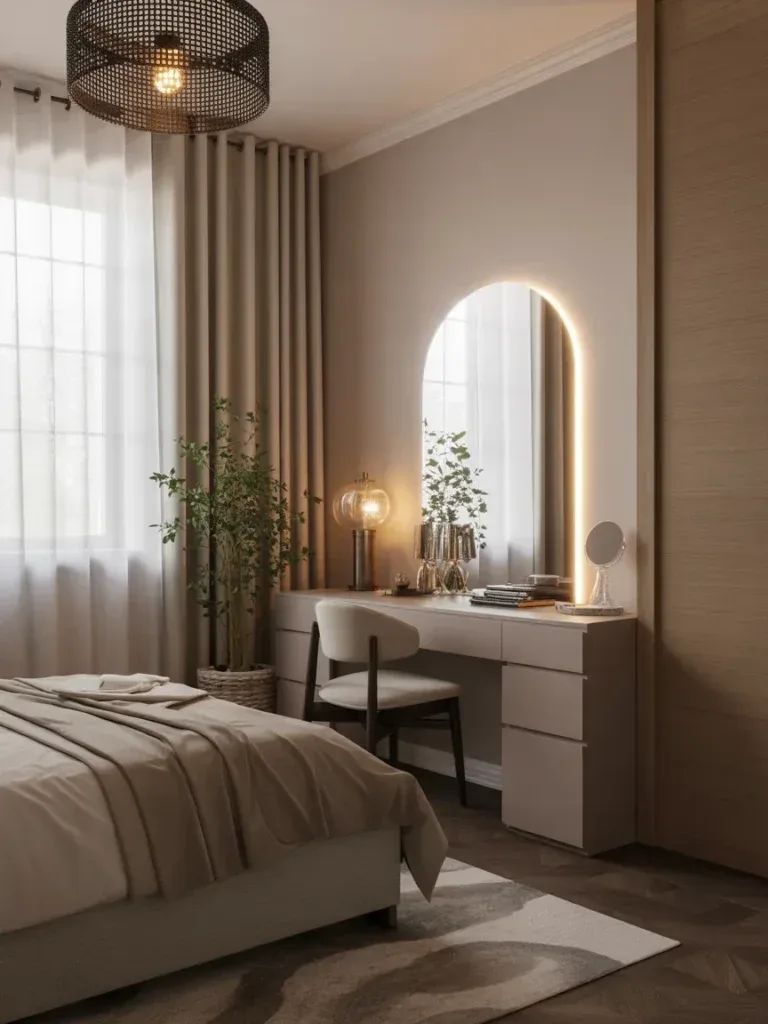
- An arched dresser or vanity with slim, tapered legs
- Rounded nightstands that echo the headboard’s curve
- A soft-edged chaise or upholstered bench at the foot of the bed, if the room has the floor space
Streamlined lighting and minimal hardware keep curved furniture from tipping into heaviness. Brushed brass pulls in a simple shape do more for a classic luxury bedroom than ornate cast hardware, which can start to look busy against curved silhouettes.

4. Layer Antique-Inspired Lighting Without Overpowering the Room
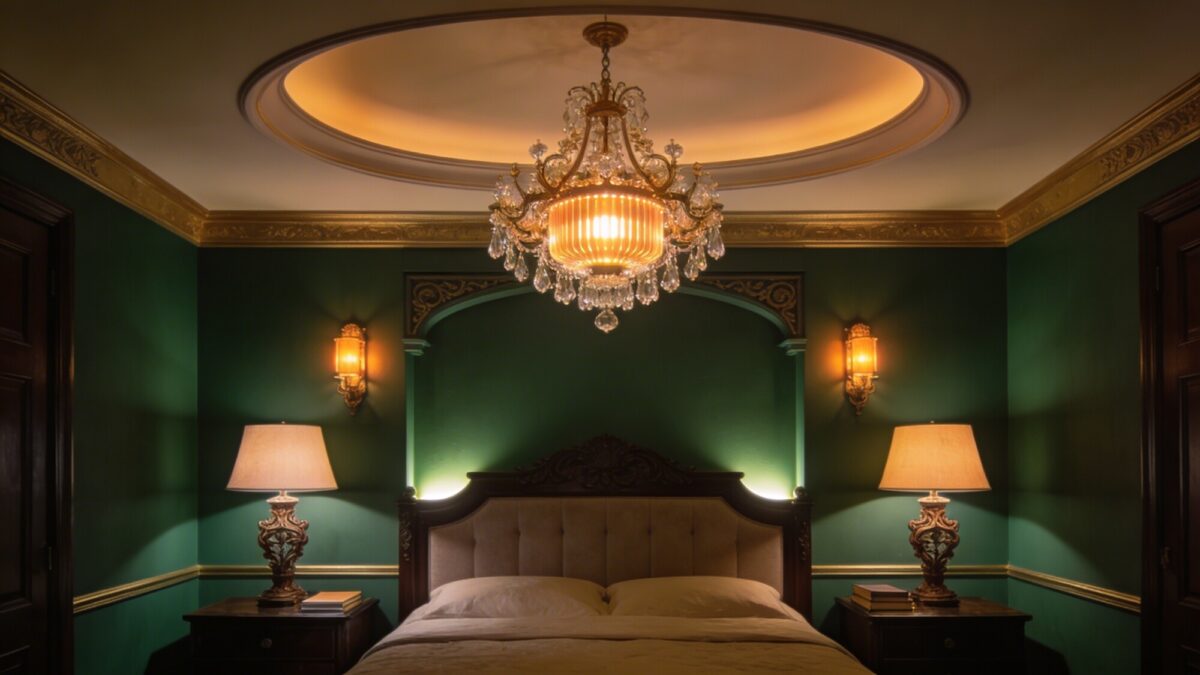
A single chandelier isn’t a lighting plan — it’s one light source doing the job of three. The rooms that actually feel like a luxury bedroom with chandelier styling use three separate layers: ambient light overhead, task lighting at the bed for reading, and a smaller accent light somewhere else in the room, usually aimed at a headboard or a piece of moulding.
| Layer | Fixture | What It’s For |
|---|---|---|
| Ambient | Crystal or resin chandelier, or a pair of wall sconces flanking the bed | General light for the whole room, usually dimmable |
| Task | Table lamps with carved bases and fabric shades on each nightstand | Reading in bed without lighting the whole room |
| Accent | A small uplight or picture light | Highlighting the headboard, moulding, or a piece of art |
Where people overspend: buying an oversized crystal chandelier as the only fixture in the room, then finding it’s either too bright to sleep under or too dim to actually read by. A dimmer switch and a second, smaller light source solve this for less than the cost of upgrading the chandelier itself. If your room runs cooler or more contemporary already, the sconces-plus-lamps combination alone can carry the modern Victorian aesthetic home feel without a chandelier at all.
5. Use Patterned Wallpaper as a Restrained Statement
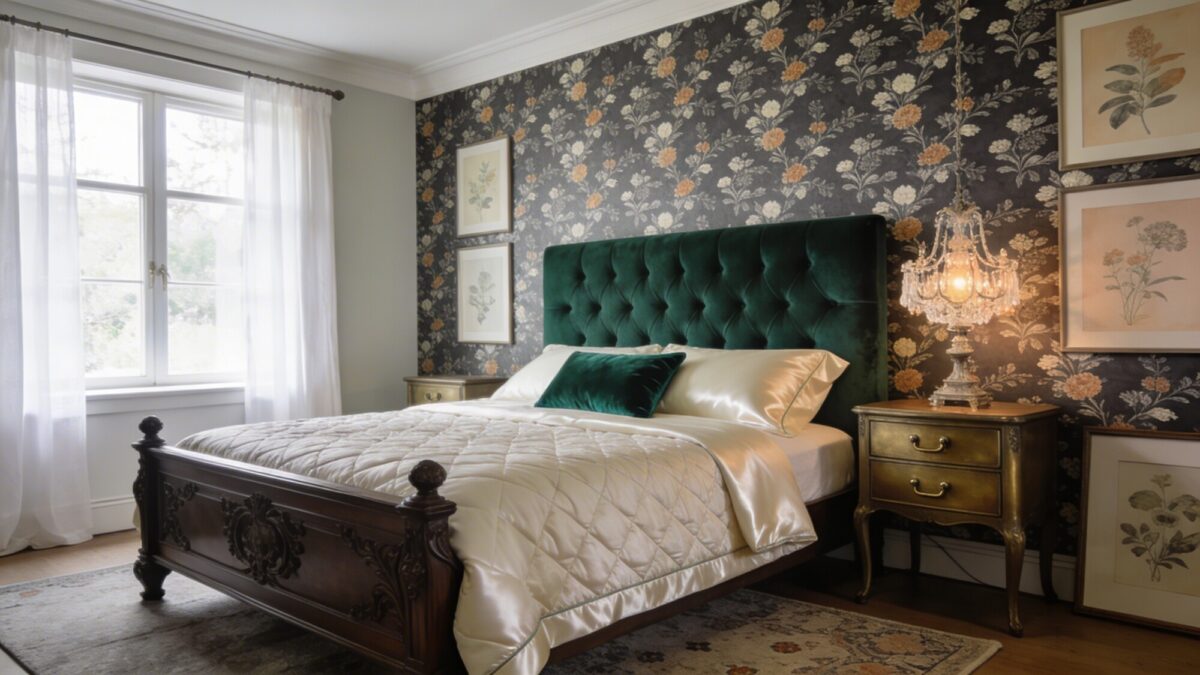
Wallpaper is the fastest way to bring Victorian vintage decor into a bedroom, and it’s also the easiest element to get wrong. A small-to-medium scale botanical or damask pattern in a matte finish, applied to a single accent wall behind the headboard, does the job. Wallpapering all four walls in a bold pattern is a much bigger commitment — it changes how the whole room reads, not just the headboard wall, and it’s far more work to undo if you change your mind in two years.
If you’re drawn to an elegant bedroom with blue walls rather than the more common emerald or burgundy, a muted slate or navy botanical print works the same way — it just shifts the room toward a cooler, more restrained version of the style. Either way, keep the rest of the palette quiet. One patterned wall plus solid bedding and solid curtains is the formula that holds up; patterned wall plus patterned bedding plus a patterned rug starts to compete with itself.
- Small-to-medium scale pattern, matte rather than glossy — glossy finishes show more wall imperfections
- Coordinate with bedding in a complementary, not matching, color family
- Reserve pattern for the headboard wall; keep the other three walls solid
6. Build a Gallery Wall That Feels Collected, Not Cluttered
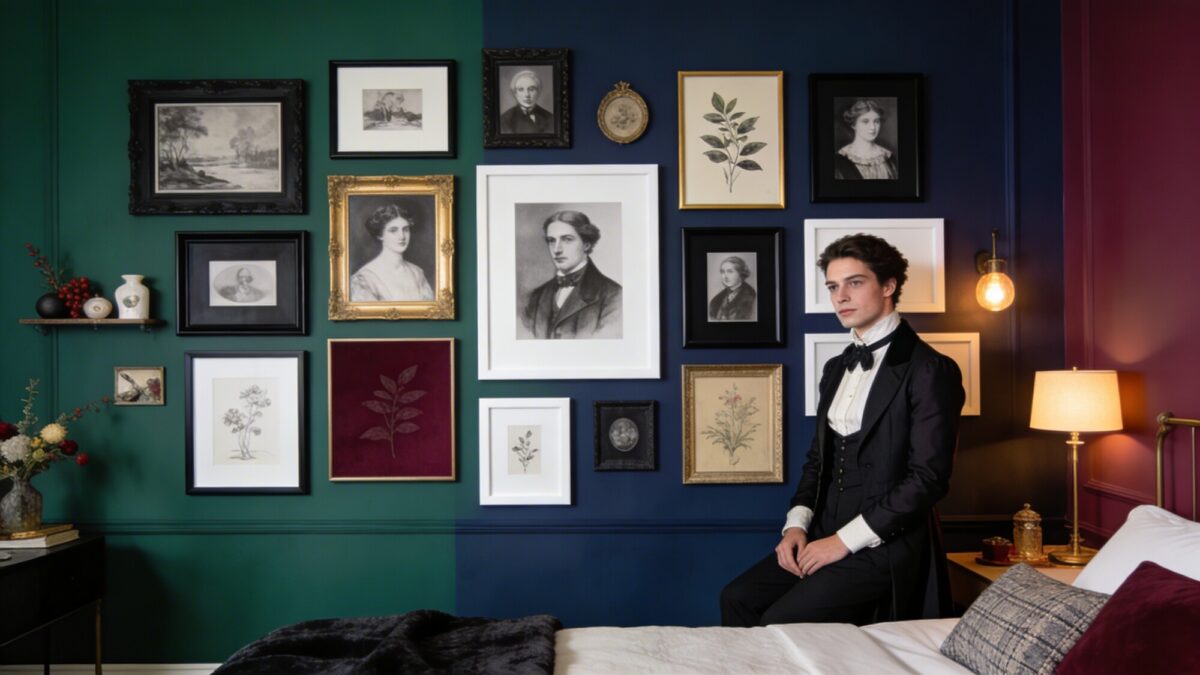
A gallery wall is where a Victorian bedroom starts to feel personal instead of showroom-styled. The mistake most people make is buying a matching frame set and filling every slot with a print bought the same week. That looks assembled, not collected. Mixing black, gold, and matte white frames — antique-style next to sleek and minimal — reads as though the pieces arrived over time, which is closer to how actual Victorian collections were built in the first place.
A working ratio: roughly half black-and-white portraits or botanical prints, a couple of bold color pieces, and a small object or two (a mirror, a small shelf) to break up the grid. Arrange most of it symmetrically, then let one or two pieces sit slightly off-center — perfect symmetry can feel as sterile as no plan at all.
- Lay the frames out on the floor first and adjust spacing before anything goes on the wall
- Start with the largest piece at roughly eye level and build outward
- Leave 2–3 inches between frames for a gallery that reads as connected, not cramped
- Step back and check the wall from the doorway, not just up close — that’s the view you’ll actually see day to day
For more on pairing a gallery wall with the rest of a cohesive, higher-end layout, see our guide to luxury bedroom styling.
7. Choose a Palette That Reads Classic, Not Costumey
Color does more to make or break a modern Victorian aesthetic home than any single piece of furniture. The rooms that hold up over time tend to build around one dominant jewel tone — emerald, sapphire, or burgundy — paired with a warm neutral (ivory, cream, or a soft gold) and a small amount of dark wood or brushed brass. Add a second bold color and the room starts to feel more like a costume set than a bedroom you’d want to fall asleep in.
| Approach | Effort & Cost | Best For |
|---|---|---|
| Full Statement (headboard + wallpaper + chandelier) | Highest — several coordinated purchases and possibly an electrician | A primary bedroom you’re not changing again soon |
| Accent Layer (headboard + one accent wall) | Moderate — one or two big purchases, a weekend of work | Renters or anyone wanting the look without a full renovation |
| Restrained Nod (bedding, lamps, and one curved piece) | Lowest — swappable pieces, no wall changes | Testing whether you actually like the style before committing |
If you’re not sure which tier fits your room, our modern vintage bedroom ideas roundup is a good next stop — it leans lighter and more eclectic than a full Victorian scheme, which might suit a room you don’t want fully committed to one era.
Things to Consider Before You Start
- Ceiling height: tall headboards and chandeliers both need room to breathe — measure before you buy.
- How long you’ll stay: wallpaper and paint are the least reversible choices here; furniture and bedding are the most.
- Natural light: darker jewel tones read richer in a room with good daylight and can feel heavy in a north-facing or low-light room.
- Maintenance: velvet and tufted upholstery show wear faster with pets or kids in the room than a linen blend.
- Budget order: headboard first, lighting second, wallpaper and gallery wall last — in that order, each step still looks finished if you stop partway through.
FAQ
What makes a bedroom “modern Victorian” instead of just Victorian?
The furniture shapes and color palette stay period-inspired — curves, jewel tones, tufting — but the layout stays open, the surfaces stay less cluttered, and the number of ornate details per room is deliberately limited. A true Victorian bedroom would layer far more pattern and more furniture pieces into the same square footage.
Do I need to repaint or wallpaper to get this look?
No. A statement headboard, layered lighting, and a curved furniture piece or two can carry the style without touching the walls. Wallpaper is the fastest way to add character, but it’s the last step to add, not the first.
What’s the most common mistake people make with this style?
Matching too hard. Buying a bedding set, curtains, and a rug all from the same “Victorian collection” tends to look flat and staged. Mixing eras and finishes — an antique-style lamp next to a plain modern nightstand — reads as more authentic than anything perfectly matched.
Is this style too dark or heavy for a small bedroom?
Not if you’re selective. Use the dark jewel tone on one surface — the headboard or one wall — and keep the rest of the room, including the ceiling and trim, in a light neutral. That contrast keeps a small room from feeling closed in.
How do I keep it from looking dated in five years?
Put the trend-sensitive choices (wallpaper, bold paint) in the cheapest, most reversible places, and put the money into furniture shapes — curved legs, a good headboard — that have stayed in style for well over a century already.
Our Take
Of the seven ideas here, the headboard and the lighting layers do the most work for the least risk — both are changes you can make without touching a wall, and both photograph and live well regardless of the rest of the room. Wallpaper and a full gallery wall are worth doing, but they’re commitments; save them for once you’re sure the rest of the room already feels right. If you’re only doing one thing this month, start with the headboard. Everything else in a classic bedroom interior design luxury scheme gets easier to choose once that anchor piece is in the room.