I painted my dining room the color of black coffee two years ago, and my mother still brings it up like I confessed to a crime. But here’s the thing — gothic glam decor gets a bad reputation it doesn’t deserve. People hear “gothic” and picture cobwebs and coffins, when really it’s just deep color, rich texture, and a little theatrical flair, dressed up with the shine and polish of glam design. Done right, it’s one of the most sophisticated looks you can pull off in a home. Done wrong, sure, it looks like a Halloween store threw up on your living room. So let’s talk about how to land on the right side of that line. Table of Contents Toggle What Gothic Glam Decor Actually Means Start With a Deep, Confident Wall Color Layer In Gothic Bedroom Accessories for Instant Drama Bring in Metallics the Glam Half of the Equation Demands Texture Is Doing More Work Than You Realize Designing a Gothic Style Apartment When You Can’t Paint the Walls Gothic Interior Design Modern Enough to Not Feel Costume-y Don’t Skip the Gothic Home Aesthetic in Your Lighting Plan Putting the Whole Look Together What Gothic Glam Decor Actually Means Before we get into the how, let’s clear something up, because I think this is where most people psych themselves out of trying the style at all. Gothic glam interior design isn’t about being dark for the sake of dark. It’s the marriage of two things that don’t usually get invited to the same party: the moodiness and drama of gothic architecture (think cathedral arches, wrought iron, deep jewel tones) and the polish of glam design (mirrored surfaces, velvet, metallics that catch the light). On its own, gothic can tip into heavy and oppressive. On its own, glam can feel a little flat and try-hard, like a hotel lobby. Together? You get a room that feels rich and a little dangerous, but still intentional and elevated. It’s moody without being murky. That distinction matters more than almost anything else in this whole guide, so hang onto it. Start With a Deep, Confident Wall Color You can’t do gothic glam decor with a beige wall. I’m sorry, but you just can’t — it’s the one non-negotiable. The walls need to carry weight. Think charcoal, deep burgundy, forest green so dark it reads almost black, or a true black if you’re feeling brave (and if your room gets decent natural light, black is far less scary than it sounds on paper). Here’s a mini before-and-after for you: a client of mine had a spare bedroom in a flat, builder-beige “greige” that could’ve belonged to literally anyone. We repainted it in a matte deep plum — closer to eggplant than purple, if that makes sense — and just that one change made the room feel three times more expensive before we’d added a single accessory. That’s the power of a confident wall color. It does 60% of the work for you. If full-room color feels like too big a leap, start with one accent wall, ideally the one your bed or sofa backs onto. And skip the eggshell finish — go matte or even a soft velvet-matte if your paint brand offers it. Glossy dark walls show every roller mark and fingerprint, which is not the vibe. Layer In Gothic Bedroom Accessories for Instant Drama The bedroom is honestly the easiest room to start this style in, because a few well-chosen gothic bedroom accessories do most of the heavy lifting without requiring a full renovation. A few of my go-tos: A statement headboard — carved wood in a dark stain, or an upholstered velvet headboard with nailhead trim. Curved, cathedral-arch shapes lean gothic without being literal about it. Candlestick-style table lamps — brass or aged bronze finishes, with a black or deep-toned lampshade. Skip anything too shiny gold; you want it to look collected, not brand new. Heavy drapery — floor-to-ceiling curtains in velvet or a rich matte fabric. This is where comparing velvet vs. linen curtains really helps, because velvet is what gives gothic glam that light-catching depth — linen just doesn’t hold the mood the same way. Antique or antique-style mirrors — ornate frames in aged gold or blackened metal, positioned to catch candlelight or lamp glow. And okay, I’ll admit it — I have a slight weakness for tarnished brass anything. It photographs beautifully and it has that “this has been in the family for generations” quality even when you bought it three weeks ago on clearance. Bedding is another spot people underestimate. A plain white duvet, no matter how nice the thread count, kind of undoes everything else in the room — it reads too crisp, too hotel-generic for this style. Swap in a deep charcoal or burgundy duvet cover, then layer a faux fur or velvet throw at the foot of the bed for texture. Even something as small as swapping brushed-nickel drawer pulls for aged brass or black iron ones on your nightstands adds up. It sounds like a tiny detail until you notice it’s the thing your eye keeps snagging on in a good way. Bring in Metallics the Glam Half of the Equation Demands This is the part people forget, and it’s the difference between a room that reads gothic glam versus one that just reads dark and heavy. The glam half needs metallics, and it needs shine. Brass, aged gold, and blackened bronze all work beautifully against deep wall colors. Chrome and polished silver can work too, but they read a little colder and more contemporary — fine if that’s the direction you want, but if you’re chasing a warmer, more romantic gothic mood, brass and gold will serve you better. A modern chandelier with candelabra-style arms is basically the MVP fixture of this entire style — it’s dramatic, it throws gorgeous shadow patterns on a dark ceiling, and it instantly signals “this room means it” the second you walk in. Mirrored furniture is another sneaky-good move. A mirrored console table or nightstand bounces light around a dark room (which, fair, dark rooms need all the help they can get) while adding that glam sparkle factor. I’d stop at one or two mirrored pieces per room, though — more than that and it starts to feel like a furniture showroom rather than a home. Texture Is Doing More Work Than You Realize Here’s something that took me embarrassingly long to figure out: in a monochromatic, dark color scheme, texture is what keeps a room from feeling flat and one-note. If everything’s the same matte finish in the same tone, your eye has nowhere interesting to land. So mix it up deliberately. Velvet throw pillows against a boucle or linen sofa. A shaggy dark rug layered under a hard, glossy coffee table. Wrought iron light fixtures next to soft draped fabric. Carved wood furniture with clean, smooth glass or lucite accents. Each texture catches and reflects light differently, and in a low-light, dark-walled room, that variation is genuinely what creates visual depth instead of a flat black hole effect. One trick I use constantly: run your hand across a vignette before you call it done (I know, sounds silly). If everything feels the same under your palm — all smooth, all soft, all rough — you’ve probably over-matched your textures and it’s time to swap one piece out. Rugs deserve their own callout here too, because they’re doing more visual heavy-lifting than most people give them credit for. A Persian or Persian-inspired rug in deep reds and blues brings in pattern without breaking the color story, and it adds an almost storied, worn-in quality that a flat solid rug just can’t fake. If that’s a direction you’re curious about, this guide to decorating with Persian rugs is worth a look — the patterning pairs surprisingly well with gothic glam’s darker palette, since the rug essentially becomes a piece of art on the floor instead of an afterthought underfoot. Designing a Gothic Style Apartment When You Can’t Paint the Walls Rentals are the eternal wrench in the works here, and I get a lot of questions about how to pull off a gothic style apartment when the landlord says absolutely not to the eggplant walls. Fair enough. It’s still very doable — it just shifts the workload onto furniture, textiles, and lighting instead of paint. Start with a large dark area rug to anchor the room; it does a surprising amount of the “grounding” work that dark walls would otherwise do. Add heavy curtains in a deep tone (these alone change the whole feel of natural light in a room, dimming it just enough to feel intentional rather than accidental). Bring in dark furniture pieces — even one or two, like a black-finished bookshelf or a dark wood coffee table — and lean hard into the metallic lighting and accessories we’ve already talked about. If your bathroom happens to have any flexibility (paint, fixtures, hardware), that’s often the one room renters can actually transform, and these dark, moody bathroom ideas are a genuinely good reference point for translating the aesthetic into a smaller, tiled space where full paint freedom isn’t required. Gothic Interior Design Modern Enough to Not Feel Costume-y This is the tip I probably care about most, because it’s the one thing that separates a genuinely well-designed room from something that reads more like a themed party. A gothic interior design modern approach pulls back on the literal medieval references — skip the actual suits of armor, please — and instead borrows the emotional tone: drama, richness, contrast, a little mystery. Practically, that means clean-lined furniture silhouettes paired with gothic color and texture, rather than heavily carved, ornate pieces everywhere. A simple, modern sofa in a deep emerald velvet does more for this look than an antique Victorian settee would, honestly, because it keeps the room feeling current instead of like a museum exhibit. Save the ornate, traditional pieces for one or two hero moments — a mirror, a light fixture, a headboard — and let everything else stay relatively restrained in shape. Black-and-white contrast is another modern gothic move worth stealing, and if that appeals to you, this collection of black and white bedroom ideas shows how stark contrast can carry a lot of the gothic mood on its own, even without deep jewel-toned walls. Don’t Skip the Gothic Home Aesthetic in Your Lighting Plan Lighting genuinely makes or breaks this entire style, more than any other design choice on this list. Overhead lighting that’s too bright and too white flattens everything — it kills shadows, kills mood, and makes deep colors look muddy instead of rich. Aim for warm bulbs (2400K to 2700K), and build in multiple light sources at different heights rather than relying on one central fixture. A floor lamp in a corner, a pair of table lamps flanking the bed or sofa, a dimmable chandelier overhead, maybe even actual candles or flameless candle alternatives on a mantel or console. Layered, warm, dimmable light is what turns a dark room from “gloomy” into “atmospheric,” and that’s genuinely the whole ballgame with a gothic home aesthetic. Get the lighting wrong and no amount of velvet or brass will save you. Putting the Whole Look Together If you take nothing else from this, take this: gothic glam decor works best as an editing exercise, not an accumulation one. Pick your deep wall color, choose two or three metallic accents, layer in real texture, and get your lighting warm and multi-source. Then stop. The temptation is to keep adding — another candlestick, another ornate mirror, another velvet throw — but restraint is actually what makes the glam half of this style read as intentional rather than cluttered. I still get a little thrill walking into that dark plum bedroom every time, two years later, and honestly? My mother’s coming around to the dining room too. Slowly. Save this pin if you’re planning your own moody corner of the house, and tell me in the comments which room you’re tackling first — I’m always curious whether people start with the bedroom or go straight for broke on the living room.
I painted my dining room the color of black coffee two years ago, and my mother still brings it up like I confessed to a crime. But here’s the thing — gothic glam decor gets a bad reputation it doesn’t deserve. People hear “gothic” and picture cobwebs and coffins, when really it’s just deep color, rich texture, and a little theatrical flair, dressed up with the shine and polish of glam design. Done right, it’s one of the most sophisticated looks you can pull off in a home. Done wrong, sure, it looks like a Halloween store threw up on your living room. So let’s talk about how to land on the right side of that line.
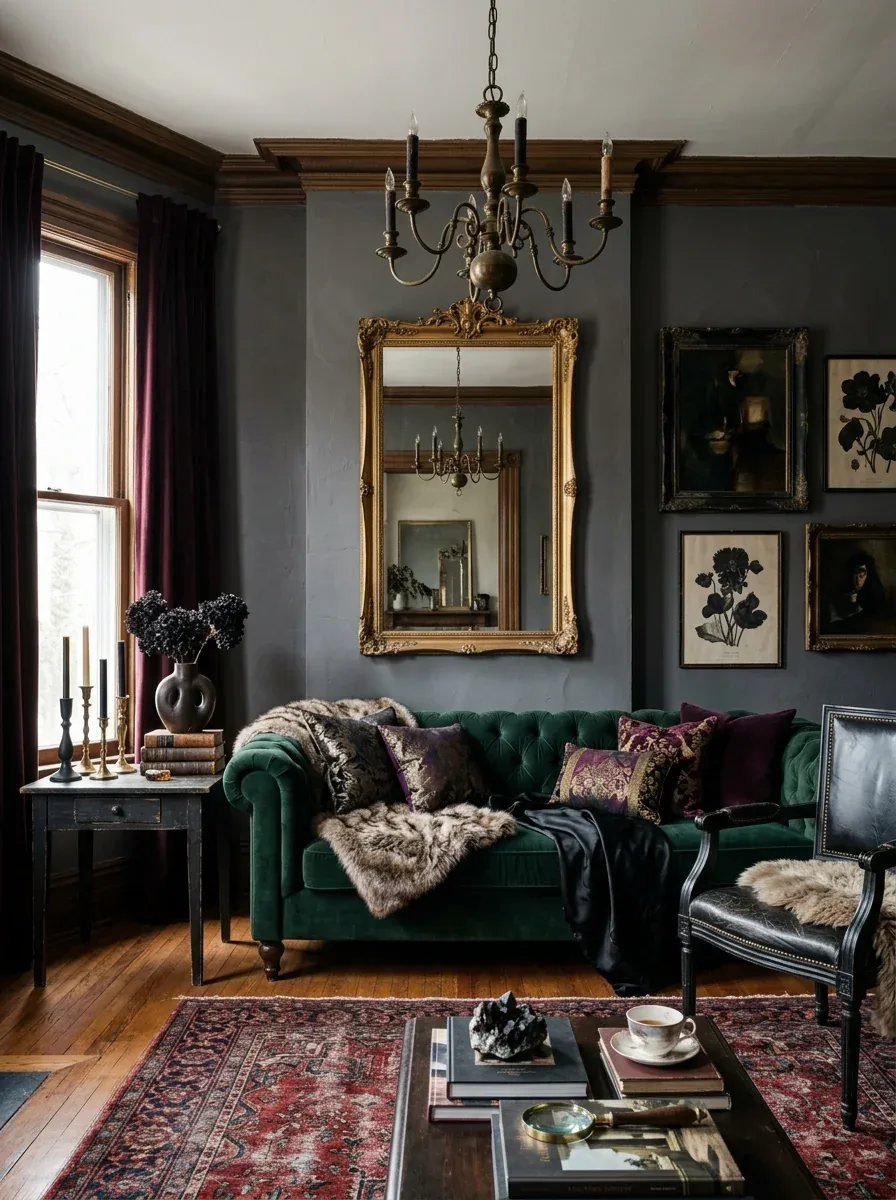
Before we get into the how, let’s clear something up, because I think this is where most people psych themselves out of trying the style at all. Gothic glam interior design isn’t about being dark for the sake of dark. It’s the marriage of two things that don’t usually get invited to the same party: the moodiness and drama of gothic architecture (think cathedral arches, wrought iron, deep jewel tones) and the polish of glam design (mirrored surfaces, velvet, metallics that catch the light).
On its own, gothic can tip into heavy and oppressive. On its own, glam can feel a little flat and try-hard, like a hotel lobby. Together? You get a room that feels rich and a little dangerous, but still intentional and elevated. It’s moody without being murky. That distinction matters more than almost anything else in this whole guide, so hang onto it.
You can’t do gothic glam decor with a beige wall. I’m sorry, but you just can’t — it’s the one non-negotiable. The walls need to carry weight. Think charcoal, deep burgundy, forest green so dark it reads almost black, or a true black if you’re feeling brave (and if your room gets decent natural light, black is far less scary than it sounds on paper).
Here’s a mini before-and-after for you: a client of mine had a spare bedroom in a flat, builder-beige “greige” that could’ve belonged to literally anyone. We repainted it in a matte deep plum — closer to eggplant than purple, if that makes sense — and just that one change made the room feel three times more expensive before we’d added a single accessory. That’s the power of a confident wall color. It does 60% of the work for you.
If full-room color feels like too big a leap, start with one accent wall, ideally the one your bed or sofa backs onto. And skip the eggshell finish — go matte or even a soft velvet-matte if your paint brand offers it. Glossy dark walls show every roller mark and fingerprint, which is not the vibe.
Layer In Gothic Bedroom Accessories for Instant Drama
The bedroom is honestly the easiest room to start this style in, because a few well-chosen gothic bedroom accessories do most of the heavy lifting without requiring a full renovation.
A few of my go-tos:
A statement headboard — carved wood in a dark stain, or an upholstered velvet headboard with nailhead trim. Curved, cathedral-arch shapes lean gothic without being literal about it.
Candlestick-style table lamps — brass or aged bronze finishes, with a black or deep-toned lampshade. Skip anything too shiny gold; you want it to look collected, not brand new.
Heavy drapery — floor-to-ceiling curtains in velvet or a rich matte fabric. This is where comparing velvet vs. linen curtains really helps, because velvet is what gives gothic glam that light-catching depth — linen just doesn’t hold the mood the same way.
Antique or antique-style mirrors — ornate frames in aged gold or blackened metal, positioned to catch candlelight or lamp glow.
And okay, I’ll admit it — I have a slight weakness for tarnished brass anything. It photographs beautifully and it has that “this has been in the family for generations” quality even when you bought it three weeks ago on clearance.
Bedding is another spot people underestimate. A plain white duvet, no matter how nice the thread count, kind of undoes everything else in the room — it reads too crisp, too hotel-generic for this style. Swap in a deep charcoal or burgundy duvet cover, then layer a faux fur or velvet throw at the foot of the bed for texture. Even something as small as swapping brushed-nickel drawer pulls for aged brass or black iron ones on your nightstands adds up. It sounds like a tiny detail until you notice it’s the thing your eye keeps snagging on in a good way.
Bring in Metallics the Glam Half of the Equation Demands
This is the part people forget, and it’s the difference between a room that reads gothic glam versus one that just reads dark and heavy. The glam half needs metallics, and it needs shine.
Brass, aged gold, and blackened bronze all work beautifully against deep wall colors. Chrome and polished silver can work too, but they read a little colder and more contemporary — fine if that’s the direction you want, but if you’re chasing a warmer, more romantic gothic mood, brass and gold will serve you better. A modern chandelier with candelabra-style arms is basically the MVP fixture of this entire style — it’s dramatic, it throws gorgeous shadow patterns on a dark ceiling, and it instantly signals “this room means it” the second you walk in.
Mirrored furniture is another sneaky-good move. A mirrored console table or nightstand bounces light around a dark room (which, fair, dark rooms need all the help they can get) while adding that glam sparkle factor. I’d stop at one or two mirrored pieces per room, though — more than that and it starts to feel like a furniture showroom rather than a home.
Here’s something that took me embarrassingly long to figure out: in a monochromatic, dark color scheme, texture is what keeps a room from feeling flat and one-note. If everything’s the same matte finish in the same tone, your eye has nowhere interesting to land.
So mix it up deliberately. Velvet throw pillows against a boucle or linen sofa. A shaggy dark rug layered under a hard, glossy coffee table. Wrought iron light fixtures next to soft draped fabric. Carved wood furniture with clean, smooth glass or lucite accents. Each texture catches and reflects light differently, and in a low-light, dark-walled room, that variation is genuinely what creates visual depth instead of a flat black hole effect.
One trick I use constantly: run your hand across a vignette before you call it done (I know, sounds silly). If everything feels the same under your palm — all smooth, all soft, all rough — you’ve probably over-matched your textures and it’s time to swap one piece out.
Rugs deserve their own callout here too, because they’re doing more visual heavy-lifting than most people give them credit for. A Persian or Persian-inspired rug in deep reds and blues brings in pattern without breaking the color story, and it adds an almost storied, worn-in quality that a flat solid rug just can’t fake. If that’s a direction you’re curious about, this guide to decorating with Persian rugs is worth a look — the patterning pairs surprisingly well with gothic glam’s darker palette, since the rug essentially becomes a piece of art on the floor instead of an afterthought underfoot.
Designing a Gothic Style Apartment When You Can’t Paint the Walls
Rentals are the eternal wrench in the works here, and I get a lot of questions about how to pull off a gothic style apartment when the landlord says absolutely not to the eggplant walls. Fair enough. It’s still very doable — it just shifts the workload onto furniture, textiles, and lighting instead of paint.
Start with a large dark area rug to anchor the room; it does a surprising amount of the “grounding” work that dark walls would otherwise do. Add heavy curtains in a deep tone (these alone change the whole feel of natural light in a room, dimming it just enough to feel intentional rather than accidental). Bring in dark furniture pieces — even one or two, like a black-finished bookshelf or a dark wood coffee table — and lean hard into the metallic lighting and accessories we’ve already talked about.
If your bathroom happens to have any flexibility (paint, fixtures, hardware), that’s often the one room renters can actually transform, and these dark, moody bathroom ideas are a genuinely good reference point for translating the aesthetic into a smaller, tiled space where full paint freedom isn’t required.
Gothic Interior Design Modern Enough to Not Feel Costume-y
This is the tip I probably care about most, because it’s the one thing that separates a genuinely well-designed room from something that reads more like a themed party. A gothic interior design modern approach pulls back on the literal medieval references — skip the actual suits of armor, please — and instead borrows the emotional tone: drama, richness, contrast, a little mystery.
Practically, that means clean-lined furniture silhouettes paired with gothic color and texture, rather than heavily carved, ornate pieces everywhere. A simple, modern sofa in a deep emerald velvet does more for this look than an antique Victorian settee would, honestly, because it keeps the room feeling current instead of like a museum exhibit. Save the ornate, traditional pieces for one or two hero moments — a mirror, a light fixture, a headboard — and let everything else stay relatively restrained in shape.
Black-and-white contrast is another modern gothic move worth stealing, and if that appeals to you, this collection of black and white bedroom ideas shows how stark contrast can carry a lot of the gothic mood on its own, even without deep jewel-toned walls.
Don’t Skip the Gothic Home Aesthetic in Your Lighting Plan
Lighting genuinely makes or breaks this entire style, more than any other design choice on this list. Overhead lighting that’s too bright and too white flattens everything — it kills shadows, kills mood, and makes deep colors look muddy instead of rich.
Aim for warm bulbs (2400K to 2700K), and build in multiple light sources at different heights rather than relying on one central fixture. A floor lamp in a corner, a pair of table lamps flanking the bed or sofa, a dimmable chandelier overhead, maybe even actual candles or flameless candle alternatives on a mantel or console. Layered, warm, dimmable light is what turns a dark room from “gloomy” into “atmospheric,” and that’s genuinely the whole ballgame with a gothic home aesthetic. Get the lighting wrong and no amount of velvet or brass will save you.
If you take nothing else from this, take this: gothic glam decor works best as an editing exercise, not an accumulation one. Pick your deep wall color, choose two or three metallic accents, layer in real texture, and get your lighting warm and multi-source. Then stop. The temptation is to keep adding — another candlestick, another ornate mirror, another velvet throw — but restraint is actually what makes the glam half of this style read as intentional rather than cluttered.
I still get a little thrill walking into that dark plum bedroom every time, two years later, and honestly? My mother’s coming around to the dining room too. Slowly. Save this pin if you’re planning your own moody corner of the house, and tell me in the comments which room you’re tackling first — I’m always curious whether people start with the bedroom or go straight for broke on the living room.
Listen to this article 10 10 0:00 / 0:00 Speed 0.75× 1× 1.25× 1.5× 2× If your workspace currently feels like a sad corner with a laptop and emotional damage, it might be time for an upgrade. A feminine boho home office brings personality, warmth, and enough style to make answering emails feel slightly less…
Listen to this article 10 10 0:00 / 0:00 Speed 0.75× 1× 1.25× 1.5× 2× Ready to elevate your living room with Indian-inspired charm? These eight ideas mix color, texture, and culture into a space that feels warm, vibrant, and totally you. FYI, you’ll want to bookmark a couple for later projects. 1. Bold Melange:…
Listen to this article 10 10 0:00 / 0:00 Speed 0.75× 1× 1.25× 1.5× 2× That weird empty corner in your living room? Yeah, the one you keep pretending doesn’t exist. It’s not a lost cause—it’s actually prime real estate waiting to shine. With the right idea, that awkward angle can become the most interesting…
Listen to this article 10 10 0:00 / 0:00 Speed 0.75× 1× 1.25× 1.5× 2× Ever walked into a living room that just felt right—cozy, balanced, and pulled together—without knowing why? Chances are, the rug did most of the heavy lifting. Rug placement can make or break your entire living room, and designers take it…
Listen to this article 10 10 0:00 / 0:00 Speed 0.75× 1× 1.25× 1.5× 2× Ready to elevate your living room without turning it into a sterile showroom? These seven minimalist moves keep things calm, chic, and actually livable. FYI, simplicity can look incredibly expensive when done right. 1. Layer Textures Like a Pro Minimalism…
Listen to this article 10 10 0:00 / 0:00 Speed 0.75× 1× 1.25× 1.5× 2× Let’s be honest—rug placement can make or break your entire living room. You can have the nicest sofa, perfect lighting, even Pinterest-worthy decor… and still end up with a space that feels off. Why? Because your rug is either too…