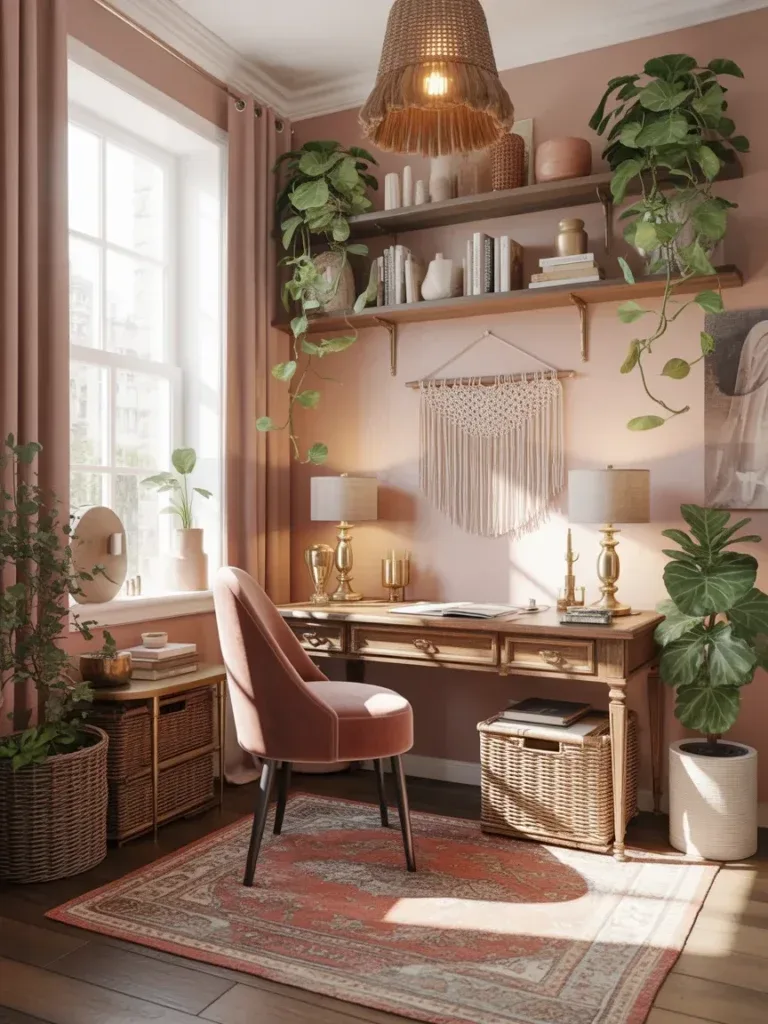
6 Floating Shelf Decor Living Room Ideas That Wow
A floating shelf in a living room either becomes the thing that pulls the whole wall together, or it becomes a dust magnet holding three random objects nobody chose on purpose. The difference usually comes down to a handful of decisions — texture, spacing, what’s practical versus what’s just pretty — not talent or a big budget. If you’re mounting a shelf for the first time and want the installation basics, our floating shelf decor guide covers height, studs, and brackets before you get to styling.
Below are six floating shelf decor living room ideas, in enough detail to actually execute, with the trade-offs and mistakes attached to each one.
1. Layer Textures Like a Pro

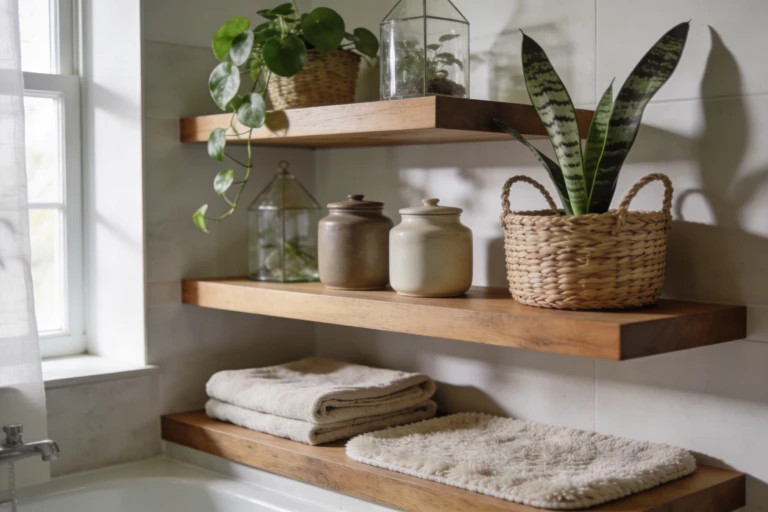
Texture is what stops a shelf from looking flat in photos and in person. Mixing warm wood or rattan, a metallic piece or two in brushed brass or matte black, and something soft like a woven throw or basket gives your eye more than one surface to land on — glossy next to matte, hard next to soft.
Key elements
- Wood or rattan accents
- Metallic decor pieces (brass, gold, or matte black)
- Fabric textures — small throws, woven baskets
- Plants in textured pots (terracotta, ceramic, woven)
💡 Pro Tip: Cap yourself at three materials per shelf — wood, one metal, one textile. Add a fourth and the mix stops reading as curated and starts reading as “everything I own.”
This approach holds up well long-term because you’re not locked into a single color story — swap the throw or the metal accent with the seasons and the bones of the shelf stay the same.
2. Create Micro Galleries With Tiny Frames

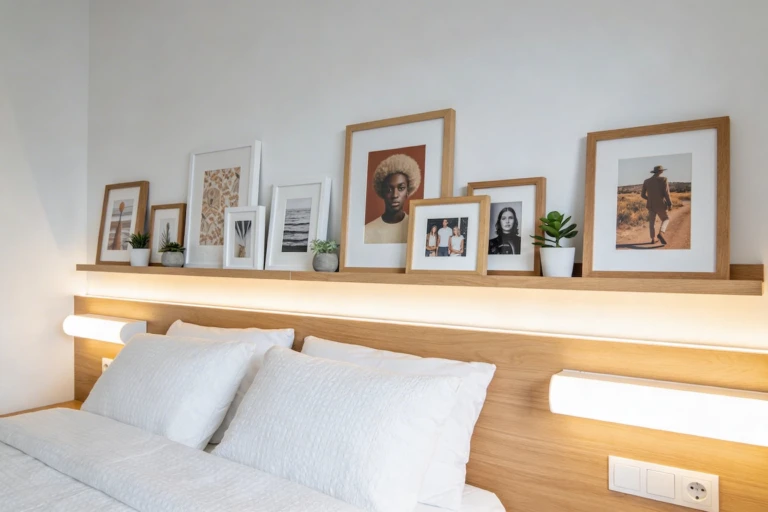
A cluster of three to five small frames does what a full gallery wall does, without committing you to a dozen nail holes. Keep the frames in a single mat color and a similar frame material — mixing white mats and black mats in the same small cluster is one of the fastest ways to make it look unplanned rather than curated.
How to do it
- Mix three to five frames of varying sizes
- Use a single mat color across all of them for cohesion
- Lean a couple directly against the wall instead of hanging them flat, for a looser, “just collected” feel
- Swap in new photos or prints seasonally rather than leaving the same shot up for years
This is the easiest of the six ideas to try if you’re renting, since nothing about it requires permanent wall changes beyond the shelf mount itself.
3. Add a Green Moment With Easy Plants

Compact, low-light-tolerant plants do more for a shelf than almost any object you could buy. A ZZ plant or a Scindapsus (often sold as “mini pothos”) handles inconsistent watering and lower light better than most flowering options, which matters if the shelf isn’t right next to a window.
Plant picks
- ZZ plant
- Mini pothos or Scindapsus (trailing, softens hard shelf edges)
- Succulents in mixed textures
- Small culinary herbs, if the shelf gets real daylight
💡 Pro Tip: Herbs almost always lose if the shelf doesn’t get several hours of direct light — they’ll survive for a few weeks and then quietly die. If your shelf is more than a few feet from a window, skip the herbs and stick with a ZZ plant or pothos instead.
Wipe the leaves down about once a week if the shelf isn’t in humid air — dust dulls the glossy look that makes plants read as a deliberate design choice instead of an afterthought.
4. Layer Objects With Purposeful Spacing

This is the idea that most directly separates a styled shelf from a shelf that just has stuff on it: scale variation and gaps. Every object needs a size relationship to the ones around it — an anchor piece, a couple of medium pieces, and small accents filling the remaining gaps, not five objects of similar size lined up in a row.
Practical setup
- Anchor pieces: a chunky vase or a heavier sculpture
- Medium pieces: a stack of books, a candle, a shallow bowl
- Small accents: figurines, coasters, a dried branch or a few smooth stones
Group items in threes or fives rather than pairs — odd numbers read as more natural to the eye than even ones, which is why symmetrical pairs of identical objects often look stiffer than an asymmetrical cluster of three.
5. Use Practical Storage With Style

Not every shelf needs to be purely decorative — in a living room, a shelf can absorb remotes, chargers, cables, and manuals if you give those items a proper container instead of leaving them loose. A woven basket or a stackable box does the job of a junk drawer while still looking intentional.
Smart inserts
- Decorative baskets for remotes and cables
- Stackable boxes for chargers and manuals
- Open space left for books or magazines you’re actually reading
Cable clutter is the single fastest way to undo an otherwise well-styled shelf near a TV or media console. A slim cord cover or a cable sleeve tucked along the back edge keeps the visible mess down without needing to hide every wire completely.
💡 Pro Tip: Don’t mix a fully decorative shelf and a fully functional one side by side at the same height — it reads as mismatched. Either stack function below and decoration above on the same wall, or keep the two roles on separate walls entirely.
6. Play With Color Highlights and Metallic Accents

One repeated color and one metallic piece can carry a whole shelf without any other changes. Pick a color already living somewhere else in the room — a throw pillow, a rug thread — and echo it in a small vase or object on the shelf, so the shelf reads as connected to the room rather than a separate display.
How to shine
- One color accent, repeated in small doses rather than a single large block
- One metallic piece — brass, gold, or matte black — as the “conversation” object
- A small lamp or candle holder positioned to catch and reflect light
The mistake here is doubling up on metallics. Brass and gold together can work if they’re close in tone, but brass paired with chrome or matte black usually reads as competing rather than complementary — pick one metal finish per shelf and stay with it.
Choosing an Idea for Your Space
| Idea | Best If | Upkeep |
|---|---|---|
| Layer textures | You want a cozy, upscale feel without a full redo | Low |
| Micro gallery frames | You’re renting or want flexible, swappable decor | Low |
| Easy plants | The shelf gets decent light and you want a living element | Medium (watering, dusting) |
| Purposeful spacing | You already own varied objects and need a system to arrange them | Low |
| Practical storage | The shelf sits near a TV, entryway, or clutter-prone spot | Low |
| Color + metallics | You want one shelf to visually anchor the room’s color story | Low |
Things to Consider Before You Start Styling
- How much daylight does the shelf actually get — does that rule plants in or out?
- Is this shelf purely decorative, or does it need to hold something functional (remotes, books you’re reading)?
- Do you already own a color or metal finish elsewhere in the room to echo, or are you starting from scratch?
- Are you renting? If so, favor ideas that don’t require extra wall holes beyond the shelf mount itself.
Our Take
If you’re only trying one of these six, start with texture layering or purposeful object spacing — both work on almost any shelf, in almost any room, and don’t depend on plant care or matching a specific room color. Plants and color-highlight styling are worth adding once the basic arrangement is working, not before. For more shelf arrangement ideas beyond the living room, our small floating shelf decor guide is a good next stop, and if you’re planning a bigger wall composition, large wall decor with floating shelves covers scaling these same ideas up.