6 Red Rug Living Room: Bold Ideas to Transform Your Space
A red rug is one of the fastest ways to make a living room feel finished, and one of the easiest ways to make it feel off. The difference usually comes down to three things: the shade of red you pick, what it sits against, and how much room you give it to breathe. Before you commit to a rug, it’s worth getting the sizing right for your floor plan — a red rug that’s too small under a sofa reads as an afterthought no matter how good the color is.
Below are six ways to build a red rug living room that holds up over time, not just in the first-week “new rug” glow. Each one solves a different problem: scale, flooring, small rooms, texture, color confidence, or tying a whole palette together.
Quick Take: What Actually Matters in a Red Rug Living Room
- Undertone match beats shade-matching — a warm brick red on cool-toned wood floors will always look slightly wrong, no matter how nice the rug is on its own.
- Rug size is more likely to sink a room than rug color. Under-sized red rugs (all four legs off the rug) read as cheap even when the rug itself is expensive.
- Red reads “loud” mainly when it’s paired with other saturated colors. Next to neutrals, it calms down fast.
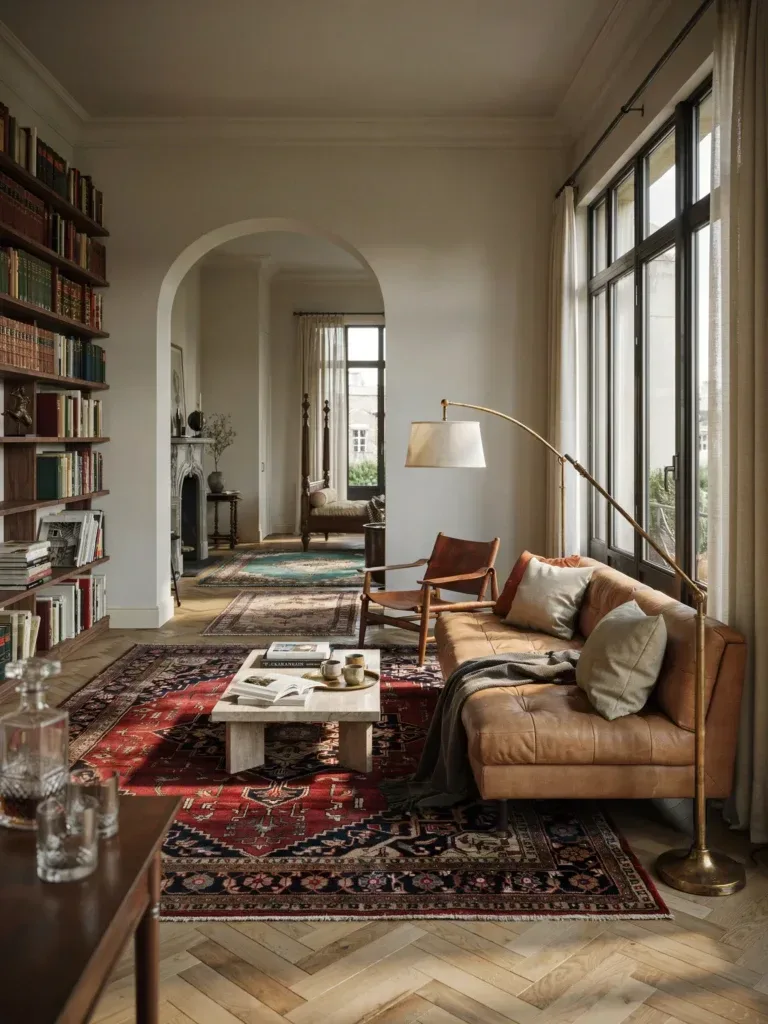
- Persian and Afghan-pattern red rugs behave differently than solid red rugs — the pattern does a lot of the visual work a solid rug needs help with.
1. Make a Bold Statement With a Large Red Rug

Going big is the move that makes a red rug living room feel intentional instead of accidental. Undersized rugs are the single most common mistake people make with statement colors — a small red rug floating in the middle of a room draws attention to itself in the wrong way, like a spotlight on an empty stage. A large rug, by contrast, reads as flooring, not decoration, which lets the color settle into the room instead of shouting from the middle of it.
The rule that actually holds up: get the front legs of every seating piece onto the rug. If your sofa, chairs, and any side tables aren’t at least partially anchored, the rug is too small for the space, full stop.
💡 Pro Tip: Measure your seating layout before you shop, not after. A rug that looks huge rolled up in a store often ends up exactly right — or still too small — once it’s under a full seating arrangement. Bring your room dimensions with you.
Getting the shade right
- Brick red and burgundy read warmer and pair well with wood tones and cream walls
- Cherry and true red read cooler and work better against white or gray walls
- Keep surrounding textiles — sofa fabric, curtains, throw pillows — mostly neutral so the rug stays the focal point
Rooms with strong natural light handle a big red rug best. If your living room has dim corners, plan for warm lamp light there — cool overhead light on a red rug can make it look flat and slightly brown by evening.
2. Pair a Red Rug With Wood Floors for a Warmer, More Grounded Look

Red on wood is a pairing that’s been working for as long as people have owned both. The reason is simple: wood tones and red share the same warm base, so instead of competing, they reinforce each other. It’s the lowest-effort, highest-payoff combination on this list.
What trips people up is undertone mismatching. A cool-toned red — think cranberry or a red with a blue cast — sitting on ashy gray-brown floors will fight the wood instead of complementing it. Match warm reds to honey and amber wood tones, and save cooler reds for lighter, more neutral floors.
Styling moves that hold this together
- Bring in one or two natural-material pieces — a live-edge coffee table, a rattan chair — to bridge the rug and the floor visually
- Keep patterns minimal elsewhere in the room; let the wood grain and rug texture do the pattern work
- Add greenery in simple pots — it softens the warm-on-warm palette without introducing a competing color
If you’re drawn to a patterned option rather than a solid, this is exactly where a red Persian-style rug tends to outperform a solid red — the pattern already contains warm and cool notes, so it’s more forgiving of a floor that isn’t a perfect undertone match.
3. Use a Narrow Red Runner to Fix an Awkward or Small Room

Runners get treated as a hallway-only item, which is a missed opportunity. In a narrow living room or along the length of a sofa, a red runner does something a square rug can’t: it visually stretches the room instead of filling it. Tight rooms often look more cramped with a big rug in the center — a runner along one wall avoids that entirely.
The other advantage is commitment. A runner is a much smaller investment than a room-sized rug, which makes it the easier option if you’re not sure red is right for you long-term. If you decide you don’t love it in six months, swapping it costs far less than replacing an 8×10.
💡 Pro Tip: Anchor a runner with something on each end — a slim side table, a lamp, a plant — so it reads as a designed element rather than a strip of leftover rug. A runner with nothing at either end looks unfinished no matter how nice the rug itself is.
For layout logic beyond just runners — where furniture should sit relative to a rug in a small or oddly shaped room — this layout guide walks through the actual measurements that make a tight room feel bigger instead of more cramped.
4. Layer Textures So the Red Reads Rich, Not Loud

Texture is what separates a red rug living room that feels expensive from one that feels like a single loud purchase. A flat red rug on its own, surrounded by smooth, matching-toned furniture, tends to look one-note. Add texture and the same color starts to read as intentional and layered.
The mix that consistently works: something soft (a fuzzy throw), something woven (natural-fiber cushions or a jute accent mat), and something matte to cut glare (a wood coffee table, a matte-finish lamp rather than polished chrome). Glossy, reflective surfaces next to a saturated rug tend to amplify the “loud” quality people are usually trying to avoid.
A simple texture checklist
- One soft layer — throw blanket or plush cushion
- One woven or natural-fiber layer — jute, sisal, rattan, wool
- One matte surface — wood, unlacquered metal, or stone
- Avoid stacking more than one high-shine surface (glass, chrome, lacquer) near the rug
If wool is your material of choice for the rug itself rather than a synthetic blend, this guide to styling wool rugs covers care and layering specifics that apply directly to a red wool piece.
5. Let Neutrals and Metallic Accents Do the Supporting Work

If picking complementary colors feels like guesswork, skip it. A neutral sofa — cream, taupe, warm gray — combined with a couple of warm metallic touches (brass, aged copper, unlacquered bronze) is close to foolproof next to a red rug. The metal catches light and adds a little polish without introducing another color to balance.
This is also the easiest option if you haven’t settled on wall color or art yet. Neutral walls plus a red rug plus warm metal accents holds together as a finished room even mid-renovation, which isn’t true of most bolder color pairings.
💡 Pro Tip: Stick to one metal family in a room. Mixing brass and chrome and pewter all in the same space, next to a bold rug, tends to read as unplanned rather than eclectic. Pick warm metals (brass, copper, gold) or cool metals (chrome, nickel, steel) and stay in that lane.
For the underlying placement rules this look depends on — rug orientation, furniture spacing, how much floor to leave exposed — this placement guide is worth reading before you rearrange anything.
6. Turn the Red Rug Into a Color Story for the Whole Room

The most advanced move on this list is also the one with the highest payoff: instead of treating the rug as an isolated object, pull two or three of its tones out into the rest of the room. A rug with hints of blush and charcoal, echoed in a throw pillow here and a piece of art there, stops looking like “the red rug” and starts looking like the room’s whole design decision.
The trick to not overdoing it: pick one dominant red, two supporting neutrals or muted hues, and let only one other item in the room carry a pattern. A patterned rug plus a patterned pillow plus patterned curtains is where color stories usually fall apart — one pattern source is plenty.
| Approach | Best For | Watch Out For |
|---|---|---|
| Large solid red rug | Open-plan rooms, defining a lounge zone | Rugs sized too small for the seating layout |
| Red rug + wood floors | Warm, low-effort cohesion | Undertone mismatch between rug and wood |
| Narrow red runner | Small or narrow living rooms | Runner with nothing anchoring either end |
| Persian or Afghan-pattern red rug | Rooms where you want built-in pattern and forgiveness on undertone | Overpowering a small room with a busy pattern |
| Red rug as color story | Pulling a whole room together cohesively | Stacking too many patterns at once |
What Makes a Red Rug Living Room Work Long-Term
Every version above shares the same underlying logic: give the rug enough physical space, match its undertone to what’s around it, and don’t ask it to compete with too many other bold choices at once. That holds whether you’re working with a solid modern red rug, a red Persian rug with a dense traditional pattern, or an Afghan rug with the flatter, geometric red-on-red patterning that style is known for. A red Afghan rug in particular tends to sit slightly darker and more muted than a Persian red, which makes it a good option for a room where you want the color’s warmth without quite as much visual punch.
Things to Consider Before You Commit to Red
- How much natural light does the room get? Red rugs read richer in bright rooms and can look muddy in consistently dim ones without added lamp light.
- Is this a solid rug or a patterned Persian/Afghan piece? Patterned rugs are more forgiving of imperfect color-matching in the rest of the room.
- Do you already own a lot of other saturated color in the room (art, furniture)? If so, a large solid red rug may be one bold element too many — consider a runner or a more muted red-toned Persian rug instead.
- What’s your flooring undertone? Warm reds want warm wood; cooler reds want lighter, more neutral floors.
FAQ
Does a red rug make a small living room feel smaller?
Not inherently — a runner or a rug sized correctly to the seating area usually reads as intentional rather than cramped. What actually shrinks a small room is an undersized rug floating with visible floor gaps on all sides, in any color.
Is a red Persian rug harder to style than a solid red rug?
It’s actually easier in most rooms, because the pattern already blends warm and cool tones, so it’s more forgiving of a floor or wall color that isn’t a perfect undertone match.
What wall color goes with a red rug living room?
Warm whites, soft creams, and light warm grays are the safest starting points. Cool, stark white walls can make some reds look slightly harsh by comparison.
Can I mix a red Afghan rug with modern furniture?
Yes — the flatter, more geometric patterning typical of Afghan rugs tends to read cleaner and more contemporary than a dense floral Persian pattern, which makes it a reasonable fit for modern or minimalist furniture.
How do I keep a red rug from looking dated?
Avoid pairing it with an entirely matching red-toned color scheme. Red rugs stay current longest when they’re the single saturated element in an otherwise neutral or muted room.
Our Take
If you’re weighing these six options against each other, start with the large solid red rug if your room gets good natural light and you want the boldest, most straightforward result — it’s the option with the fewest moving parts to get wrong. If your space is small, narrow, or you’re not fully committed to red yet, the runner is the lower-risk entry point. And if you already have a room full of neutrals that needs one confident anchor, a red Persian or Afghan rug will do more of the visual work for you than a solid color will. For more ways to bring that same warmth and pattern into a room, this collection of Persian rug decor ideas is a good next stop.