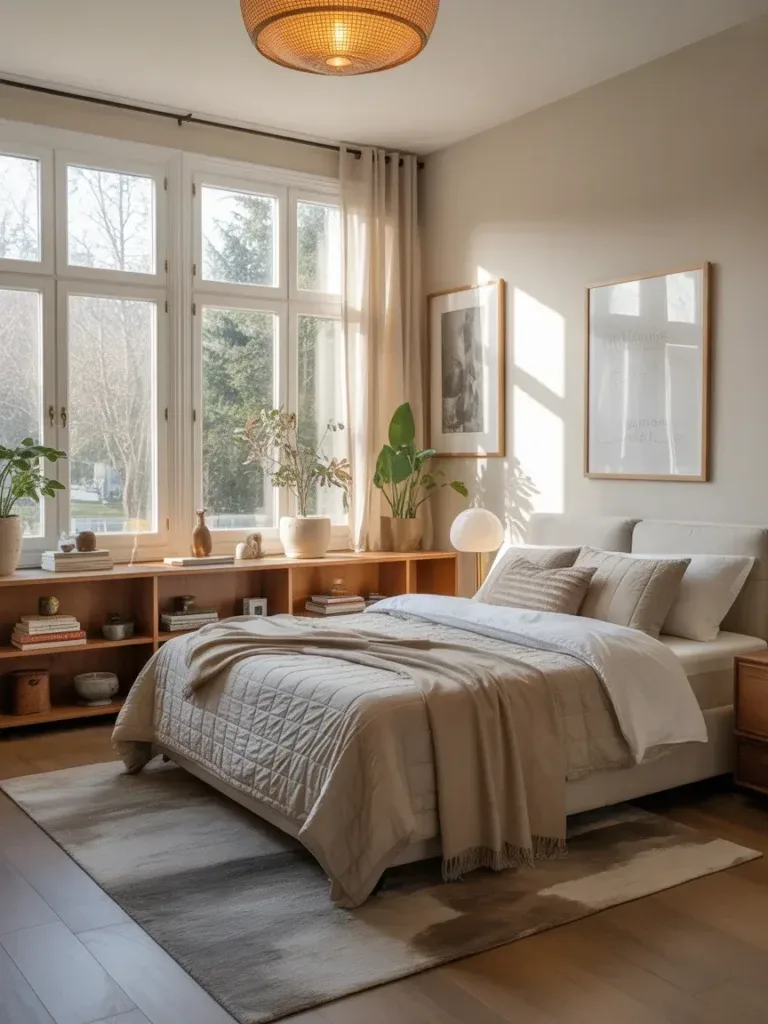
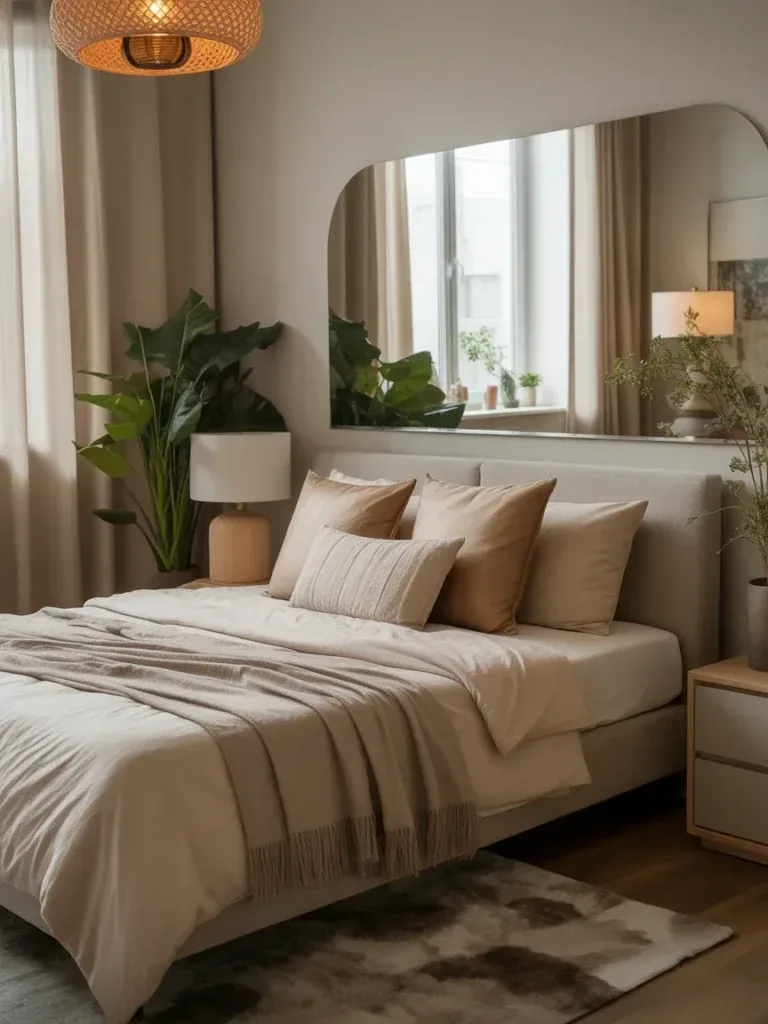
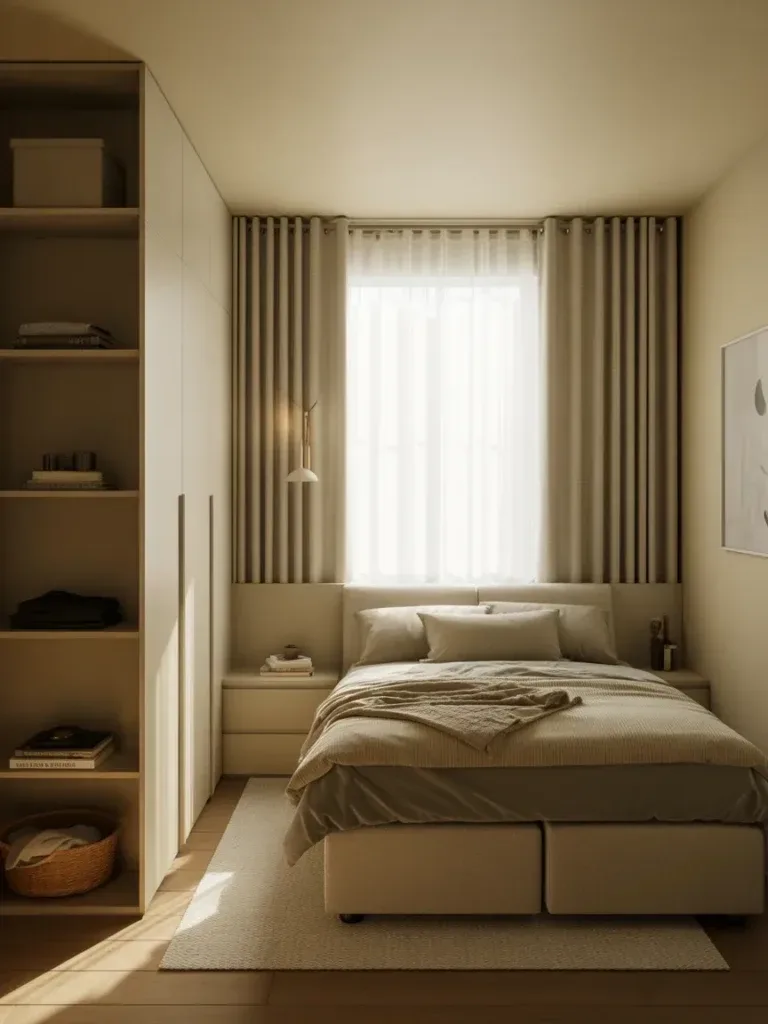
So your bed is stuck under a window and you’re not sure if that’s a design flaw or a design opportunity. I’ve lived in three different apartments where a bedroom with window behind bed was just… the only option, no negotiating with the floor plan. And honestly? Once I stopped fighting it and started working with it, it became one of my favorite layouts. This isn’t a workaround post. It’s a real guide for making this setup functional, cozy, and actually kind of beautiful. Why a Bedroom With Window Behind Bed Layout Works (Even Though It Feels Wrong at First) Every design rule you’ve read probably says to put your headboard against a solid wall. I get why — it feels more grounded, more “anchored.” But a bedroom with window behind bed isn’t automatically a mistake. It just needs a slightly different approach than the standard advice assumes. Here’s the thing nobody tells you: a window behind the bed gives you natural light streaming in without it hitting you directly in the face when you’re trying to sleep in on a Sunday. The light bounces off the opposite wall instead. That’s actually a small win. My first apartment had exactly this setup, and I remember being annoyed about it for months before realizing the room felt brighter and airier than any bedroom I’d had before, precisely because the window wasn’t competing with furniture placement anywhere else. The real issue is usually one of three things: drafts, a headboard that looks like it’s just floating there with nothing to lean on, or curtains that feel like an afterthought. Fix those three, and the “problem” mostly disappears. Bed Design Window Behind: Getting the Headboard Placement Right This is where most people go wrong, and it’s an easy fix. A bed design window behind a window needs a few inches of breathing room — I’d say 4 to 8 inches minimum between the top of the headboard and the bottom of the window sill. Push the bed flush against the wall and you’ll end up with curtains dragging across the mattress every time you open them, which is annoying at 2am, trust me. Sizing Your Headboard for a Window Wall Go tall. A low headboard against a window just draws attention to the gap of blank wall above it, and that gap tends to look unfinished no matter what you put there. A headboard that reaches close to (but not touching) the window sill visually “completes” the wall. Upholstered headboards in the 48 to 54 inch height range work beautifully here — enough presence to anchor the bed, not so much that it swallows the window frame. If you’re drawn to a lighter, more serene palette for this look, a white headboard bedroom idea tends to photograph and live beautifully against a sunlit window, since the white doesn’t compete with the daylight the way a dark, saturated color can. Choosing the Right Bed With Panel for a Window Wall A bed with panel — meaning a paneled or slatted wood headboard, sometimes matched with a wall panel treatment behind it — solves the “floating headboard” problem in a completely different way than upholstery does. Instead of softness, you get structure. Think shiplap-style vertical slats, or a fluted wood panel that runs from the headboard up toward (or even around) the window frame, tying the whole wall together as one designed element rather than “bed here, window there, unrelated.” I tried this in a rental once with a temporary, removable panel kit — it took a Saturday afternoon and cost less than $200 in materials, and it completely changed how finished the room felt. Not going to pretend it was a professional job (it wasn’t, there’s a slightly crooked panel on the left side I still notice), but from three feet away, nobody knows. A few panel styles that work particularly well flanking a window: Vertical slat wood panels stained a warm walnut or left raw oak Fluted MDF panels painted to match the wall for a subtle, textural look Shaker-style flat panels for a more traditional, quietly luxe feel If your overall vision leans more polished hotel-suite than cozy cabin, browsing a few modern luxury bedroom ideas can help you settle on a panel finish that won’t feel out of place against nicer bedding and brass hardware. PVC Bedroom Design Ideas for a Window Behind the Bed Now, PVC bedroom design panels are a bit divisive, and I’ll be upfront: I’m not a huge fan of the glossy, high-shine PVC panels that were everywhere a few years back. They photograph fine but feel cold and slightly plasticky in person, especially in a room that’s supposed to feel restful. That said, PVC has come a long way, and the matte, wood-grain-textured versions are genuinely hard to distinguish from real wood panels once installed. The appeal is practical, not just aesthetic. PVC panels resist moisture (useful if your window isn’t perfectly sealed and you get the occasional condensation in colder months), they’re lightweight enough to install without hiring anyone, and they run considerably cheaper than solid wood — often somewhere in the $8 to $25 per square foot range depending on texture and thickness, versus real wood panel systems that can run double that or more. Bed Design Window Behind Panels: PVC vs. Wood, Honestly If budget is tight and you’re renting, PVC wins, full stop. If you own the place and plan to stay a while, I’d lean wood or a wood-veneer MDF — it ages better and doesn’t have that faint plastic smell some cheaper PVC lines carry for the first few weeks (yes, that’s a real thing, and yes, it eventually fades). Bedroom PVC Design Wall: Pros, Cons, and What I’d Actually Choose Let’s actually weigh this out instead of just listing generic pros and cons: Pros of a bedroom PVC design wall: Budget-friendly, especially for renters Water and humidity resistant near a window Lightweight, easy DIY installation Wide range of textures now, including convincing faux-wood grain Cons: Lower-end versions can look and feel obviously synthetic up close Some off-gassing smell initially Harder to repair if scratched or dented compared to solid wood Can feel slightly “trend-of-the-moment” rather than timeless If I were doing this in my own space today, I’d go with a mid-tier textured PVC panel in a warm oak or driftwood finish, paired with a fabric headboard rather than a matching PVC headboard — mixing the material with something soft keeps it from feeling like one flat surface. That contrast is honestly what makes or breaks whether a PVC wall reads as intentional design versus a builder-grade shortcut. Bed Back Window Wall Design Modern Ideas That Don’t Feel Cold A modern bed back window wall design can tip into feeling sterile fast if you’re not careful — too much matte black, too many hard angles, no texture. The fix is layering in at least one soft or organic element even within a minimalist scheme: a boucle throw, a woven rattan pendant, a slightly imperfect ceramic vase on the nightstand. Some modern approaches that hold up over time instead of feeling dated in two years: A single wide wood panel behind the bed with the window centered above it, flanked by simple wall sconces instead of table lamps (frees up nightstand space and avoids cord clutter near the window) A textured plaster or limewash finish just on the window wall, left otherwise unadorned Full-height, floor-to-ceiling drapery in a neutral linen, which visually stretches the wall and makes the window feel intentional rather than like a hole in the design If your taste runs toward a softer, sun-washed modern look rather than sleek and stark, a few light and airy bedroom ideas pair really naturally with this layout, since you’ve already got the natural light doing half the work for you. Lighting, Curtains, and Privacy Fixes for This Layout Drafts and light leaks are the two real functional complaints with this setup, so let’s handle both. For temperature: cellular shades (also called honeycomb shades) mounted inside the window frame are the single best fix I’ve found. They trap air in their honeycomb pockets and noticeably cut down on the cold-glass draft you feel at night, way more than curtains alone. For light control and privacy, layer two things rather than relying on one: A blackout roller shade or cellular shade mounted close to the glass Flowing curtain panels over top for softness and to hide the hardware This two-layer approach also solves the “curtains dragging on the bed” issue I mentioned earlier — because the functional shade sits close to the window, your decorative curtain panels can be mounted a bit wider and higher, well clear of the headboard, purely for looks. Color and Style Pairings That Make a Window Behind Bed Layout Sing Because natural light is doing so much of the visual work here, color choice matters more than in a windowless-wall bedroom. Whatever paint or wallpaper goes on that wall is going to be lit differently throughout the day, so test swatches at different times before committing. A few pairings that consistently work: Warm white or soft greige walls with a walnut or black-framed window — classic, sells well if you’re ever staging the home Deep forest green or navy on just the window wall, with white trim around the window itself to keep it from feeling too heavy A gray and white bedroom palette, which handles shifting daylight particularly gracefully since gray doesn’t go muddy or blown-out the way some warmer tones can under strong sun If you’re still narrowing down an overall direction, working through a broader bedroom color combination guide before you paint is worth the hour it takes — repainting a window wall after the fact, once you’ve hung panels or a headboard, is way more annoying than getting it right the first time. And if beachy, relaxed, sun-bleached wood tones are more your speed than moody and dramatic, a coastal bedroom idea or two can show you how well this layout leans into that vibe, since the window essentially becomes a frame for outdoor light in a way that coastal design already leans on heavily. Common Mistakes to Avoid With a Bedroom With Window Behind Bed Setup I’ll be honest, I’ve made most of these myself: Pushing the bed too tight against the window — leaves no clearance for curtains or airflow, and you’ll feel every draft directly on your pillow. Skipping window treatments entirely because “it’s just for light” — you’ll regret this the first early summer morning when the sun hits at 5:30am. Choosing a headboard that’s too short, leaving an awkward gap of bare wall that draws the eye more than the window itself. Matching every material too literally — an all-PVC wall with a PVC headboard and matching PVC nightstands starts to look like a showroom display rather than a lived-in bedroom. Mix in fabric, wood, or a woven texture somewhere. Forgetting about nightstand lighting when you remove wall space for sconces — plan your outlets and switch placement before the panels go up, not after. If you take nothing else from this, take this: clearance and layering (in fabric, material, and light) are what separate a bedroom with window behind bed that feels awkward from one that feels like it was designed that way on purpose. Final Thoughts A window behind the bed isn’t a flaw to hide — it’s a feature that just asks for a slightly different setup than the standard “headboard against a solid wall” advice. Give your headboard some breathing room, pick a panel material that matches your budget and how long you’re staying put, layer your window treatments for both temperature and privacy, and let the natural light guide your color choices rather than fighting against them. If this helped you picture your own space a little more clearly, save this pin for later — you’ll probably want to reference the headboard sizing and panel pros/cons again once you’re actually shopping. And if you’ve already tackled this layout in your own bedroom, I’d genuinely love to hear what worked (or didn’t) for you in the comments.So your bed is stuck under a window and you’re not sure if that’s a design flaw or a design opportunity. I’ve lived in three different apartments where a bedroom with window behind bed was just… the only option, no negotiating with the floor plan. And honestly? Once I stopped fighting it and started working with it, it became one of my favorite layouts. This isn’t a workaround post. It’s a real guide for making this setup functional, cozy, and actually kind of beautiful. Why a Bedroom With Window Behind Bed Layout Works (Even Though It Feels Wrong at First) Every design rule you’ve read probably says to put your headboard against a solid wall. I get why — it feels more grounded, more “anchored.” But a bedroom with window behind bed isn’t automatically a mistake. It just needs a slightly different approach than the standard advice assumes. Here’s the thing nobody tells you: a window behind the bed gives you natural light streaming in without it hitting you directly in the face when you’re trying to sleep in on a Sunday. The light bounces off the opposite wall instead. That’s actually a small win. My first apartment had exactly this setup, and I remember being annoyed about it for months before realizing the room felt brighter and airier than any bedroom I’d had before, precisely because the window wasn’t competing with furniture placement anywhere else. The real issue is usually one of three things: drafts, a headboard that looks like it’s just floating there with nothing to lean on, or curtains that feel like an afterthought. Fix those three, and the “problem” mostly disappears. Bed Design Window Behind: Getting the Headboard Placement Right This is where most people go wrong, and it’s an easy fix. A bed design window behind a window needs a few inches of breathing room — I’d say 4 to 8 inches minimum between the top of the headboard and the bottom of the window sill. Push the bed flush against the wall and you’ll end up with curtains dragging across the mattress every time you open them, which is annoying at 2am, trust me. Sizing Your Headboard for a Window Wall Go tall. A low headboard against a window just draws attention to the gap of blank wall above it, and that gap tends to look unfinished no matter what you put there. A headboard that reaches close to (but not touching) the window sill visually “completes” the wall. Upholstered headboards in the 48 to 54 inch height range work beautifully here — enough presence to anchor the bed, not so much that it swallows the window frame. If you’re drawn to a lighter, more serene palette for this look, a white headboard bedroom idea tends to photograph and live beautifully against a sunlit window, since the white doesn’t compete with the daylight the way a dark, saturated color can. Choosing the Right Bed With Panel for a Window Wall A bed with panel — meaning a paneled or slatted wood headboard, sometimes matched with a wall panel treatment behind it — solves the “floating headboard” problem in a completely different way than upholstery does. Instead of softness, you get structure. Think shiplap-style vertical slats, or a fluted wood panel that runs from the headboard up toward (or even around) the window frame, tying the whole wall together as one designed element rather than “bed here, window there, unrelated.” I tried this in a rental once with a temporary, removable panel kit — it took a Saturday afternoon and cost less than $200 in materials, and it completely changed how finished the room felt. Not going to pretend it was a professional job (it wasn’t, there’s a slightly crooked panel on the left side I still notice), but from three feet away, nobody knows. A few panel styles that work particularly well flanking a window: Vertical slat wood panels stained a warm walnut or left raw oak Fluted MDF panels painted to match the wall for a subtle, textural look Shaker-style flat panels for a more traditional, quietly luxe feel If your overall vision leans more polished hotel-suite than cozy cabin, browsing a few modern luxury bedroom ideas can help you settle on a panel finish that won’t feel out of place against nicer bedding and brass hardware. PVC Bedroom Design Ideas for a Window Behind the Bed Now, PVC bedroom design panels are a bit divisive, and I’ll be upfront: I’m not a huge fan of the glossy, high-shine PVC panels that were everywhere a few years back. They photograph fine but feel cold and slightly plasticky in person, especially in a room that’s supposed to feel restful. That said, PVC has come a long way, and the matte, wood-grain-textured versions are genuinely hard to distinguish from real wood panels once installed. The appeal is practical, not just aesthetic. PVC panels resist moisture (useful if your window isn’t perfectly sealed and you get the occasional condensation in colder months), they’re lightweight enough to install without hiring anyone, and they run considerably cheaper than solid wood — often somewhere in the $8 to $25 per square foot range depending on texture and thickness, versus real wood panel systems that can run double that or more. Bed Design Window Behind Panels: PVC vs. Wood, Honestly If budget is tight and you’re renting, PVC wins, full stop. If you own the place and plan to stay a while, I’d lean wood or a wood-veneer MDF — it ages better and doesn’t have that faint plastic smell some cheaper PVC lines carry for the first few weeks (yes, that’s a real thing, and yes, it eventually fades). Bedroom PVC Design Wall: Pros, Cons, and What I’d Actually Choose Let’s actually weigh this out instead of just listing generic pros and cons: Pros of a bedroom PVC design wall: Budget-friendly, especially for renters Water and humidity resistant near a window Lightweight, easy DIY installation Wide range of textures now, including convincing faux-wood grain Cons: Lower-end versions can look and feel obviously synthetic up close Some off-gassing smell initially Harder to repair if scratched or dented compared to solid wood Can feel slightly “trend-of-the-moment” rather than timeless If I were doing this in my own space today, I’d go with a mid-tier textured PVC panel in a warm oak or driftwood finish, paired with a fabric headboard rather than a matching PVC headboard — mixing the material with something soft keeps it from feeling like one flat surface. That contrast is honestly what makes or breaks whether a PVC wall reads as intentional design versus a builder-grade shortcut. Bed Back Window Wall Design Modern Ideas That Don’t Feel Cold A modern bed back window wall design can tip into feeling sterile fast if you’re not careful — too much matte black, too many hard angles, no texture. The fix is layering in at least one soft or organic element even within a minimalist scheme: a boucle throw, a woven rattan pendant, a slightly imperfect ceramic vase on the nightstand. Some modern approaches that hold up over time instead of feeling dated in two years: A single wide wood panel behind the bed with the window centered above it, flanked by simple wall sconces instead of table lamps (frees up nightstand space and avoids cord clutter near the window) A textured plaster or limewash finish just on the window wall, left otherwise unadorned Full-height, floor-to-ceiling drapery in a neutral linen, which visually stretches the wall and makes the window feel intentional rather than like a hole in the design If your taste runs toward a softer, sun-washed modern look rather than sleek and stark, a few light and airy bedroom ideas pair really naturally with this layout, since you’ve already got the natural light doing half the work for you. Lighting, Curtains, and Privacy Fixes for This Layout Drafts and light leaks are the two real functional complaints with this setup, so let’s handle both. For temperature: cellular shades (also called honeycomb shades) mounted inside the window frame are the single best fix I’ve found. They trap air in their honeycomb pockets and noticeably cut down on the cold-glass draft you feel at night, way more than curtains alone. For light control and privacy, layer two things rather than relying on one: A blackout roller shade or cellular shade mounted close to the glass Flowing curtain panels over top for softness and to hide the hardware This two-layer approach also solves the “curtains dragging on the bed” issue I mentioned earlier — because the functional shade sits close to the window, your decorative curtain panels can be mounted a bit wider and higher, well clear of the headboard, purely for looks. Color and Style Pairings That Make a Window Behind Bed Layout Sing Because natural light is doing so much of the visual work here, color choice matters more than in a windowless-wall bedroom. Whatever paint or wallpaper goes on that wall is going to be lit differently throughout the day, so test swatches at different times before committing. A few pairings that consistently work: Warm white or soft greige walls with a walnut or black-framed window — classic, sells well if you’re ever staging the home Deep forest green or navy on just the window wall, with white trim around the window itself to keep it from feeling too heavy A gray and white bedroom palette, which handles shifting daylight particularly gracefully since gray doesn’t go muddy or blown-out the way some warmer tones can under strong sun If you’re still narrowing down an overall direction, working through a broader bedroom color combination guide before you paint is worth the hour it takes — repainting a window wall after the fact, once you’ve hung panels or a headboard, is way more annoying than getting it right the first time. And if beachy, relaxed, sun-bleached wood tones are more your speed than moody and dramatic, a coastal bedroom idea or two can show you how well this layout leans into that vibe, since the window essentially becomes a frame for outdoor light in a way that coastal design already leans on heavily. Common Mistakes to Avoid With a Bedroom With Window Behind Bed Setup I’ll be honest, I’ve made most of these myself: Pushing the bed too tight against the window — leaves no clearance for curtains or airflow, and you’ll feel every draft directly on your pillow. Skipping window treatments entirely because “it’s just for light” — you’ll regret this the first early summer morning when the sun hits at 5:30am. Choosing a headboard that’s too short, leaving an awkward gap of bare wall that draws the eye more than the window itself. Matching every material too literally — an all-PVC wall with a PVC headboard and matching PVC nightstands starts to look like a showroom display rather than a lived-in bedroom. Mix in fabric, wood, or a woven texture somewhere. Forgetting about nightstand lighting when you remove wall space for sconces — plan your outlets and switch placement before the panels go up, not after. If you take nothing else from this, take this: clearance and layering (in fabric, material, and light) are what separate a bedroom with window behind bed that feels awkward from one that feels like it was designed that way on purpose. Final Thoughts A window behind the bed isn’t a flaw to hide — it’s a feature that just asks for a slightly different setup than the standard “headboard against a solid wall” advice. Give your headboard some breathing room, pick a panel material that matches your budget and how long you’re staying put, layer your window treatments for both temperature and privacy, and let the natural light guide your color choices rather than fighting against them. If this helped you picture your own space a little more clearly, save this pin for later — you’ll probably want to reference the headboard sizing and panel pros/cons again once you’re actually shopping. And if you’ve already tackled this layout in your own bedroom, I’d genuinely love to hear what worked (or didn’t) for you in the comments.So your bed is stuck under a window and you’re not sure if that’s a design flaw or a design opportunity. I’ve lived in three different apartments where a bedroom with window behind bed was just… the only option, no negotiating with the floor plan. And honestly? Once I stopped fighting it and started working with it, it became one of my favorite layouts. This isn’t a workaround post. It’s a real guide for making this setup functional, cozy, and actually kind of beautiful. Why a Bedroom With Window Behind Bed Layout Works (Even Though It Feels Wrong at First) Every design rule you’ve read probably says to put your headboard against a solid wall. I get why — it feels more grounded, more “anchored.” But a bedroom with window behind bed isn’t automatically a mistake. It just needs a slightly different approach than the standard advice assumes. Here’s the thing nobody tells you: a window behind the bed gives you natural light streaming in without it hitting you directly in the face when you’re trying to sleep in on a Sunday. The light bounces off the opposite wall instead. That’s actually a small win. My first apartment had exactly this setup, and I remember being annoyed about it for months before realizing the room felt brighter and airier than any bedroom I’d had before, precisely because the window wasn’t competing with furniture placement anywhere else. The real issue is usually one of three things: drafts, a headboard that looks like it’s just floating there with nothing to lean on, or curtains that feel like an afterthought. Fix those three, and the “problem” mostly disappears. Bed Design Window Behind: Getting the Headboard Placement Right This is where most people go wrong, and it’s an easy fix. A bed design window behind a window needs a few inches of breathing room — I’d say 4 to 8 inches minimum between the top of the headboard and the bottom of the window sill. Push the bed flush against the wall and you’ll end up with curtains dragging across the mattress every time you open them, which is annoying at 2am, trust me. Sizing Your Headboard for a Window Wall Go tall. A low headboard against a window just draws attention to the gap of blank wall above it, and that gap tends to look unfinished no matter what you put there. A headboard that reaches close to (but not touching) the window sill visually “completes” the wall. Upholstered headboards in the 48 to 54 inch height range work beautifully here — enough presence to anchor the bed, not so much that it swallows the window frame. If you’re drawn to a lighter, more serene palette for this look, a white headboard bedroom idea tends to photograph and live beautifully against a sunlit window, since the white doesn’t compete with the daylight the way a dark, saturated color can. Choosing the Right Bed With Panel for a Window Wall A bed with panel — meaning a paneled or slatted wood headboard, sometimes matched with a wall panel treatment behind it — solves the “floating headboard” problem in a completely different way than upholstery does. Instead of softness, you get structure. Think shiplap-style vertical slats, or a fluted wood panel that runs from the headboard up toward (or even around) the window frame, tying the whole wall together as one designed element rather than “bed here, window there, unrelated.” I tried this in a rental once with a temporary, removable panel kit — it took a Saturday afternoon and cost less than $200 in materials, and it completely changed how finished the room felt. Not going to pretend it was a professional job (it wasn’t, there’s a slightly crooked panel on the left side I still notice), but from three feet away, nobody knows. A few panel styles that work particularly well flanking a window: Vertical slat wood panels stained a warm walnut or left raw oak Fluted MDF panels painted to match the wall for a subtle, textural look Shaker-style flat panels for a more traditional, quietly luxe feel If your overall vision leans more polished hotel-suite than cozy cabin, browsing a few modern luxury bedroom ideas can help you settle on a panel finish that won’t feel out of place against nicer bedding and brass hardware. PVC Bedroom Design Ideas for a Window Behind the Bed Now, PVC bedroom design panels are a bit divisive, and I’ll be upfront: I’m not a huge fan of the glossy, high-shine PVC panels that were everywhere a few years back. They photograph fine but feel cold and slightly plasticky in person, especially in a room that’s supposed to feel restful. That said, PVC has come a long way, and the matte, wood-grain-textured versions are genuinely hard to distinguish from real wood panels once installed. The appeal is practical, not just aesthetic. PVC panels resist moisture (useful if your window isn’t perfectly sealed and you get the occasional condensation in colder months), they’re lightweight enough to install without hiring anyone, and they run considerably cheaper than solid wood — often somewhere in the $8 to $25 per square foot range depending on texture and thickness, versus real wood panel systems that can run double that or more. Bed Design Window Behind Panels: PVC vs. Wood, Honestly If budget is tight and you’re renting, PVC wins, full stop. If you own the place and plan to stay a while, I’d lean wood or a wood-veneer MDF — it ages better and doesn’t have that faint plastic smell some cheaper PVC lines carry for the first few weeks (yes, that’s a real thing, and yes, it eventually fades). Bedroom PVC Design Wall: Pros, Cons, and What I’d Actually Choose Let’s actually weigh this out instead of just listing generic pros and cons: Pros of a bedroom PVC design wall: Budget-friendly, especially for renters Water and humidity resistant near a window Lightweight, easy DIY installation Wide range of textures now, including convincing faux-wood grain Cons: Lower-end versions can look and feel obviously synthetic up close Some off-gassing smell initially Harder to repair if scratched or dented compared to solid wood Can feel slightly “trend-of-the-moment” rather than timeless If I were doing this in my own space today, I’d go with a mid-tier textured PVC panel in a warm oak or driftwood finish, paired with a fabric headboard rather than a matching PVC headboard — mixing the material with something soft keeps it from feeling like one flat surface. That contrast is honestly what makes or breaks whether a PVC wall reads as intentional design versus a builder-grade shortcut. Bed Back Window Wall Design Modern Ideas That Don’t Feel Cold A modern bed back window wall design can tip into feeling sterile fast if you’re not careful — too much matte black, too many hard angles, no texture. The fix is layering in at least one soft or organic element even within a minimalist scheme: a boucle throw, a woven rattan pendant, a slightly imperfect ceramic vase on the nightstand. Some modern approaches that hold up over time instead of feeling dated in two years: A single wide wood panel behind the bed with the window centered above it, flanked by simple wall sconces instead of table lamps (frees up nightstand space and avoids cord clutter near the window) A textured plaster or limewash finish just on the window wall, left otherwise unadorned Full-height, floor-to-ceiling drapery in a neutral linen, which visually stretches the wall and makes the window feel intentional rather than like a hole in the design If your taste runs toward a softer, sun-washed modern look rather than sleek and stark, a few light and airy bedroom ideas pair really naturally with this layout, since you’ve already got the natural light doing half the work for you. Lighting, Curtains, and Privacy Fixes for This Layout Drafts and light leaks are the two real functional complaints with this setup, so let’s handle both. For temperature: cellular shades (also called honeycomb shades) mounted inside the window frame are the single best fix I’ve found. They trap air in their honeycomb pockets and noticeably cut down on the cold-glass draft you feel at night, way more than curtains alone. For light control and privacy, layer two things rather than relying on one: A blackout roller shade or cellular shade mounted close to the glass Flowing curtain panels over top for softness and to hide the hardware This two-layer approach also solves the “curtains dragging on the bed” issue I mentioned earlier — because the functional shade sits close to the window, your decorative curtain panels can be mounted a bit wider and higher, well clear of the headboard, purely for looks. Color and Style Pairings That Make a Window Behind Bed Layout Sing Because natural light is doing so much of the visual work here, color choice matters more than in a windowless-wall bedroom. Whatever paint or wallpaper goes on that wall is going to be lit differently throughout the day, so test swatches at different times before committing. A few pairings that consistently work: Warm white or soft greige walls with a walnut or black-framed window — classic, sells well if you’re ever staging the home Deep forest green or navy on just the window wall, with white trim around the window itself to keep it from feeling too heavy A gray and white bedroom palette, which handles shifting daylight particularly gracefully since gray doesn’t go muddy or blown-out the way some warmer tones can under strong sun If you’re still narrowing down an overall direction, working through a broader bedroom color combination guide before you paint is worth the hour it takes — repainting a window wall after the fact, once you’ve hung panels or a headboard, is way more annoying than getting it right the first time. And if beachy, relaxed, sun-bleached wood tones are more your speed than moody and dramatic, a coastal bedroom idea or two can show you how well this layout leans into that vibe, since the window essentially becomes a frame for outdoor light in a way that coastal design already leans on heavily. Common Mistakes to Avoid With a Bedroom With Window Behind Bed Setup I’ll be honest, I’ve made most of these myself: Pushing the bed too tight against the window — leaves no clearance for curtains or airflow, and you’ll feel every draft directly on your pillow. Skipping window treatments entirely because “it’s just for light” — you’ll regret this the first early summer morning when the sun hits at 5:30am. Choosing a headboard that’s too short, leaving an awkward gap of bare wall that draws the eye more than the window itself. Matching every material too literally — an all-PVC wall with a PVC headboard and matching PVC nightstands starts to look like a showroom display rather than a lived-in bedroom. Mix in fabric, wood, or a woven texture somewhere. Forgetting about nightstand lighting when you remove wall space for sconces — plan your outlets and switch placement before the panels go up, not after. If you take nothing else from this, take this: clearance and layering (in fabric, material, and light) are what separate a bedroom with window behind bed that feels awkward from one that feels like it was designed that way on purpose. Final Thoughts A window behind the bed isn’t a flaw to hide — it’s a feature that just asks for a slightly different setup than the standard “headboard against a solid wall” advice. Give your headboard some breathing room, pick a panel material that matches your budget and how long you’re staying put, layer your window treatments for both temperature and privacy, and let the natural light guide your color choices rather than fighting against them. If this helped you picture your own space a little more clearly, save this pin for later — you’ll probably want to reference the headboard sizing and panel pros/cons again once you’re actually shopping. And if you’ve already tackled this layout in your own bedroom, I’d genuinely love to hear what worked (or didn’t) for you in the comments.So your bed is stuck under a window and you’re not sure if that’s a design flaw or a design opportunity. I’ve lived in three different apartments where a bedroom with window behind bed was just… the only option, no negotiating with the floor plan. And honestly? Once I stopped fighting it and started working with it, it became one of my favorite layouts. This isn’t a workaround post. It’s a real guide for making this setup functional, cozy, and actually kind of beautiful. Why a Bedroom With Window Behind Bed Layout Works (Even Though It Feels Wrong at First) Every design rule you’ve read probably says to put your headboard against a solid wall. I get why — it feels more grounded, more “anchored.” But a bedroom with window behind bed isn’t automatically a mistake. It just needs a slightly different approach than the standard advice assumes. Here’s the thing nobody tells you: a window behind the bed gives you natural light streaming in without it hitting you directly in the face when you’re trying to sleep in on a Sunday. The light bounces off the opposite wall instead. That’s actually a small win. My first apartment had exactly this setup, and I remember being annoyed about it for months before realizing the room felt brighter and airier than any bedroom I’d had before, precisely because the window wasn’t competing with furniture placement anywhere else. The real issue is usually one of three things: drafts, a headboard that looks like it’s just floating there with nothing to lean on, or curtains that feel like an afterthought. Fix those three, and the “problem” mostly disappears. Bed Design Window Behind: Getting the Headboard Placement Right This is where most people go wrong, and it’s an easy fix. A bed design window behind a window needs a few inches of breathing room — I’d say 4 to 8 inches minimum between the top of the headboard and the bottom of the window sill. Push the bed flush against the wall and you’ll end up with curtains dragging across the mattress every time you open them, which is annoying at 2am, trust me. Sizing Your Headboard for a Window Wall Go tall. A low headboard against a window just draws attention to the gap of blank wall above it, and that gap tends to look unfinished no matter what you put there. A headboard that reaches close to (but not touching) the window sill visually “completes” the wall. Upholstered headboards in the 48 to 54 inch height range work beautifully here — enough presence to anchor the bed, not so much that it swallows the window frame. If you’re drawn to a lighter, more serene palette for this look, a white headboard bedroom idea tends to photograph and live beautifully against a sunlit window, since the white doesn’t compete with the daylight the way a dark, saturated color can. Choosing the Right Bed With Panel for a Window Wall A bed with panel — meaning a paneled or slatted wood headboard, sometimes matched with a wall panel treatment behind it — solves the “floating headboard” problem in a completely different way than upholstery does. Instead of softness, you get structure. Think shiplap-style vertical slats, or a fluted wood panel that runs from the headboard up toward (or even around) the window frame, tying the whole wall together as one designed element rather than “bed here, window there, unrelated.” I tried this in a rental once with a temporary, removable panel kit — it took a Saturday afternoon and cost less than $200 in materials, and it completely changed how finished the room felt. Not going to pretend it was a professional job (it wasn’t, there’s a slightly crooked panel on the left side I still notice), but from three feet away, nobody knows. A few panel styles that work particularly well flanking a window: Vertical slat wood panels stained a warm walnut or left raw oak Fluted MDF panels painted to match the wall for a subtle, textural look Shaker-style flat panels for a more traditional, quietly luxe feel If your overall vision leans more polished hotel-suite than cozy cabin, browsing a few modern luxury bedroom ideas can help you settle on a panel finish that won’t feel out of place against nicer bedding and brass hardware. PVC Bedroom Design Ideas for a Window Behind the Bed Now, PVC bedroom design panels are a bit divisive, and I’ll be upfront: I’m not a huge fan of the glossy, high-shine PVC panels that were everywhere a few years back. They photograph fine but feel cold and slightly plasticky in person, especially in a room that’s supposed to feel restful. That said, PVC has come a long way, and the matte, wood-grain-textured versions are genuinely hard to distinguish from real wood panels once installed. The appeal is practical, not just aesthetic. PVC panels resist moisture (useful if your window isn’t perfectly sealed and you get the occasional condensation in colder months), they’re lightweight enough to install without hiring anyone, and they run considerably cheaper than solid wood — often somewhere in the $8 to $25 per square foot range depending on texture and thickness, versus real wood panel systems that can run double that or more. Bed Design Window Behind Panels: PVC vs. Wood, Honestly If budget is tight and you’re renting, PVC wins, full stop. If you own the place and plan to stay a while, I’d lean wood or a wood-veneer MDF — it ages better and doesn’t have that faint plastic smell some cheaper PVC lines carry for the first few weeks (yes, that’s a real thing, and yes, it eventually fades). Bedroom PVC Design Wall: Pros, Cons, and What I’d Actually Choose Let’s actually weigh this out instead of just listing generic pros and cons: Pros of a bedroom PVC design wall: Budget-friendly, especially for renters Water and humidity resistant near a window Lightweight, easy DIY installation Wide range of textures now, including convincing faux-wood grain Cons: Lower-end versions can look and feel obviously synthetic up close Some off-gassing smell initially Harder to repair if scratched or dented compared to solid wood Can feel slightly “trend-of-the-moment” rather than timeless If I were doing this in my own space today, I’d go with a mid-tier textured PVC panel in a warm oak or driftwood finish, paired with a fabric headboard rather than a matching PVC headboard — mixing the material with something soft keeps it from feeling like one flat surface. That contrast is honestly what makes or breaks whether a PVC wall reads as intentional design versus a builder-grade shortcut. Bed Back Window Wall Design Modern Ideas That Don’t Feel Cold A modern bed back window wall design can tip into feeling sterile fast if you’re not careful — too much matte black, too many hard angles, no texture. The fix is layering in at least one soft or organic element even within a minimalist scheme: a boucle throw, a woven rattan pendant, a slightly imperfect ceramic vase on the nightstand. Some modern approaches that hold up over time instead of feeling dated in two years: A single wide wood panel behind the bed with the window centered above it, flanked by simple wall sconces instead of table lamps (frees up nightstand space and avoids cord clutter near the window) A textured plaster or limewash finish just on the window wall, left otherwise unadorned Full-height, floor-to-ceiling drapery in a neutral linen, which visually stretches the wall and makes the window feel intentional rather than like a hole in the design If your taste runs toward a softer, sun-washed modern look rather than sleek and stark, a few light and airy bedroom ideas pair really naturally with this layout, since you’ve already got the natural light doing half the work for you. Lighting, Curtains, and Privacy Fixes for This Layout Drafts and light leaks are the two real functional complaints with this setup, so let’s handle both. For temperature: cellular shades (also called honeycomb shades) mounted inside the window frame are the single best fix I’ve found. They trap air in their honeycomb pockets and noticeably cut down on the cold-glass draft you feel at night, way more than curtains alone. For light control and privacy, layer two things rather than relying on one: A blackout roller shade or cellular shade mounted close to the glass Flowing curtain panels over top for softness and to hide the hardware This two-layer approach also solves the “curtains dragging on the bed” issue I mentioned earlier — because the functional shade sits close to the window, your decorative curtain panels can be mounted a bit wider and higher, well clear of the headboard, purely for looks. Color and Style Pairings That Make a Window Behind Bed Layout Sing Because natural light is doing so much of the visual work here, color choice matters more than in a windowless-wall bedroom. Whatever paint or wallpaper goes on that wall is going to be lit differently throughout the day, so test swatches at different times before committing. A few pairings that consistently work: Warm white or soft greige walls with a walnut or black-framed window — classic, sells well if you’re ever staging the home Deep forest green or navy on just the window wall, with white trim around the window itself to keep it from feeling too heavy A gray and white bedroom palette, which handles shifting daylight particularly gracefully since gray doesn’t go muddy or blown-out the way some warmer tones can under strong sun If you’re still narrowing down an overall direction, working through a broader bedroom color combination guide before you paint is worth the hour it takes — repainting a window wall after the fact, once you’ve hung panels or a headboard, is way more annoying than getting it right the first time. And if beachy, relaxed, sun-bleached wood tones are more your speed than moody and dramatic, a coastal bedroom idea or two can show you how well this layout leans into that vibe, since the window essentially becomes a frame for outdoor light in a way that coastal design already leans on heavily. Common Mistakes to Avoid With a Bedroom With Window Behind Bed Setup I’ll be honest, I’ve made most of these myself: Pushing the bed too tight against the window — leaves no clearance for curtains or airflow, and you’ll feel every draft directly on your pillow. Skipping window treatments entirely because “it’s just for light” — you’ll regret this the first early summer morning when the sun hits at 5:30am. Choosing a headboard that’s too short, leaving an awkward gap of bare wall that draws the eye more than the window itself. Matching every material too literally — an all-PVC wall with a PVC headboard and matching PVC nightstands starts to look like a showroom display rather than a lived-in bedroom. Mix in fabric, wood, or a woven texture somewhere. Forgetting about nightstand lighting when you remove wall space for sconces — plan your outlets and switch placement before the panels go up, not after. If you take nothing else from this, take this: clearance and layering (in fabric, material, and light) are what separate a bedroom with window behind bed that feels awkward from one that feels like it was designed that way on purpose. Final Thoughts A window behind the bed isn’t a flaw to hide — it’s a feature that just asks for a slightly different setup than the standard “headboard against a solid wall” advice. Give your headboard some breathing room, pick a panel material that matches your budget and how long you’re staying put, layer your window treatments for both temperature and privacy, and let the natural light guide your color choices rather than fighting against them. If this helped you picture your own space a little more clearly, save this pin for later — you’ll probably want to reference the headboard sizing and panel pros/cons again once you’re actually shopping. And if you’ve already tackled this layout in your own bedroom, I’d genuinely love to hear what worked (or didn’t) for you in the comments.So your bed is stuck under a window and you’re not sure if that’s a design flaw or a design opportunity. I’ve lived in three different apartments where a bedroom with window behind bed was just… the only option, no negotiating with the floor plan. And honestly? Once I stopped fighting it and started working with it, it became one of my favorite layouts. This isn’t a workaround post. It’s a real guide for making this setup functional, cozy, and actually kind of beautiful. Why a Bedroom With Window Behind Bed Layout Works (Even Though It Feels Wrong at First) Every design rule you’ve read probably says to put your headboard against a solid wall. I get why — it feels more grounded, more “anchored.” But a bedroom with window behind bed isn’t automatically a mistake. It just needs a slightly different approach than the standard advice assumes. Here’s the thing nobody tells you: a window behind the bed gives you natural light streaming in without it hitting you directly in the face when you’re trying to sleep in on a Sunday. The light bounces off the opposite wall instead. That’s actually a small win. My first apartment had exactly this setup, and I remember being annoyed about it for months before realizing the room felt brighter and airier than any bedroom I’d had before, precisely because the window wasn’t competing with furniture placement anywhere else. The real issue is usually one of three things: drafts, a headboard that looks like it’s just floating there with nothing to lean on, or curtains that feel like an afterthought. Fix those three, and the “problem” mostly disappears. Bed Design Window Behind: Getting the Headboard Placement Right This is where most people go wrong, and it’s an easy fix. A bed design window behind a window needs a few inches of breathing room — I’d say 4 to 8 inches minimum between the top of the headboard and the bottom of the window sill. Push the bed flush against the wall and you’ll end up with curtains dragging across the mattress every time you open them, which is annoying at 2am, trust me. Sizing Your Headboard for a Window Wall Go tall. A low headboard against a window just draws attention to the gap of blank wall above it, and that gap tends to look unfinished no matter what you put there. A headboard that reaches close to (but not touching) the window sill visually “completes” the wall. Upholstered headboards in the 48 to 54 inch height range work beautifully here — enough presence to anchor the bed, not so much that it swallows the window frame. If you’re drawn to a lighter, more serene palette for this look, a white headboard bedroom idea tends to photograph and live beautifully against a sunlit window, since the white doesn’t compete with the daylight the way a dark, saturated color can. Choosing the Right Bed With Panel for a Window Wall A bed with panel — meaning a paneled or slatted wood headboard, sometimes matched with a wall panel treatment behind it — solves the “floating headboard” problem in a completely different way than upholstery does. Instead of softness, you get structure. Think shiplap-style vertical slats, or a fluted wood panel that runs from the headboard up toward (or even around) the window frame, tying the whole wall together as one designed element rather than “bed here, window there, unrelated.” I tried this in a rental once with a temporary, removable panel kit — it took a Saturday afternoon and cost less than $200 in materials, and it completely changed how finished the room felt. Not going to pretend it was a professional job (it wasn’t, there’s a slightly crooked panel on the left side I still notice), but from three feet away, nobody knows. A few panel styles that work particularly well flanking a window: Vertical slat wood panels stained a warm walnut or left raw oak Fluted MDF panels painted to match the wall for a subtle, textural look Shaker-style flat panels for a more traditional, quietly luxe feel If your overall vision leans more polished hotel-suite than cozy cabin, browsing a few modern luxury bedroom ideas can help you settle on a panel finish that won’t feel out of place against nicer bedding and brass hardware. PVC Bedroom Design Ideas for a Window Behind the Bed Now, PVC bedroom design panels are a bit divisive, and I’ll be upfront: I’m not a huge fan of the glossy, high-shine PVC panels that were everywhere a few years back. They photograph fine but feel cold and slightly plasticky in person, especially in a room that’s supposed to feel restful. That said, PVC has come a long way, and the matte, wood-grain-textured versions are genuinely hard to distinguish from real wood panels once installed. The appeal is practical, not just aesthetic. PVC panels resist moisture (useful if your window isn’t perfectly sealed and you get the occasional condensation in colder months), they’re lightweight enough to install without hiring anyone, and they run considerably cheaper than solid wood — often somewhere in the $8 to $25 per square foot range depending on texture and thickness, versus real wood panel systems that can run double that or more. Bed Design Window Behind Panels: PVC vs. Wood, Honestly If budget is tight and you’re renting, PVC wins, full stop. If you own the place and plan to stay a while, I’d lean wood or a wood-veneer MDF — it ages better and doesn’t have that faint plastic smell some cheaper PVC lines carry for the first few weeks (yes, that’s a real thing, and yes, it eventually fades). Bedroom PVC Design Wall: Pros, Cons, and What I’d Actually Choose Let’s actually weigh this out instead of just listing generic pros and cons: Pros of a bedroom PVC design wall: Budget-friendly, especially for renters Water and humidity resistant near a window Lightweight, easy DIY installation Wide range of textures now, including convincing faux-wood grain Cons: Lower-end versions can look and feel obviously synthetic up close Some off-gassing smell initially Harder to repair if scratched or dented compared to solid wood Can feel slightly “trend-of-the-moment” rather than timeless If I were doing this in my own space today, I’d go with a mid-tier textured PVC panel in a warm oak or driftwood finish, paired with a fabric headboard rather than a matching PVC headboard — mixing the material with something soft keeps it from feeling like one flat surface. That contrast is honestly what makes or breaks whether a PVC wall reads as intentional design versus a builder-grade shortcut. Bed Back Window Wall Design Modern Ideas That Don’t Feel Cold A modern bed back window wall design can tip into feeling sterile fast if you’re not careful — too much matte black, too many hard angles, no texture. The fix is layering in at least one soft or organic element even within a minimalist scheme: a boucle throw, a woven rattan pendant, a slightly imperfect ceramic vase on the nightstand. Some modern approaches that hold up over time instead of feeling dated in two years: A single wide wood panel behind the bed with the window centered above it, flanked by simple wall sconces instead of table lamps (frees up nightstand space and avoids cord clutter near the window) A textured plaster or limewash finish just on the window wall, left otherwise unadorned Full-height, floor-to-ceiling drapery in a neutral linen, which visually stretches the wall and makes the window feel intentional rather than like a hole in the design If your taste runs toward a softer, sun-washed modern look rather than sleek and stark, a few light and airy bedroom ideas pair really naturally with this layout, since you’ve already got the natural light doing half the work for you. Lighting, Curtains, and Privacy Fixes for This Layout Drafts and light leaks are the two real functional complaints with this setup, so let’s handle both. For temperature: cellular shades (also called honeycomb shades) mounted inside the window frame are the single best fix I’ve found. They trap air in their honeycomb pockets and noticeably cut down on the cold-glass draft you feel at night, way more than curtains alone. For light control and privacy, layer two things rather than relying on one: A blackout roller shade or cellular shade mounted close to the glass Flowing curtain panels over top for softness and to hide the hardware This two-layer approach also solves the “curtains dragging on the bed” issue I mentioned earlier — because the functional shade sits close to the window, your decorative curtain panels can be mounted a bit wider and higher, well clear of the headboard, purely for looks. Color and Style Pairings That Make a Window Behind Bed Layout Sing Because natural light is doing so much of the visual work here, color choice matters more than in a windowless-wall bedroom. Whatever paint or wallpaper goes on that wall is going to be lit differently throughout the day, so test swatches at different times before committing. A few pairings that consistently work: Warm white or soft greige walls with a walnut or black-framed window — classic, sells well if you’re ever staging the home Deep forest green or navy on just the window wall, with white trim around the window itself to keep it from feeling too heavy A gray and white bedroom palette, which handles shifting daylight particularly gracefully since gray doesn’t go muddy or blown-out the way some warmer tones can under strong sun If you’re still narrowing down an overall direction, working through a broader bedroom color combination guide before you paint is worth the hour it takes — repainting a window wall after the fact, once you’ve hung panels or a headboard, is way more annoying than getting it right the first time. And if beachy, relaxed, sun-bleached wood tones are more your speed than moody and dramatic, a coastal bedroom idea or two can show you how well this layout leans into that vibe, since the window essentially becomes a frame for outdoor light in a way that coastal design already leans on heavily. Common Mistakes to Avoid With a Bedroom With Window Behind Bed Setup I’ll be honest, I’ve made most of these myself: Pushing the bed too tight against the window — leaves no clearance for curtains or airflow, and you’ll feel every draft directly on your pillow. Skipping window treatments entirely because “it’s just for light” — you’ll regret this the first early summer morning when the sun hits at 5:30am. Choosing a headboard that’s too short, leaving an awkward gap of bare wall that draws the eye more than the window itself. Matching every material too literally — an all-PVC wall with a PVC headboard and matching PVC nightstands starts to look like a showroom display rather than a lived-in bedroom. Mix in fabric, wood, or a woven texture somewhere. Forgetting about nightstand lighting when you remove wall space for sconces — plan your outlets and switch placement before the panels go up, not after. If you take nothing else from this, take this: clearance and layering (in fabric, material, and light) are what separate a bedroom with window behind bed that feels awkward from one that feels like it was designed that way on purpose. Final Thoughts A window behind the bed isn’t a flaw to hide — it’s a feature that just asks for a slightly different setup than the standard “headboard against a solid wall” advice. Give your headboard some breathing room, pick a panel material that matches your budget and how long you’re staying put, layer your window treatments for both temperature and privacy, and let the natural light guide your color choices rather than fighting against them. If this helped you picture your own space a little more clearly, save this pin for later — you’ll probably want to reference the headboard sizing and panel pros/cons again once you’re actually shopping. And if you’ve already tackled this layout in your own bedroom, I’d genuinely love to hear what worked (or didn’t) for you in the comments.So your bed is stuck under a window and you’re not sure if that’s a design flaw or a design opportunity. I’ve lived in three different apartments where a bedroom with window behind bed was just… the only option, no negotiating with the floor plan. And honestly? Once I stopped fighting it and started working with it, it became one of my favorite layouts. This isn’t a workaround post. It’s a real guide for making this setup functional, cozy, and actually kind of beautiful. Why a Bedroom With Window Behind Bed Layout Works (Even Though It Feels Wrong at First) Every design rule you’ve read probably says to put your headboard against a solid wall. I get why — it feels more grounded, more “anchored.” But a bedroom with window behind bed isn’t automatically a mistake. It just needs a slightly different approach than the standard advice assumes. Here’s the thing nobody tells you: a window behind the bed gives you natural light streaming in without it hitting you directly in the face when you’re trying to sleep in on a Sunday. The light bounces off the opposite wall instead. That’s actually a small win. My first apartment had exactly this setup, and I remember being annoyed about it for months before realizing the room felt brighter and airier than any bedroom I’d had before, precisely because the window wasn’t competing with furniture placement anywhere else. The real issue is usually one of three things: drafts, a headboard that looks like it’s just floating there with nothing to lean on, or curtains that feel like an afterthought. Fix those three, and the “problem” mostly disappears. Bed Design Window Behind: Getting the Headboard Placement Right This is where most people go wrong, and it’s an easy fix. A bed design window behind a window needs a few inches of breathing room — I’d say 4 to 8 inches minimum between the top of the headboard and the bottom of the window sill. Push the bed flush against the wall and you’ll end up with curtains dragging across the mattress every time you open them, which is annoying at 2am, trust me. Sizing Your Headboard for a Window Wall Go tall. A low headboard against a window just draws attention to the gap of blank wall above it, and that gap tends to look unfinished no matter what you put there. A headboard that reaches close to (but not touching) the window sill visually “completes” the wall. Upholstered headboards in the 48 to 54 inch height range work beautifully here — enough presence to anchor the bed, not so much that it swallows the window frame. If you’re drawn to a lighter, more serene palette for this look, a white headboard bedroom idea tends to photograph and live beautifully against a sunlit window, since the white doesn’t compete with the daylight the way a dark, saturated color can. Choosing the Right Bed With Panel for a Window Wall A bed with panel — meaning a paneled or slatted wood headboard, sometimes matched with a wall panel treatment behind it — solves the “floating headboard” problem in a completely different way than upholstery does. Instead of softness, you get structure. Think shiplap-style vertical slats, or a fluted wood panel that runs from the headboard up toward (or even around) the window frame, tying the whole wall together as one designed element rather than “bed here, window there, unrelated.” I tried this in a rental once with a temporary, removable panel kit — it took a Saturday afternoon and cost less than $200 in materials, and it completely changed how finished the room felt. Not going to pretend it was a professional job (it wasn’t, there’s a slightly crooked panel on the left side I still notice), but from three feet away, nobody knows. A few panel styles that work particularly well flanking a window: Vertical slat wood panels stained a warm walnut or left raw oak Fluted MDF panels painted to match the wall for a subtle, textural look Shaker-style flat panels for a more traditional, quietly luxe feel If your overall vision leans more polished hotel-suite than cozy cabin, browsing a few modern luxury bedroom ideas can help you settle on a panel finish that won’t feel out of place against nicer bedding and brass hardware. PVC Bedroom Design Ideas for a Window Behind the Bed Now, PVC bedroom design panels are a bit divisive, and I’ll be upfront: I’m not a huge fan of the glossy, high-shine PVC panels that were everywhere a few years back. They photograph fine but feel cold and slightly plasticky in person, especially in a room that’s supposed to feel restful. That said, PVC has come a long way, and the matte, wood-grain-textured versions are genuinely hard to distinguish from real wood panels once installed. The appeal is practical, not just aesthetic. PVC panels resist moisture (useful if your window isn’t perfectly sealed and you get the occasional condensation in colder months), they’re lightweight enough to install without hiring anyone, and they run considerably cheaper than solid wood — often somewhere in the $8 to $25 per square foot range depending on texture and thickness, versus real wood panel systems that can run double that or more. Bed Design Window Behind Panels: PVC vs. Wood, Honestly If budget is tight and you’re renting, PVC wins, full stop. If you own the place and plan to stay a while, I’d lean wood or a wood-veneer MDF — it ages better and doesn’t have that faint plastic smell some cheaper PVC lines carry for the first few weeks (yes, that’s a real thing, and yes, it eventually fades). Bedroom PVC Design Wall: Pros, Cons, and What I’d Actually Choose Let’s actually weigh this out instead of just listing generic pros and cons: Pros of a bedroom PVC design wall: Budget-friendly, especially for renters Water and humidity resistant near a window Lightweight, easy DIY installation Wide range of textures now, including convincing faux-wood grain Cons: Lower-end versions can look and feel obviously synthetic up close Some off-gassing smell initially Harder to repair if scratched or dented compared to solid wood Can feel slightly “trend-of-the-moment” rather than timeless If I were doing this in my own space today, I’d go with a mid-tier textured PVC panel in a warm oak or driftwood finish, paired with a fabric headboard rather than a matching PVC headboard — mixing the material with something soft keeps it from feeling like one flat surface. That contrast is honestly what makes or breaks whether a PVC wall reads as intentional design versus a builder-grade shortcut. Bed Back Window Wall Design Modern Ideas That Don’t Feel Cold A modern bed back window wall design can tip into feeling sterile fast if you’re not careful — too much matte black, too many hard angles, no texture. The fix is layering in at least one soft or organic element even within a minimalist scheme: a boucle throw, a woven rattan pendant, a slightly imperfect ceramic vase on the nightstand. Some modern approaches that hold up over time instead of feeling dated in two years: A single wide wood panel behind the bed with the window centered above it, flanked by simple wall sconces instead of table lamps (frees up nightstand space and avoids cord clutter near the window) A textured plaster or limewash finish just on the window wall, left otherwise unadorned Full-height, floor-to-ceiling drapery in a neutral linen, which visually stretches the wall and makes the window feel intentional rather than like a hole in the design If your taste runs toward a softer, sun-washed modern look rather than sleek and stark, a few light and airy bedroom ideas pair really naturally with this layout, since you’ve already got the natural light doing half the work for you. Lighting, Curtains, and Privacy Fixes for This Layout Drafts and light leaks are the two real functional complaints with this setup, so let’s handle both. For temperature: cellular shades (also called honeycomb shades) mounted inside the window frame are the single best fix I’ve found. They trap air in their honeycomb pockets and noticeably cut down on the cold-glass draft you feel at night, way more than curtains alone. For light control and privacy, layer two things rather than relying on one: A blackout roller shade or cellular shade mounted close to the glass Flowing curtain panels over top for softness and to hide the hardware This two-layer approach also solves the “curtains dragging on the bed” issue I mentioned earlier — because the functional shade sits close to the window, your decorative curtain panels can be mounted a bit wider and higher, well clear of the headboard, purely for looks. Color and Style Pairings That Make a Window Behind Bed Layout Sing Because natural light is doing so much of the visual work here, color choice matters more than in a windowless-wall bedroom. Whatever paint or wallpaper goes on that wall is going to be lit differently throughout the day, so test swatches at different times before committing. A few pairings that consistently work: Warm white or soft greige walls with a walnut or black-framed window — classic, sells well if you’re ever staging the home Deep forest green or navy on just the window wall, with white trim around the window itself to keep it from feeling too heavy A gray and white bedroom palette, which handles shifting daylight particularly gracefully since gray doesn’t go muddy or blown-out the way some warmer tones can under strong sun If you’re still narrowing down an overall direction, working through a broader bedroom color combination guide before you paint is worth the hour it takes — repainting a window wall after the fact, once you’ve hung panels or a headboard, is way more annoying than getting it right the first time. And if beachy, relaxed, sun-bleached wood tones are more your speed than moody and dramatic, a coastal bedroom idea or two can show you how well this layout leans into that vibe, since the window essentially becomes a frame for outdoor light in a way that coastal design already leans on heavily. Common Mistakes to Avoid With a Bedroom With Window Behind Bed Setup I’ll be honest, I’ve made most of these myself: Pushing the bed too tight against the window — leaves no clearance for curtains or airflow, and you’ll feel every draft directly on your pillow. Skipping window treatments entirely because “it’s just for light” — you’ll regret this the first early summer morning when the sun hits at 5:30am. Choosing a headboard that’s too short, leaving an awkward gap of bare wall that draws the eye more than the window itself. Matching every material too literally — an all-PVC wall with a PVC headboard and matching PVC nightstands starts to look like a showroom display rather than a lived-in bedroom. Mix in fabric, wood, or a woven texture somewhere. Forgetting about nightstand lighting when you remove wall space for sconces — plan your outlets and switch placement before the panels go up, not after. If you take nothing else from this, take this: clearance and layering (in fabric, material, and light) are what separate a bedroom with window behind bed that feels awkward from one that feels like it was designed that way on purpose. Final Thoughts A window behind the bed isn’t a flaw to hide — it’s a feature that just asks for a slightly different setup than the standard “headboard against a solid wall” advice. Give your headboard some breathing room, pick a panel material that matches your budget and how long you’re staying put, layer your window treatments for both temperature and privacy, and let the natural light guide your color choices rather than fighting against them. If this helped you picture your own space a little more clearly, save this pin for later — you’ll probably want to reference the headboard sizing and panel pros/cons again once you’re actually shopping. And if you’ve already tackled this layout in your own bedroom, I’d genuinely love to hear what worked (or didn’t) for you in the comments.So your bed is stuck under a window and you’re not sure if that’s a design flaw or a design opportunity. I’ve lived in three different apartments where a bedroom with window behind bed was just… the only option, no negotiating with the floor plan. And honestly? Once I stopped fighting it and started working with it, it became one of my favorite layouts. This isn’t a workaround post. It’s a real guide for making this setup functional, cozy, and actually kind of beautiful. Why a Bedroom With Window Behind Bed Layout Works (Even Though It Feels Wrong at First) Every design rule you’ve read probably says to put your headboard against a solid wall. I get why — it feels more grounded, more “anchored.” But a bedroom with window behind bed isn’t automatically a mistake. It just needs a slightly different approach than the standard advice assumes. Here’s the thing nobody tells you: a window behind the bed gives you natural light streaming in without it hitting you directly in the face when you’re trying to sleep in on a Sunday. The light bounces off the opposite wall instead. That’s actually a small win. My first apartment had exactly this setup, and I remember being annoyed about it for months before realizing the room felt brighter and airier than any bedroom I’d had before, precisely because the window wasn’t competing with furniture placement anywhere else. The real issue is usually one of three things: drafts, a headboard that looks like it’s just floating there with nothing to lean on, or curtains that feel like an afterthought. Fix those three, and the “problem” mostly disappears. Bed Design Window Behind: Getting the Headboard Placement Right This is where most people go wrong, and it’s an easy fix. A bed design window behind a window needs a few inches of breathing room — I’d say 4 to 8 inches minimum between the top of the headboard and the bottom of the window sill. Push the bed flush against the wall and you’ll end up with curtains dragging across the mattress every time you open them, which is annoying at 2am, trust me. Sizing Your Headboard for a Window Wall Go tall. A low headboard against a window just draws attention to the gap of blank wall above it, and that gap tends to look unfinished no matter what you put there. A headboard that reaches close to (but not touching) the window sill visually “completes” the wall. Upholstered headboards in the 48 to 54 inch height range work beautifully here — enough presence to anchor the bed, not so much that it swallows the window frame. If you’re drawn to a lighter, more serene palette for this look, a white headboard bedroom idea tends to photograph and live beautifully against a sunlit window, since the white doesn’t compete with the daylight the way a dark, saturated color can. Choosing the Right Bed With Panel for a Window Wall A bed with panel — meaning a paneled or slatted wood headboard, sometimes matched with a wall panel treatment behind it — solves the “floating headboard” problem in a completely different way than upholstery does. Instead of softness, you get structure. Think shiplap-style vertical slats, or a fluted wood panel that runs from the headboard up toward (or even around) the window frame, tying the whole wall together as one designed element rather than “bed here, window there, unrelated.” I tried this in a rental once with a temporary, removable panel kit — it took a Saturday afternoon and cost less than $200 in materials, and it completely changed how finished the room felt. Not going to pretend it was a professional job (it wasn’t, there’s a slightly crooked panel on the left side I still notice), but from three feet away, nobody knows. A few panel styles that work particularly well flanking a window: Vertical slat wood panels stained a warm walnut or left raw oak Fluted MDF panels painted to match the wall for a subtle, textural look Shaker-style flat panels for a more traditional, quietly luxe feel If your overall vision leans more polished hotel-suite than cozy cabin, browsing a few modern luxury bedroom ideas can help you settle on a panel finish that won’t feel out of place against nicer bedding and brass hardware. PVC Bedroom Design Ideas for a Window Behind the Bed Now, PVC bedroom design panels are a bit divisive, and I’ll be upfront: I’m not a huge fan of the glossy, high-shine PVC panels that were everywhere a few years back. They photograph fine but feel cold and slightly plasticky in person, especially in a room that’s supposed to feel restful. That said, PVC has come a long way, and the matte, wood-grain-textured versions are genuinely hard to distinguish from real wood panels once installed. The appeal is practical, not just aesthetic. PVC panels resist moisture (useful if your window isn’t perfectly sealed and you get the occasional condensation in colder months), they’re lightweight enough to install without hiring anyone, and they run considerably cheaper than solid wood — often somewhere in the $8 to $25 per square foot range depending on texture and thickness, versus real wood panel systems that can run double that or more. Bed Design Window Behind Panels: PVC vs. Wood, Honestly If budget is tight and you’re renting, PVC wins, full stop. If you own the place and plan to stay a while, I’d lean wood or a wood-veneer MDF — it ages better and doesn’t have that faint plastic smell some cheaper PVC lines carry for the first few weeks (yes, that’s a real thing, and yes, it eventually fades). Bedroom PVC Design Wall: Pros, Cons, and What I’d Actually Choose Let’s actually weigh this out instead of just listing generic pros and cons: Pros of a bedroom PVC design wall: Budget-friendly, especially for renters Water and humidity resistant near a window Lightweight, easy DIY installation Wide range of textures now, including convincing faux-wood grain Cons: Lower-end versions can look and feel obviously synthetic up close Some off-gassing smell initially Harder to repair if scratched or dented compared to solid wood Can feel slightly “trend-of-the-moment” rather than timeless If I were doing this in my own space today, I’d go with a mid-tier textured PVC panel in a warm oak or driftwood finish, paired with a fabric headboard rather than a matching PVC headboard — mixing the material with something soft keeps it from feeling like one flat surface. That contrast is honestly what makes or breaks whether a PVC wall reads as intentional design versus a builder-grade shortcut. Bed Back Window Wall Design Modern Ideas That Don’t Feel Cold A modern bed back window wall design can tip into feeling sterile fast if you’re not careful — too much matte black, too many hard angles, no texture. The fix is layering in at least one soft or organic element even within a minimalist scheme: a boucle throw, a woven rattan pendant, a slightly imperfect ceramic vase on the nightstand. Some modern approaches that hold up over time instead of feeling dated in two years: A single wide wood panel behind the bed with the window centered above it, flanked by simple wall sconces instead of table lamps (frees up nightstand space and avoids cord clutter near the window) A textured plaster or limewash finish just on the window wall, left otherwise unadorned Full-height, floor-to-ceiling drapery in a neutral linen, which visually stretches the wall and makes the window feel intentional rather than like a hole in the design If your taste runs toward a softer, sun-washed modern look rather than sleek and stark, a few light and airy bedroom ideas pair really naturally with this layout, since you’ve already got the natural light doing half the work for you. Lighting, Curtains, and Privacy Fixes for This Layout Drafts and light leaks are the two real functional complaints with this setup, so let’s handle both. For temperature: cellular shades (also called honeycomb shades) mounted inside the window frame are the single best fix I’ve found. They trap air in their honeycomb pockets and noticeably cut down on the cold-glass draft you feel at night, way more than curtains alone. For light control and privacy, layer two things rather than relying on one: A blackout roller shade or cellular shade mounted close to the glass Flowing curtain panels over top for softness and to hide the hardware This two-layer approach also solves the “curtains dragging on the bed” issue I mentioned earlier — because the functional shade sits close to the window, your decorative curtain panels can be mounted a bit wider and higher, well clear of the headboard, purely for looks. Color and Style Pairings That Make a Window Behind Bed Layout Sing Because natural light is doing so much of the visual work here, color choice matters more than in a windowless-wall bedroom. Whatever paint or wallpaper goes on that wall is going to be lit differently throughout the day, so test swatches at different times before committing. A few pairings that consistently work: Warm white or soft greige walls with a walnut or black-framed window — classic, sells well if you’re ever staging the home Deep forest green or navy on just the window wall, with white trim around the window itself to keep it from feeling too heavy A gray and white bedroom palette, which handles shifting daylight particularly gracefully since gray doesn’t go muddy or blown-out the way some warmer tones can under strong sun If you’re still narrowing down an overall direction, working through a broader bedroom color combination guide before you paint is worth the hour it takes — repainting a window wall after the fact, once you’ve hung panels or a headboard, is way more annoying than getting it right the first time. And if beachy, relaxed, sun-bleached wood tones are more your speed than moody and dramatic, a coastal bedroom idea or two can show you how well this layout leans into that vibe, since the window essentially becomes a frame for outdoor light in a way that coastal design already leans on heavily. Common Mistakes to Avoid With a Bedroom With Window Behind Bed Setup I’ll be honest, I’ve made most of these myself: Pushing the bed too tight against the window — leaves no clearance for curtains or airflow, and you’ll feel every draft directly on your pillow. Skipping window treatments entirely because “it’s just for light” — you’ll regret this the first early summer morning when the sun hits at 5:30am. Choosing a headboard that’s too short, leaving an awkward gap of bare wall that draws the eye more than the window itself. Matching every material too literally — an all-PVC wall with a PVC headboard and matching PVC nightstands starts to look like a showroom display rather than a lived-in bedroom. Mix in fabric, wood, or a woven texture somewhere. Forgetting about nightstand lighting when you remove wall space for sconces — plan your outlets and switch placement before the panels go up, not after. If you take nothing else from this, take this: clearance and layering (in fabric, material, and light) are what separate a bedroom with window behind bed that feels awkward from one that feels like it was designed that way on purpose. Final Thoughts A window behind the bed isn’t a flaw to hide — it’s a feature that just asks for a slightly different setup than the standard “headboard against a solid wall” advice. Give your headboard some breathing room, pick a panel material that matches your budget and how long you’re staying put, layer your window treatments for both temperature and privacy, and let the natural light guide your color choices rather than fighting against them. If this helped you picture your own space a little more clearly, save this pin for later — you’ll probably want to reference the headboard sizing and panel pros/cons again once you’re actually shopping. And if you’ve already tackled this layout in your own bedroom, I’d genuinely love to hear what worked (or didn’t) for you in the comments.So your bed is stuck under a window and you’re not sure if that’s a design flaw or a design opportunity. I’ve lived in three different apartments where a bedroom with window behind bed was just… the only option, no negotiating with the floor plan. And honestly? Once I stopped fighting it and started working with it, it became one of my favorite layouts. This isn’t a workaround post. It’s a real guide for making this setup functional, cozy, and actually kind of beautiful. Why a Bedroom With Window Behind Bed Layout Works (Even Though It Feels Wrong at First) Every design rule you’ve read probably says to put your headboard against a solid wall. I get why — it feels more grounded, more “anchored.” But a bedroom with window behind bed isn’t automatically a mistake. It just needs a slightly different approach than the standard advice assumes. Here’s the thing nobody tells you: a window behind the bed gives you natural light streaming in without it hitting you directly in the face when you’re trying to sleep in on a Sunday. The light bounces off the opposite wall instead. That’s actually a small win. My first apartment had exactly this setup, and I remember being annoyed about it for months before realizing the room felt brighter and airier than any bedroom I’d had before, precisely because the window wasn’t competing with furniture placement anywhere else. The real issue is usually one of three things: drafts, a headboard that looks like it’s just floating there with nothing to lean on, or curtains that feel like an afterthought. Fix those three, and the “problem” mostly disappears. Bed Design Window Behind: Getting the Headboard Placement Right This is where most people go wrong, and it’s an easy fix. A bed design window behind a window needs a few inches of breathing room — I’d say 4 to 8 inches minimum between the top of the headboard and the bottom of the window sill. Push the bed flush against the wall and you’ll end up with curtains dragging across the mattress every time you open them, which is annoying at 2am, trust me. Sizing Your Headboard for a Window Wall Go tall. A low headboard against a window just draws attention to the gap of blank wall above it, and that gap tends to look unfinished no matter what you put there. A headboard that reaches close to (but not touching) the window sill visually “completes” the wall. Upholstered headboards in the 48 to 54 inch height range work beautifully here — enough presence to anchor the bed, not so much that it swallows the window frame. If you’re drawn to a lighter, more serene palette for this look, a white headboard bedroom idea tends to photograph and live beautifully against a sunlit window, since the white doesn’t compete with the daylight the way a dark, saturated color can. Choosing the Right Bed With Panel for a Window Wall A bed with panel — meaning a paneled or slatted wood headboard, sometimes matched with a wall panel treatment behind it — solves the “floating headboard” problem in a completely different way than upholstery does. Instead of softness, you get structure. Think shiplap-style vertical slats, or a fluted wood panel that runs from the headboard up toward (or even around) the window frame, tying the whole wall together as one designed element rather than “bed here, window there, unrelated.” I tried this in a rental once with a temporary, removable panel kit — it took a Saturday afternoon and cost less than $200 in materials, and it completely changed how finished the room felt. Not going to pretend it was a professional job (it wasn’t, there’s a slightly crooked panel on the left side I still notice), but from three feet away, nobody knows. A few panel styles that work particularly well flanking a window: Vertical slat wood panels stained a warm walnut or left raw oak Fluted MDF panels painted to match the wall for a subtle, textural look Shaker-style flat panels for a more traditional, quietly luxe feel If your overall vision leans more polished hotel-suite than cozy cabin, browsing a few modern luxury bedroom ideas can help you settle on a panel finish that won’t feel out of place against nicer bedding and brass hardware. PVC Bedroom Design Ideas for a Window Behind the Bed Now, PVC bedroom design panels are a bit divisive, and I’ll be upfront: I’m not a huge fan of the glossy, high-shine PVC panels that were everywhere a few years back. They photograph fine but feel cold and slightly plasticky in person, especially in a room that’s supposed to feel restful. That said, PVC has come a long way, and the matte, wood-grain-textured versions are genuinely hard to distinguish from real wood panels once installed. The appeal is practical, not just aesthetic. PVC panels resist moisture (useful if your window isn’t perfectly sealed and you get the occasional condensation in colder months), they’re lightweight enough to install without hiring anyone, and they run considerably cheaper than solid wood — often somewhere in the $8 to $25 per square foot range depending on texture and thickness, versus real wood panel systems that can run double that or more. Bed Design Window Behind Panels: PVC vs. Wood, Honestly If budget is tight and you’re renting, PVC wins, full stop. If you own the place and plan to stay a while, I’d lean wood or a wood-veneer MDF — it ages better and doesn’t have that faint plastic smell some cheaper PVC lines carry for the first few weeks (yes, that’s a real thing, and yes, it eventually fades). Bedroom PVC Design Wall: Pros, Cons, and What I’d Actually Choose Let’s actually weigh this out instead of just listing generic pros and cons: Pros of a bedroom PVC design wall: Budget-friendly, especially for renters Water and humidity resistant near a window Lightweight, easy DIY installation Wide range of textures now, including convincing faux-wood grain Cons: Lower-end versions can look and feel obviously synthetic up close Some off-gassing smell initially Harder to repair if scratched or dented compared to solid wood Can feel slightly “trend-of-the-moment” rather than timeless If I were doing this in my own space today, I’d go with a mid-tier textured PVC panel in a warm oak or driftwood finish, paired with a fabric headboard rather than a matching PVC headboard — mixing the material with something soft keeps it from feeling like one flat surface. That contrast is honestly what makes or breaks whether a PVC wall reads as intentional design versus a builder-grade shortcut. Bed Back Window Wall Design Modern Ideas That Don’t Feel Cold A modern bed back window wall design can tip into feeling sterile fast if you’re not careful — too much matte black, too many hard angles, no texture. The fix is layering in at least one soft or organic element even within a minimalist scheme: a boucle throw, a woven rattan pendant, a slightly imperfect ceramic vase on the nightstand. Some modern approaches that hold up over time instead of feeling dated in two years: A single wide wood panel behind the bed with the window centered above it, flanked by simple wall sconces instead of table lamps (frees up nightstand space and avoids cord clutter near the window) A textured plaster or limewash finish just on the window wall, left otherwise unadorned Full-height, floor-to-ceiling drapery in a neutral linen, which visually stretches the wall and makes the window feel intentional rather than like a hole in the design If your taste runs toward a softer, sun-washed modern look rather than sleek and stark, a few light and airy bedroom ideas pair really naturally with this layout, since you’ve already got the natural light doing half the work for you. Lighting, Curtains, and Privacy Fixes for This Layout Drafts and light leaks are the two real functional complaints with this setup, so let’s handle both. For temperature: cellular shades (also called honeycomb shades) mounted inside the window frame are the single best fix I’ve found. They trap air in their honeycomb pockets and noticeably cut down on the cold-glass draft you feel at night, way more than curtains alone. For light control and privacy, layer two things rather than relying on one: A blackout roller shade or cellular shade mounted close to the glass Flowing curtain panels over top for softness and to hide the hardware This two-layer approach also solves the “curtains dragging on the bed” issue I mentioned earlier — because the functional shade sits close to the window, your decorative curtain panels can be mounted a bit wider and higher, well clear of the headboard, purely for looks. Color and Style Pairings That Make a Window Behind Bed Layout Sing Because natural light is doing so much of the visual work here, color choice matters more than in a windowless-wall bedroom. Whatever paint or wallpaper goes on that wall is going to be lit differently throughout the day, so test swatches at different times before committing. A few pairings that consistently work: Warm white or soft greige walls with a walnut or black-framed window — classic, sells well if you’re ever staging the home Deep forest green or navy on just the window wall, with white trim around the window itself to keep it from feeling too heavy A gray and white bedroom palette, which handles shifting daylight particularly gracefully since gray doesn’t go muddy or blown-out the way some warmer tones can under strong sun If you’re still narrowing down an overall direction, working through a broader bedroom color combination guide before you paint is worth the hour it takes — repainting a window wall after the fact, once you’ve hung panels or a headboard, is way more annoying than getting it right the first time. And if beachy, relaxed, sun-bleached wood tones are more your speed than moody and dramatic, a coastal bedroom idea or two can show you how well this layout leans into that vibe, since the window essentially becomes a frame for outdoor light in a way that coastal design already leans on heavily. Common Mistakes to Avoid With a Bedroom With Window Behind Bed Setup I’ll be honest, I’ve made most of these myself: Pushing the bed too tight against the window — leaves no clearance for curtains or airflow, and you’ll feel every draft directly on your pillow. Skipping window treatments entirely because “it’s just for light” — you’ll regret this the first early summer morning when the sun hits at 5:30am. Choosing a headboard that’s too short, leaving an awkward gap of bare wall that draws the eye more than the window itself. Matching every material too literally — an all-PVC wall with a PVC headboard and matching PVC nightstands starts to look like a showroom display rather than a lived-in bedroom. Mix in fabric, wood, or a woven texture somewhere. Forgetting about nightstand lighting when you remove wall space for sconces — plan your outlets and switch placement before the panels go up, not after. If you take nothing else from this, take this: clearance and layering (in fabric, material, and light) are what separate a bedroom with window behind bed that feels awkward from one that feels like it was designed that way on purpose. Final Thoughts A window behind the bed isn’t a flaw to hide — it’s a feature that just asks for a slightly different setup than the standard “headboard against a solid wall” advice. Give your headboard some breathing room, pick a panel material that matches your budget and how long you’re staying put, layer your window treatments for both temperature and privacy, and let the natural light guide your color choices rather than fighting against them. If this helped you picture your own space a little more clearly, save this pin for later — you’ll probably want to reference the headboard sizing and panel pros/cons again once you’re actually shopping. And if you’ve already tackled this layout in your own bedroom, I’d genuinely love to hear what worked (or didn’t) for you in the comments.So your bed is stuck under a window and you’re not sure if that’s a design flaw or a design opportunity. I’ve lived in three different apartments where a bedroom with window behind bed was just… the only option, no negotiating with the floor plan. And honestly? Once I stopped fighting it and started working with it, it became one of my favorite layouts. This isn’t a workaround post. It’s a real guide for making this setup functional, cozy, and actually kind of beautiful. Why a Bedroom With Window Behind Bed Layout Works (Even Though It Feels Wrong at First) Every design rule you’ve read probably says to put your headboard against a solid wall. I get why — it feels more grounded, more “anchored.” But a bedroom with window behind bed isn’t automatically a mistake. It just needs a slightly different approach than the standard advice assumes. Here’s the thing nobody tells you: a window behind the bed gives you natural light streaming in without it hitting you directly in the face when you’re trying to sleep in on a Sunday. The light bounces off the opposite wall instead. That’s actually a small win. My first apartment had exactly this setup, and I remember being annoyed about it for months before realizing the room felt brighter and airier than any bedroom I’d had before, precisely because the window wasn’t competing with furniture placement anywhere else. The real issue is usually one of three things: drafts, a headboard that looks like it’s just floating there with nothing to lean on, or curtains that feel like an afterthought. Fix those three, and the “problem” mostly disappears. Bed Design Window Behind: Getting the Headboard Placement Right This is where most people go wrong, and it’s an easy fix. A bed design window behind a window needs a few inches of breathing room — I’d say 4 to 8 inches minimum between the top of the headboard and the bottom of the window sill. Push the bed flush against the wall and you’ll end up with curtains dragging across the mattress every time you open them, which is annoying at 2am, trust me. Sizing Your Headboard for a Window Wall Go tall. A low headboard against a window just draws attention to the gap of blank wall above it, and that gap tends to look unfinished no matter what you put there. A headboard that reaches close to (but not touching) the window sill visually “completes” the wall. Upholstered headboards in the 48 to 54 inch height range work beautifully here — enough presence to anchor the bed, not so much that it swallows the window frame. If you’re drawn to a lighter, more serene palette for this look, a white headboard bedroom idea tends to photograph and live beautifully against a sunlit window, since the white doesn’t compete with the daylight the way a dark, saturated color can. Choosing the Right Bed With Panel for a Window Wall A bed with panel — meaning a paneled or slatted wood headboard, sometimes matched with a wall panel treatment behind it — solves the “floating headboard” problem in a completely different way than upholstery does. Instead of softness, you get structure. Think shiplap-style vertical slats, or a fluted wood panel that runs from the headboard up toward (or even around) the window frame, tying the whole wall together as one designed element rather than “bed here, window there, unrelated.” I tried this in a rental once with a temporary, removable panel kit — it took a Saturday afternoon and cost less than $200 in materials, and it completely changed how finished the room felt. Not going to pretend it was a professional job (it wasn’t, there’s a slightly crooked panel on the left side I still notice), but from three feet away, nobody knows. A few panel styles that work particularly well flanking a window: Vertical slat wood panels stained a warm walnut or left raw oak Fluted MDF panels painted to match the wall for a subtle, textural look Shaker-style flat panels for a more traditional, quietly luxe feel If your overall vision leans more polished hotel-suite than cozy cabin, browsing a few modern luxury bedroom ideas can help you settle on a panel finish that won’t feel out of place against nicer bedding and brass hardware. PVC Bedroom Design Ideas for a Window Behind the Bed Now, PVC bedroom design panels are a bit divisive, and I’ll be upfront: I’m not a huge fan of the glossy, high-shine PVC panels that were everywhere a few years back. They photograph fine but feel cold and slightly plasticky in person, especially in a room that’s supposed to feel restful. That said, PVC has come a long way, and the matte, wood-grain-textured versions are genuinely hard to distinguish from real wood panels once installed. The appeal is practical, not just aesthetic. PVC panels resist moisture (useful if your window isn’t perfectly sealed and you get the occasional condensation in colder months), they’re lightweight enough to install without hiring anyone, and they run considerably cheaper than solid wood — often somewhere in the $8 to $25 per square foot range depending on texture and thickness, versus real wood panel systems that can run double that or more. Bed Design Window Behind Panels: PVC vs. Wood, Honestly If budget is tight and you’re renting, PVC wins, full stop. If you own the place and plan to stay a while, I’d lean wood or a wood-veneer MDF — it ages better and doesn’t have that faint plastic smell some cheaper PVC lines carry for the first few weeks (yes, that’s a real thing, and yes, it eventually fades). Bedroom PVC Design Wall: Pros, Cons, and What I’d Actually Choose Let’s actually weigh this out instead of just listing generic pros and cons: Pros of a bedroom PVC design wall: Budget-friendly, especially for renters Water and humidity resistant near a window Lightweight, easy DIY installation Wide range of textures now, including convincing faux-wood grain Cons: Lower-end versions can look and feel obviously synthetic up close Some off-gassing smell initially Harder to repair if scratched or dented compared to solid wood Can feel slightly “trend-of-the-moment” rather than timeless If I were doing this in my own space today, I’d go with a mid-tier textured PVC panel in a warm oak or driftwood finish, paired with a fabric headboard rather than a matching PVC headboard — mixing the material with something soft keeps it from feeling like one flat surface. That contrast is honestly what makes or breaks whether a PVC wall reads as intentional design versus a builder-grade shortcut. Bed Back Window Wall Design Modern Ideas That Don’t Feel Cold A modern bed back window wall design can tip into feeling sterile fast if you’re not careful — too much matte black, too many hard angles, no texture. The fix is layering in at least one soft or organic element even within a minimalist scheme: a boucle throw, a woven rattan pendant, a slightly imperfect ceramic vase on the nightstand. Some modern approaches that hold up over time instead of feeling dated in two years: A single wide wood panel behind the bed with the window centered above it, flanked by simple wall sconces instead of table lamps (frees up nightstand space and avoids cord clutter near the window) A textured plaster or limewash finish just on the window wall, left otherwise unadorned Full-height, floor-to-ceiling drapery in a neutral linen, which visually stretches the wall and makes the window feel intentional rather than like a hole in the design If your taste runs toward a softer, sun-washed modern look rather than sleek and stark, a few light and airy bedroom ideas pair really naturally with this layout, since you’ve already got the natural light doing half the work for you. Lighting, Curtains, and Privacy Fixes for This Layout Drafts and light leaks are the two real functional complaints with this setup, so let’s handle both. For temperature: cellular shades (also called honeycomb shades) mounted inside the window frame are the single best fix I’ve found. They trap air in their honeycomb pockets and noticeably cut down on the cold-glass draft you feel at night, way more than curtains alone. For light control and privacy, layer two things rather than relying on one: A blackout roller shade or cellular shade mounted close to the glass Flowing curtain panels over top for softness and to hide the hardware This two-layer approach also solves the “curtains dragging on the bed” issue I mentioned earlier — because the functional shade sits close to the window, your decorative curtain panels can be mounted a bit wider and higher, well clear of the headboard, purely for looks. Color and Style Pairings That Make a Window Behind Bed Layout Sing Because natural light is doing so much of the visual work here, color choice matters more than in a windowless-wall bedroom. Whatever paint or wallpaper goes on that wall is going to be lit differently throughout the day, so test swatches at different times before committing. A few pairings that consistently work: Warm white or soft greige walls with a walnut or black-framed window — classic, sells well if you’re ever staging the home Deep forest green or navy on just the window wall, with white trim around the window itself to keep it from feeling too heavy A gray and white bedroom palette, which handles shifting daylight particularly gracefully since gray doesn’t go muddy or blown-out the way some warmer tones can under strong sun If you’re still narrowing down an overall direction, working through a broader bedroom color combination guide before you paint is worth the hour it takes — repainting a window wall after the fact, once you’ve hung panels or a headboard, is way more annoying than getting it right the first time. And if beachy, relaxed, sun-bleached wood tones are more your speed than moody and dramatic, a coastal bedroom idea or two can show you how well this layout leans into that vibe, since the window essentially becomes a frame for outdoor light in a way that coastal design already leans on heavily. Common Mistakes to Avoid With a Bedroom With Window Behind Bed Setup I’ll be honest, I’ve made most of these myself: Pushing the bed too tight against the window — leaves no clearance for curtains or airflow, and you’ll feel every draft directly on your pillow. Skipping window treatments entirely because “it’s just for light” — you’ll regret this the first early summer morning when the sun hits at 5:30am. Choosing a headboard that’s too short, leaving an awkward gap of bare wall that draws the eye more than the window itself. Matching every material too literally — an all-PVC wall with a PVC headboard and matching PVC nightstands starts to look like a showroom display rather than a lived-in bedroom. Mix in fabric, wood, or a woven texture somewhere. Forgetting about nightstand lighting when you remove wall space for sconces — plan your outlets and switch placement before the panels go up, not after. If you take nothing else from this, take this: clearance and layering (in fabric, material, and light) are what separate a bedroom with window behind bed that feels awkward from one that feels like it was designed that way on purpose. Final Thoughts A window behind the bed isn’t a flaw to hide — it’s a feature that just asks for a slightly different setup than the standard “headboard against a solid wall” advice. Give your headboard some breathing room, pick a panel material that matches your budget and how long you’re staying put, layer your window treatments for both temperature and privacy, and let the natural light guide your color choices rather than fighting against them. If this helped you picture your own space a little more clearly, save this pin for later — you’ll probably want to reference the headboard sizing and panel pros/cons again once you’re actually shopping. And if you’ve already tackled this layout in your own bedroom, I’d genuinely love to hear what worked (or didn’t) for you in the comments.
So your bed is stuck under a window and you’re not sure if that’s a design flaw or a design opportunity. I’ve lived in three different apartments where a bedroom with window behind bed was just… the only option, no negotiating with the floor plan. And honestly? Once I stopped fighting it and started working with it, it became one of my favorite layouts. This isn’t a workaround post. It’s a real guide for making this setup functional, cozy, and actually kind of beautiful.
Why a Bedroom With Window Behind Bed Layout Works (Even Though It Feels Wrong at First)
Every design rule you’ve read probably says to put your headboard against a solid wall. I get why — it feels more grounded, more “anchored.” But a bedroom with window behind bed isn’t automatically a mistake. It just needs a slightly different approach than the standard advice assumes.
Here’s the thing nobody tells you: a window behind the bed gives you natural light streaming in without it hitting you directly in the face when you’re trying to sleep in on a Sunday. The light bounces off the opposite wall instead. That’s actually a small win. My first apartment had exactly this setup, and I remember being annoyed about it for months before realizing the room felt brighter and airier than any bedroom I’d had before, precisely because the window wasn’t competing with furniture placement anywhere else.
The real issue is usually one of three things: drafts, a headboard that looks like it’s just floating there with nothing to lean on, or curtains that feel like an afterthought. Fix those three, and the “problem” mostly disappears.
Bed Design Window Behind: Getting the Headboard Placement Right
This is where most people go wrong, and it’s an easy fix. A bed design window behind a window needs a few inches of breathing room — I’d say 4 to 8 inches minimum between the top of the headboard and the bottom of the window sill. Push the bed flush against the wall and you’ll end up with curtains dragging across the mattress every time you open them, which is annoying at 2am, trust me.
Sizing Your Headboard for a Window Wall
Go tall. A low headboard against a window just draws attention to the gap of blank wall above it, and that gap tends to look unfinished no matter what you put there. A headboard that reaches close to (but not touching) the window sill visually “completes” the wall. Upholstered headboards in the 48 to 54 inch height range work beautifully here — enough presence to anchor the bed, not so much that it swallows the window frame.
If you’re drawn to a lighter, more serene palette for this look, a white headboard bedroom idea tends to photograph and live beautifully against a sunlit window, since the white doesn’t compete with the daylight the way a dark, saturated color can.
Choosing the Right Bed With Panel for a Window Wall
A bed with panel — meaning a paneled or slatted wood headboard, sometimes matched with a wall panel treatment behind it — solves the “floating headboard” problem in a completely different way than upholstery does. Instead of softness, you get structure. Think shiplap-style vertical slats, or a fluted wood panel that runs from the headboard up toward (or even around) the window frame, tying the whole wall together as one designed element rather than “bed here, window there, unrelated.”
I tried this in a rental once with a temporary, removable panel kit — it took a Saturday afternoon and cost less than $200 in materials, and it completely changed how finished the room felt. Not going to pretend it was a professional job (it wasn’t, there’s a slightly crooked panel on the left side I still notice), but from three feet away, nobody knows.
A few panel styles that work particularly well flanking a window:
Vertical slat wood panels stained a warm walnut or left raw oak
Fluted MDF panels painted to match the wall for a subtle, textural look
Shaker-style flat panels for a more traditional, quietly luxe feel
If your overall vision leans more polished hotel-suite than cozy cabin, browsing a few modern luxury bedroom ideas can help you settle on a panel finish that won’t feel out of place against nicer bedding and brass hardware.
PVC Bedroom Design Ideas for a Window Behind the Bed
Now, PVC bedroom design panels are a bit divisive, and I’ll be upfront: I’m not a huge fan of the glossy, high-shine PVC panels that were everywhere a few years back. They photograph fine but feel cold and slightly plasticky in person, especially in a room that’s supposed to feel restful. That said, PVC has come a long way, and the matte, wood-grain-textured versions are genuinely hard to distinguish from real wood panels once installed.
The appeal is practical, not just aesthetic. PVC panels resist moisture (useful if your window isn’t perfectly sealed and you get the occasional condensation in colder months), they’re lightweight enough to install without hiring anyone, and they run considerably cheaper than solid wood — often somewhere in the $8 to $25 per square foot range depending on texture and thickness, versus real wood panel systems that can run double that or more.
Bed Design Window Behind Panels: PVC vs. Wood, Honestly
If budget is tight and you’re renting, PVC wins, full stop. If you own the place and plan to stay a while, I’d lean wood or a wood-veneer MDF — it ages better and doesn’t have that faint plastic smell some cheaper PVC lines carry for the first few weeks (yes, that’s a real thing, and yes, it eventually fades).
Bedroom PVC Design Wall: Pros, Cons, and What I’d Actually Choose
Let’s actually weigh this out instead of just listing generic pros and cons:
Pros of a bedroom PVC design wall:
Budget-friendly, especially for renters
Water and humidity resistant near a window
Lightweight, easy DIY installation
Wide range of textures now, including convincing faux-wood grain
Cons:
Lower-end versions can look and feel obviously synthetic up close
Some off-gassing smell initially
Harder to repair if scratched or dented compared to solid wood
Can feel slightly “trend-of-the-moment” rather than timeless
If I were doing this in my own space today, I’d go with a mid-tier textured PVC panel in a warm oak or driftwood finish, paired with a fabric headboard rather than a matching PVC headboard — mixing the material with something soft keeps it from feeling like one flat surface. That contrast is honestly what makes or breaks whether a PVC wall reads as intentional design versus a builder-grade shortcut.
Bed Back Window Wall Design Modern Ideas That Don’t Feel Cold
A modern bed back window wall design can tip into feeling sterile fast if you’re not careful — too much matte black, too many hard angles, no texture. The fix is layering in at least one soft or organic element even within a minimalist scheme: a boucle throw, a woven rattan pendant, a slightly imperfect ceramic vase on the nightstand.
Some modern approaches that hold up over time instead of feeling dated in two years:
A single wide wood panel behind the bed with the window centered above it, flanked by simple wall sconces instead of table lamps (frees up nightstand space and avoids cord clutter near the window)
A textured plaster or limewash finish just on the window wall, left otherwise unadorned
Full-height, floor-to-ceiling drapery in a neutral linen, which visually stretches the wall and makes the window feel intentional rather than like a hole in the design
If your taste runs toward a softer, sun-washed modern look rather than sleek and stark, a few light and airy bedroom ideas pair really naturally with this layout, since you’ve already got the natural light doing half the work for you.
Lighting, Curtains, and Privacy Fixes for This Layout
Drafts and light leaks are the two real functional complaints with this setup, so let’s handle both.
For temperature: cellular shades (also called honeycomb shades) mounted inside the window frame are the single best fix I’ve found. They trap air in their honeycomb pockets and noticeably cut down on the cold-glass draft you feel at night, way more than curtains alone.
For light control and privacy, layer two things rather than relying on one:
A blackout roller shade or cellular shade mounted close to the glass
Flowing curtain panels over top for softness and to hide the hardware
This two-layer approach also solves the “curtains dragging on the bed” issue I mentioned earlier — because the functional shade sits close to the window, your decorative curtain panels can be mounted a bit wider and higher, well clear of the headboard, purely for looks.
Color and Style Pairings That Make a Window Behind Bed Layout Sing
Because natural light is doing so much of the visual work here, color choice matters more than in a windowless-wall bedroom. Whatever paint or wallpaper goes on that wall is going to be lit differently throughout the day, so test swatches at different times before committing.
A few pairings that consistently work:
Warm white or soft greige walls with a walnut or black-framed window — classic, sells well if you’re ever staging the home
Deep forest green or navy on just the window wall, with white trim around the window itself to keep it from feeling too heavy
A gray and white bedroom palette, which handles shifting daylight particularly gracefully since gray doesn’t go muddy or blown-out the way some warmer tones can under strong sun
If you’re still narrowing down an overall direction, working through a broader bedroom color combination guide before you paint is worth the hour it takes — repainting a window wall after the fact, once you’ve hung panels or a headboard, is way more annoying than getting it right the first time.
And if beachy, relaxed, sun-bleached wood tones are more your speed than moody and dramatic, a coastal bedroom idea or two can show you how well this layout leans into that vibe, since the window essentially becomes a frame for outdoor light in a way that coastal design already leans on heavily.
Common Mistakes to Avoid With a Bedroom With Window Behind Bed Setup
I’ll be honest, I’ve made most of these myself:
Pushing the bed too tight against the window — leaves no clearance for curtains or airflow, and you’ll feel every draft directly on your pillow.
Skipping window treatments entirely because “it’s just for light” — you’ll regret this the first early summer morning when the sun hits at 5:30am.
Choosing a headboard that’s too short, leaving an awkward gap of bare wall that draws the eye more than the window itself.
Matching every material too literally — an all-PVC wall with a PVC headboard and matching PVC nightstands starts to look like a showroom display rather than a lived-in bedroom. Mix in fabric, wood, or a woven texture somewhere.
Forgetting about nightstand lighting when you remove wall space for sconces — plan your outlets and switch placement before the panels go up, not after.
If you take nothing else from this, take this: clearance and layering (in fabric, material, and light) are what separate a bedroom with window behind bed that feels awkward from one that feels like it was designed that way on purpose.
Final Thoughts
A window behind the bed isn’t a flaw to hide — it’s a feature that just asks for a slightly different setup than the standard “headboard against a solid wall” advice. Give your headboard some breathing room, pick a panel material that matches your budget and how long you’re staying put, layer your window treatments for both temperature and privacy, and let the natural light guide your color choices rather than fighting against them.
If this helped you picture your own space a little more clearly, save this pin for later — you’ll probably want to reference the headboard sizing and panel pros/cons again once you’re actually shopping. And if you’ve already tackled this layout in your own bedroom, I’d genuinely love to hear what worked (or didn’t) for you in the comments.So your bed is stuck under a window and you’re not sure if that’s a design flaw or a design opportunity. I’ve lived in three different apartments where a bedroom with window behind bed was just… the only option, no negotiating with the floor plan. And honestly? Once I stopped fighting it and started working with it, it became one of my favorite layouts. This isn’t a workaround post. It’s a real guide for making this setup functional, cozy, and actually kind of beautiful.
Why a Bedroom With Window Behind Bed Layout Works (Even Though It Feels Wrong at First)
Every design rule you’ve read probably says to put your headboard against a solid wall. I get why — it feels more grounded, more “anchored.” But a bedroom with window behind bed isn’t automatically a mistake. It just needs a slightly different approach than the standard advice assumes.
Here’s the thing nobody tells you: a window behind the bed gives you natural light streaming in without it hitting you directly in the face when you’re trying to sleep in on a Sunday. The light bounces off the opposite wall instead. That’s actually a small win. My first apartment had exactly this setup, and I remember being annoyed about it for months before realizing the room felt brighter and airier than any bedroom I’d had before, precisely because the window wasn’t competing with furniture placement anywhere else.
The real issue is usually one of three things: drafts, a headboard that looks like it’s just floating there with nothing to lean on, or curtains that feel like an afterthought. Fix those three, and the “problem” mostly disappears.
Bed Design Window Behind: Getting the Headboard Placement Right
This is where most people go wrong, and it’s an easy fix. A bed design window behind a window needs a few inches of breathing room — I’d say 4 to 8 inches minimum between the top of the headboard and the bottom of the window sill. Push the bed flush against the wall and you’ll end up with curtains dragging across the mattress every time you open them, which is annoying at 2am, trust me.
Sizing Your Headboard for a Window Wall
Go tall. A low headboard against a window just draws attention to the gap of blank wall above it, and that gap tends to look unfinished no matter what you put there. A headboard that reaches close to (but not touching) the window sill visually “completes” the wall. Upholstered headboards in the 48 to 54 inch height range work beautifully here — enough presence to anchor the bed, not so much that it swallows the window frame.
If you’re drawn to a lighter, more serene palette for this look, a white headboard bedroom idea tends to photograph and live beautifully against a sunlit window, since the white doesn’t compete with the daylight the way a dark, saturated color can.
Choosing the Right Bed With Panel for a Window Wall
A bed with panel — meaning a paneled or slatted wood headboard, sometimes matched with a wall panel treatment behind it — solves the “floating headboard” problem in a completely different way than upholstery does. Instead of softness, you get structure. Think shiplap-style vertical slats, or a fluted wood panel that runs from the headboard up toward (or even around) the window frame, tying the whole wall together as one designed element rather than “bed here, window there, unrelated.”
I tried this in a rental once with a temporary, removable panel kit — it took a Saturday afternoon and cost less than $200 in materials, and it completely changed how finished the room felt. Not going to pretend it was a professional job (it wasn’t, there’s a slightly crooked panel on the left side I still notice), but from three feet away, nobody knows.
A few panel styles that work particularly well flanking a window:
Vertical slat wood panels stained a warm walnut or left raw oak
Fluted MDF panels painted to match the wall for a subtle, textural look
Shaker-style flat panels for a more traditional, quietly luxe feel
If your overall vision leans more polished hotel-suite than cozy cabin, browsing a few modern luxury bedroom ideas can help you settle on a panel finish that won’t feel out of place against nicer bedding and brass hardware.
PVC Bedroom Design Ideas for a Window Behind the Bed
Now, PVC bedroom design panels are a bit divisive, and I’ll be upfront: I’m not a huge fan of the glossy, high-shine PVC panels that were everywhere a few years back. They photograph fine but feel cold and slightly plasticky in person, especially in a room that’s supposed to feel restful. That said, PVC has come a long way, and the matte, wood-grain-textured versions are genuinely hard to distinguish from real wood panels once installed.
The appeal is practical, not just aesthetic. PVC panels resist moisture (useful if your window isn’t perfectly sealed and you get the occasional condensation in colder months), they’re lightweight enough to install without hiring anyone, and they run considerably cheaper than solid wood — often somewhere in the $8 to $25 per square foot range depending on texture and thickness, versus real wood panel systems that can run double that or more.
Bed Design Window Behind Panels: PVC vs. Wood, Honestly
If budget is tight and you’re renting, PVC wins, full stop. If you own the place and plan to stay a while, I’d lean wood or a wood-veneer MDF — it ages better and doesn’t have that faint plastic smell some cheaper PVC lines carry for the first few weeks (yes, that’s a real thing, and yes, it eventually fades).
Bedroom PVC Design Wall: Pros, Cons, and What I’d Actually Choose
Let’s actually weigh this out instead of just listing generic pros and cons:
Pros of a bedroom PVC design wall:
Budget-friendly, especially for renters
Water and humidity resistant near a window
Lightweight, easy DIY installation
Wide range of textures now, including convincing faux-wood grain
Cons:
Lower-end versions can look and feel obviously synthetic up close
Some off-gassing smell initially
Harder to repair if scratched or dented compared to solid wood
Can feel slightly “trend-of-the-moment” rather than timeless
If I were doing this in my own space today, I’d go with a mid-tier textured PVC panel in a warm oak or driftwood finish, paired with a fabric headboard rather than a matching PVC headboard — mixing the material with something soft keeps it from feeling like one flat surface. That contrast is honestly what makes or breaks whether a PVC wall reads as intentional design versus a builder-grade shortcut.
Bed Back Window Wall Design Modern Ideas That Don’t Feel Cold
A modern bed back window wall design can tip into feeling sterile fast if you’re not careful — too much matte black, too many hard angles, no texture. The fix is layering in at least one soft or organic element even within a minimalist scheme: a boucle throw, a woven rattan pendant, a slightly imperfect ceramic vase on the nightstand.
Some modern approaches that hold up over time instead of feeling dated in two years:
A single wide wood panel behind the bed with the window centered above it, flanked by simple wall sconces instead of table lamps (frees up nightstand space and avoids cord clutter near the window)
A textured plaster or limewash finish just on the window wall, left otherwise unadorned
Full-height, floor-to-ceiling drapery in a neutral linen, which visually stretches the wall and makes the window feel intentional rather than like a hole in the design
If your taste runs toward a softer, sun-washed modern look rather than sleek and stark, a few light and airy bedroom ideas pair really naturally with this layout, since you’ve already got the natural light doing half the work for you.
Lighting, Curtains, and Privacy Fixes for This Layout
Drafts and light leaks are the two real functional complaints with this setup, so let’s handle both.
For temperature: cellular shades (also called honeycomb shades) mounted inside the window frame are the single best fix I’ve found. They trap air in their honeycomb pockets and noticeably cut down on the cold-glass draft you feel at night, way more than curtains alone.
For light control and privacy, layer two things rather than relying on one:
A blackout roller shade or cellular shade mounted close to the glass
Flowing curtain panels over top for softness and to hide the hardware
This two-layer approach also solves the “curtains dragging on the bed” issue I mentioned earlier — because the functional shade sits close to the window, your decorative curtain panels can be mounted a bit wider and higher, well clear of the headboard, purely for looks.
Color and Style Pairings That Make a Window Behind Bed Layout Sing
Because natural light is doing so much of the visual work here, color choice matters more than in a windowless-wall bedroom. Whatever paint or wallpaper goes on that wall is going to be lit differently throughout the day, so test swatches at different times before committing.
A few pairings that consistently work:
Warm white or soft greige walls with a walnut or black-framed window — classic, sells well if you’re ever staging the home
Deep forest green or navy on just the window wall, with white trim around the window itself to keep it from feeling too heavy
A gray and white bedroom palette, which handles shifting daylight particularly gracefully since gray doesn’t go muddy or blown-out the way some warmer tones can under strong sun
If you’re still narrowing down an overall direction, working through a broader bedroom color combination guide before you paint is worth the hour it takes — repainting a window wall after the fact, once you’ve hung panels or a headboard, is way more annoying than getting it right the first time.
And if beachy, relaxed, sun-bleached wood tones are more your speed than moody and dramatic, a coastal bedroom idea or two can show you how well this layout leans into that vibe, since the window essentially becomes a frame for outdoor light in a way that coastal design already leans on heavily.
Common Mistakes to Avoid With a Bedroom With Window Behind Bed Setup
I’ll be honest, I’ve made most of these myself:
Pushing the bed too tight against the window — leaves no clearance for curtains or airflow, and you’ll feel every draft directly on your pillow.
Skipping window treatments entirely because “it’s just for light” — you’ll regret this the first early summer morning when the sun hits at 5:30am.
Choosing a headboard that’s too short, leaving an awkward gap of bare wall that draws the eye more than the window itself.
Matching every material too literally — an all-PVC wall with a PVC headboard and matching PVC nightstands starts to look like a showroom display rather than a lived-in bedroom. Mix in fabric, wood, or a woven texture somewhere.
Forgetting about nightstand lighting when you remove wall space for sconces — plan your outlets and switch placement before the panels go up, not after.
If you take nothing else from this, take this: clearance and layering (in fabric, material, and light) are what separate a bedroom with window behind bed that feels awkward from one that feels like it was designed that way on purpose.
Final Thoughts
A window behind the bed isn’t a flaw to hide — it’s a feature that just asks for a slightly different setup than the standard “headboard against a solid wall” advice. Give your headboard some breathing room, pick a panel material that matches your budget and how long you’re staying put, layer your window treatments for both temperature and privacy, and let the natural light guide your color choices rather than fighting against them.
If this helped you picture your own space a little more clearly, save this pin for later — you’ll probably want to reference the headboard sizing and panel pros/cons again once you’re actually shopping. And if you’ve already tackled this layout in your own bedroom, I’d genuinely love to hear what worked (or didn’t) for you in the comments.So your bed is stuck under a window and you’re not sure if that’s a design flaw or a design opportunity. I’ve lived in three different apartments where a bedroom with window behind bed was just… the only option, no negotiating with the floor plan. And honestly? Once I stopped fighting it and started working with it, it became one of my favorite layouts. This isn’t a workaround post. It’s a real guide for making this setup functional, cozy, and actually kind of beautiful.
Why a Bedroom With Window Behind Bed Layout Works (Even Though It Feels Wrong at First)
Every design rule you’ve read probably says to put your headboard against a solid wall. I get why — it feels more grounded, more “anchored.” But a bedroom with window behind bed isn’t automatically a mistake. It just needs a slightly different approach than the standard advice assumes.
Here’s the thing nobody tells you: a window behind the bed gives you natural light streaming in without it hitting you directly in the face when you’re trying to sleep in on a Sunday. The light bounces off the opposite wall instead. That’s actually a small win. My first apartment had exactly this setup, and I remember being annoyed about it for months before realizing the room felt brighter and airier than any bedroom I’d had before, precisely because the window wasn’t competing with furniture placement anywhere else.
The real issue is usually one of three things: drafts, a headboard that looks like it’s just floating there with nothing to lean on, or curtains that feel like an afterthought. Fix those three, and the “problem” mostly disappears.
Bed Design Window Behind: Getting the Headboard Placement Right
This is where most people go wrong, and it’s an easy fix. A bed design window behind a window needs a few inches of breathing room — I’d say 4 to 8 inches minimum between the top of the headboard and the bottom of the window sill. Push the bed flush against the wall and you’ll end up with curtains dragging across the mattress every time you open them, which is annoying at 2am, trust me.
Sizing Your Headboard for a Window Wall
Go tall. A low headboard against a window just draws attention to the gap of blank wall above it, and that gap tends to look unfinished no matter what you put there. A headboard that reaches close to (but not touching) the window sill visually “completes” the wall. Upholstered headboards in the 48 to 54 inch height range work beautifully here — enough presence to anchor the bed, not so much that it swallows the window frame.
If you’re drawn to a lighter, more serene palette for this look, a white headboard bedroom idea tends to photograph and live beautifully against a sunlit window, since the white doesn’t compete with the daylight the way a dark, saturated color can.
Choosing the Right Bed With Panel for a Window Wall
A bed with panel — meaning a paneled or slatted wood headboard, sometimes matched with a wall panel treatment behind it — solves the “floating headboard” problem in a completely different way than upholstery does. Instead of softness, you get structure. Think shiplap-style vertical slats, or a fluted wood panel that runs from the headboard up toward (or even around) the window frame, tying the whole wall together as one designed element rather than “bed here, window there, unrelated.”
I tried this in a rental once with a temporary, removable panel kit — it took a Saturday afternoon and cost less than $200 in materials, and it completely changed how finished the room felt. Not going to pretend it was a professional job (it wasn’t, there’s a slightly crooked panel on the left side I still notice), but from three feet away, nobody knows.
A few panel styles that work particularly well flanking a window:
Vertical slat wood panels stained a warm walnut or left raw oak
Fluted MDF panels painted to match the wall for a subtle, textural look
Shaker-style flat panels for a more traditional, quietly luxe feel
If your overall vision leans more polished hotel-suite than cozy cabin, browsing a few modern luxury bedroom ideas can help you settle on a panel finish that won’t feel out of place against nicer bedding and brass hardware.
PVC Bedroom Design Ideas for a Window Behind the Bed
Now, PVC bedroom design panels are a bit divisive, and I’ll be upfront: I’m not a huge fan of the glossy, high-shine PVC panels that were everywhere a few years back. They photograph fine but feel cold and slightly plasticky in person, especially in a room that’s supposed to feel restful. That said, PVC has come a long way, and the matte, wood-grain-textured versions are genuinely hard to distinguish from real wood panels once installed.
The appeal is practical, not just aesthetic. PVC panels resist moisture (useful if your window isn’t perfectly sealed and you get the occasional condensation in colder months), they’re lightweight enough to install without hiring anyone, and they run considerably cheaper than solid wood — often somewhere in the $8 to $25 per square foot range depending on texture and thickness, versus real wood panel systems that can run double that or more.
Bed Design Window Behind Panels: PVC vs. Wood, Honestly
If budget is tight and you’re renting, PVC wins, full stop. If you own the place and plan to stay a while, I’d lean wood or a wood-veneer MDF — it ages better and doesn’t have that faint plastic smell some cheaper PVC lines carry for the first few weeks (yes, that’s a real thing, and yes, it eventually fades).
Bedroom PVC Design Wall: Pros, Cons, and What I’d Actually Choose
Let’s actually weigh this out instead of just listing generic pros and cons:
Pros of a bedroom PVC design wall:
Budget-friendly, especially for renters
Water and humidity resistant near a window
Lightweight, easy DIY installation
Wide range of textures now, including convincing faux-wood grain
Cons:
Lower-end versions can look and feel obviously synthetic up close
Some off-gassing smell initially
Harder to repair if scratched or dented compared to solid wood
Can feel slightly “trend-of-the-moment” rather than timeless
If I were doing this in my own space today, I’d go with a mid-tier textured PVC panel in a warm oak or driftwood finish, paired with a fabric headboard rather than a matching PVC headboard — mixing the material with something soft keeps it from feeling like one flat surface. That contrast is honestly what makes or breaks whether a PVC wall reads as intentional design versus a builder-grade shortcut.
Bed Back Window Wall Design Modern Ideas That Don’t Feel Cold
A modern bed back window wall design can tip into feeling sterile fast if you’re not careful — too much matte black, too many hard angles, no texture. The fix is layering in at least one soft or organic element even within a minimalist scheme: a boucle throw, a woven rattan pendant, a slightly imperfect ceramic vase on the nightstand.
Some modern approaches that hold up over time instead of feeling dated in two years:
A single wide wood panel behind the bed with the window centered above it, flanked by simple wall sconces instead of table lamps (frees up nightstand space and avoids cord clutter near the window)
A textured plaster or limewash finish just on the window wall, left otherwise unadorned
Full-height, floor-to-ceiling drapery in a neutral linen, which visually stretches the wall and makes the window feel intentional rather than like a hole in the design
If your taste runs toward a softer, sun-washed modern look rather than sleek and stark, a few light and airy bedroom ideas pair really naturally with this layout, since you’ve already got the natural light doing half the work for you.
Lighting, Curtains, and Privacy Fixes for This Layout
Drafts and light leaks are the two real functional complaints with this setup, so let’s handle both.
For temperature: cellular shades (also called honeycomb shades) mounted inside the window frame are the single best fix I’ve found. They trap air in their honeycomb pockets and noticeably cut down on the cold-glass draft you feel at night, way more than curtains alone.
For light control and privacy, layer two things rather than relying on one:
A blackout roller shade or cellular shade mounted close to the glass
Flowing curtain panels over top for softness and to hide the hardware
This two-layer approach also solves the “curtains dragging on the bed” issue I mentioned earlier — because the functional shade sits close to the window, your decorative curtain panels can be mounted a bit wider and higher, well clear of the headboard, purely for looks.
Color and Style Pairings That Make a Window Behind Bed Layout Sing
Because natural light is doing so much of the visual work here, color choice matters more than in a windowless-wall bedroom. Whatever paint or wallpaper goes on that wall is going to be lit differently throughout the day, so test swatches at different times before committing.
A few pairings that consistently work:
Warm white or soft greige walls with a walnut or black-framed window — classic, sells well if you’re ever staging the home
Deep forest green or navy on just the window wall, with white trim around the window itself to keep it from feeling too heavy
A gray and white bedroom palette, which handles shifting daylight particularly gracefully since gray doesn’t go muddy or blown-out the way some warmer tones can under strong sun
If you’re still narrowing down an overall direction, working through a broader bedroom color combination guide before you paint is worth the hour it takes — repainting a window wall after the fact, once you’ve hung panels or a headboard, is way more annoying than getting it right the first time.
And if beachy, relaxed, sun-bleached wood tones are more your speed than moody and dramatic, a coastal bedroom idea or two can show you how well this layout leans into that vibe, since the window essentially becomes a frame for outdoor light in a way that coastal design already leans on heavily.
Common Mistakes to Avoid With a Bedroom With Window Behind Bed Setup
I’ll be honest, I’ve made most of these myself:
Pushing the bed too tight against the window — leaves no clearance for curtains or airflow, and you’ll feel every draft directly on your pillow.
Skipping window treatments entirely because “it’s just for light” — you’ll regret this the first early summer morning when the sun hits at 5:30am.
Choosing a headboard that’s too short, leaving an awkward gap of bare wall that draws the eye more than the window itself.
Matching every material too literally — an all-PVC wall with a PVC headboard and matching PVC nightstands starts to look like a showroom display rather than a lived-in bedroom. Mix in fabric, wood, or a woven texture somewhere.
Forgetting about nightstand lighting when you remove wall space for sconces — plan your outlets and switch placement before the panels go up, not after.
If you take nothing else from this, take this: clearance and layering (in fabric, material, and light) are what separate a bedroom with window behind bed that feels awkward from one that feels like it was designed that way on purpose.
Final Thoughts
A window behind the bed isn’t a flaw to hide — it’s a feature that just asks for a slightly different setup than the standard “headboard against a solid wall” advice. Give your headboard some breathing room, pick a panel material that matches your budget and how long you’re staying put, layer your window treatments for both temperature and privacy, and let the natural light guide your color choices rather than fighting against them.
If this helped you picture your own space a little more clearly, save this pin for later — you’ll probably want to reference the headboard sizing and panel pros/cons again once you’re actually shopping. And if you’ve already tackled this layout in your own bedroom, I’d genuinely love to hear what worked (or didn’t) for you in the comments.So your bed is stuck under a window and you’re not sure if that’s a design flaw or a design opportunity. I’ve lived in three different apartments where a bedroom with window behind bed was just… the only option, no negotiating with the floor plan. And honestly? Once I stopped fighting it and started working with it, it became one of my favorite layouts. This isn’t a workaround post. It’s a real guide for making this setup functional, cozy, and actually kind of beautiful.
Why a Bedroom With Window Behind Bed Layout Works (Even Though It Feels Wrong at First)
Every design rule you’ve read probably says to put your headboard against a solid wall. I get why — it feels more grounded, more “anchored.” But a bedroom with window behind bed isn’t automatically a mistake. It just needs a slightly different approach than the standard advice assumes.
Here’s the thing nobody tells you: a window behind the bed gives you natural light streaming in without it hitting you directly in the face when you’re trying to sleep in on a Sunday. The light bounces off the opposite wall instead. That’s actually a small win. My first apartment had exactly this setup, and I remember being annoyed about it for months before realizing the room felt brighter and airier than any bedroom I’d had before, precisely because the window wasn’t competing with furniture placement anywhere else.
The real issue is usually one of three things: drafts, a headboard that looks like it’s just floating there with nothing to lean on, or curtains that feel like an afterthought. Fix those three, and the “problem” mostly disappears.
Bed Design Window Behind: Getting the Headboard Placement Right
This is where most people go wrong, and it’s an easy fix. A bed design window behind a window needs a few inches of breathing room — I’d say 4 to 8 inches minimum between the top of the headboard and the bottom of the window sill. Push the bed flush against the wall and you’ll end up with curtains dragging across the mattress every time you open them, which is annoying at 2am, trust me.
Sizing Your Headboard for a Window Wall
Go tall. A low headboard against a window just draws attention to the gap of blank wall above it, and that gap tends to look unfinished no matter what you put there. A headboard that reaches close to (but not touching) the window sill visually “completes” the wall. Upholstered headboards in the 48 to 54 inch height range work beautifully here — enough presence to anchor the bed, not so much that it swallows the window frame.
If you’re drawn to a lighter, more serene palette for this look, a white headboard bedroom idea tends to photograph and live beautifully against a sunlit window, since the white doesn’t compete with the daylight the way a dark, saturated color can.
Choosing the Right Bed With Panel for a Window Wall
A bed with panel — meaning a paneled or slatted wood headboard, sometimes matched with a wall panel treatment behind it — solves the “floating headboard” problem in a completely different way than upholstery does. Instead of softness, you get structure. Think shiplap-style vertical slats, or a fluted wood panel that runs from the headboard up toward (or even around) the window frame, tying the whole wall together as one designed element rather than “bed here, window there, unrelated.”
I tried this in a rental once with a temporary, removable panel kit — it took a Saturday afternoon and cost less than $200 in materials, and it completely changed how finished the room felt. Not going to pretend it was a professional job (it wasn’t, there’s a slightly crooked panel on the left side I still notice), but from three feet away, nobody knows.
A few panel styles that work particularly well flanking a window:
Vertical slat wood panels stained a warm walnut or left raw oak
Fluted MDF panels painted to match the wall for a subtle, textural look
Shaker-style flat panels for a more traditional, quietly luxe feel
If your overall vision leans more polished hotel-suite than cozy cabin, browsing a few modern luxury bedroom ideas can help you settle on a panel finish that won’t feel out of place against nicer bedding and brass hardware.
PVC Bedroom Design Ideas for a Window Behind the Bed
Now, PVC bedroom design panels are a bit divisive, and I’ll be upfront: I’m not a huge fan of the glossy, high-shine PVC panels that were everywhere a few years back. They photograph fine but feel cold and slightly plasticky in person, especially in a room that’s supposed to feel restful. That said, PVC has come a long way, and the matte, wood-grain-textured versions are genuinely hard to distinguish from real wood panels once installed.
The appeal is practical, not just aesthetic. PVC panels resist moisture (useful if your window isn’t perfectly sealed and you get the occasional condensation in colder months), they’re lightweight enough to install without hiring anyone, and they run considerably cheaper than solid wood — often somewhere in the $8 to $25 per square foot range depending on texture and thickness, versus real wood panel systems that can run double that or more.
Bed Design Window Behind Panels: PVC vs. Wood, Honestly
If budget is tight and you’re renting, PVC wins, full stop. If you own the place and plan to stay a while, I’d lean wood or a wood-veneer MDF — it ages better and doesn’t have that faint plastic smell some cheaper PVC lines carry for the first few weeks (yes, that’s a real thing, and yes, it eventually fades).
Bedroom PVC Design Wall: Pros, Cons, and What I’d Actually Choose
Let’s actually weigh this out instead of just listing generic pros and cons:
Pros of a bedroom PVC design wall:
Budget-friendly, especially for renters
Water and humidity resistant near a window
Lightweight, easy DIY installation
Wide range of textures now, including convincing faux-wood grain
Cons:
Lower-end versions can look and feel obviously synthetic up close
Some off-gassing smell initially
Harder to repair if scratched or dented compared to solid wood
Can feel slightly “trend-of-the-moment” rather than timeless
If I were doing this in my own space today, I’d go with a mid-tier textured PVC panel in a warm oak or driftwood finish, paired with a fabric headboard rather than a matching PVC headboard — mixing the material with something soft keeps it from feeling like one flat surface. That contrast is honestly what makes or breaks whether a PVC wall reads as intentional design versus a builder-grade shortcut.
Bed Back Window Wall Design Modern Ideas That Don’t Feel Cold
A modern bed back window wall design can tip into feeling sterile fast if you’re not careful — too much matte black, too many hard angles, no texture. The fix is layering in at least one soft or organic element even within a minimalist scheme: a boucle throw, a woven rattan pendant, a slightly imperfect ceramic vase on the nightstand.
Some modern approaches that hold up over time instead of feeling dated in two years:
A single wide wood panel behind the bed with the window centered above it, flanked by simple wall sconces instead of table lamps (frees up nightstand space and avoids cord clutter near the window)
A textured plaster or limewash finish just on the window wall, left otherwise unadorned
Full-height, floor-to-ceiling drapery in a neutral linen, which visually stretches the wall and makes the window feel intentional rather than like a hole in the design
If your taste runs toward a softer, sun-washed modern look rather than sleek and stark, a few light and airy bedroom ideas pair really naturally with this layout, since you’ve already got the natural light doing half the work for you.
Lighting, Curtains, and Privacy Fixes for This Layout
Drafts and light leaks are the two real functional complaints with this setup, so let’s handle both.
For temperature: cellular shades (also called honeycomb shades) mounted inside the window frame are the single best fix I’ve found. They trap air in their honeycomb pockets and noticeably cut down on the cold-glass draft you feel at night, way more than curtains alone.
For light control and privacy, layer two things rather than relying on one:
A blackout roller shade or cellular shade mounted close to the glass
Flowing curtain panels over top for softness and to hide the hardware
This two-layer approach also solves the “curtains dragging on the bed” issue I mentioned earlier — because the functional shade sits close to the window, your decorative curtain panels can be mounted a bit wider and higher, well clear of the headboard, purely for looks.
Color and Style Pairings That Make a Window Behind Bed Layout Sing
Because natural light is doing so much of the visual work here, color choice matters more than in a windowless-wall bedroom. Whatever paint or wallpaper goes on that wall is going to be lit differently throughout the day, so test swatches at different times before committing.
A few pairings that consistently work:
Warm white or soft greige walls with a walnut or black-framed window — classic, sells well if you’re ever staging the home
Deep forest green or navy on just the window wall, with white trim around the window itself to keep it from feeling too heavy
A gray and white bedroom palette, which handles shifting daylight particularly gracefully since gray doesn’t go muddy or blown-out the way some warmer tones can under strong sun
If you’re still narrowing down an overall direction, working through a broader bedroom color combination guide before you paint is worth the hour it takes — repainting a window wall after the fact, once you’ve hung panels or a headboard, is way more annoying than getting it right the first time.
And if beachy, relaxed, sun-bleached wood tones are more your speed than moody and dramatic, a coastal bedroom idea or two can show you how well this layout leans into that vibe, since the window essentially becomes a frame for outdoor light in a way that coastal design already leans on heavily.
Common Mistakes to Avoid With a Bedroom With Window Behind Bed Setup
I’ll be honest, I’ve made most of these myself:
Pushing the bed too tight against the window — leaves no clearance for curtains or airflow, and you’ll feel every draft directly on your pillow.
Skipping window treatments entirely because “it’s just for light” — you’ll regret this the first early summer morning when the sun hits at 5:30am.
Choosing a headboard that’s too short, leaving an awkward gap of bare wall that draws the eye more than the window itself.
Matching every material too literally — an all-PVC wall with a PVC headboard and matching PVC nightstands starts to look like a showroom display rather than a lived-in bedroom. Mix in fabric, wood, or a woven texture somewhere.
Forgetting about nightstand lighting when you remove wall space for sconces — plan your outlets and switch placement before the panels go up, not after.
If you take nothing else from this, take this: clearance and layering (in fabric, material, and light) are what separate a bedroom with window behind bed that feels awkward from one that feels like it was designed that way on purpose.
Final Thoughts
A window behind the bed isn’t a flaw to hide — it’s a feature that just asks for a slightly different setup than the standard “headboard against a solid wall” advice. Give your headboard some breathing room, pick a panel material that matches your budget and how long you’re staying put, layer your window treatments for both temperature and privacy, and let the natural light guide your color choices rather than fighting against them.
If this helped you picture your own space a little more clearly, save this pin for later — you’ll probably want to reference the headboard sizing and panel pros/cons again once you’re actually shopping. And if you’ve already tackled this layout in your own bedroom, I’d genuinely love to hear what worked (or didn’t) for you in the comments.So your bed is stuck under a window and you’re not sure if that’s a design flaw or a design opportunity. I’ve lived in three different apartments where a bedroom with window behind bed was just… the only option, no negotiating with the floor plan. And honestly? Once I stopped fighting it and started working with it, it became one of my favorite layouts. This isn’t a workaround post. It’s a real guide for making this setup functional, cozy, and actually kind of beautiful.
Why a Bedroom With Window Behind Bed Layout Works (Even Though It Feels Wrong at First)
Every design rule you’ve read probably says to put your headboard against a solid wall. I get why — it feels more grounded, more “anchored.” But a bedroom with window behind bed isn’t automatically a mistake. It just needs a slightly different approach than the standard advice assumes.
Here’s the thing nobody tells you: a window behind the bed gives you natural light streaming in without it hitting you directly in the face when you’re trying to sleep in on a Sunday. The light bounces off the opposite wall instead. That’s actually a small win. My first apartment had exactly this setup, and I remember being annoyed about it for months before realizing the room felt brighter and airier than any bedroom I’d had before, precisely because the window wasn’t competing with furniture placement anywhere else.
The real issue is usually one of three things: drafts, a headboard that looks like it’s just floating there with nothing to lean on, or curtains that feel like an afterthought. Fix those three, and the “problem” mostly disappears.
Bed Design Window Behind: Getting the Headboard Placement Right
This is where most people go wrong, and it’s an easy fix. A bed design window behind a window needs a few inches of breathing room — I’d say 4 to 8 inches minimum between the top of the headboard and the bottom of the window sill. Push the bed flush against the wall and you’ll end up with curtains dragging across the mattress every time you open them, which is annoying at 2am, trust me.
Sizing Your Headboard for a Window Wall
Go tall. A low headboard against a window just draws attention to the gap of blank wall above it, and that gap tends to look unfinished no matter what you put there. A headboard that reaches close to (but not touching) the window sill visually “completes” the wall. Upholstered headboards in the 48 to 54 inch height range work beautifully here — enough presence to anchor the bed, not so much that it swallows the window frame.
If you’re drawn to a lighter, more serene palette for this look, a white headboard bedroom idea tends to photograph and live beautifully against a sunlit window, since the white doesn’t compete with the daylight the way a dark, saturated color can.
Choosing the Right Bed With Panel for a Window Wall
A bed with panel — meaning a paneled or slatted wood headboard, sometimes matched with a wall panel treatment behind it — solves the “floating headboard” problem in a completely different way than upholstery does. Instead of softness, you get structure. Think shiplap-style vertical slats, or a fluted wood panel that runs from the headboard up toward (or even around) the window frame, tying the whole wall together as one designed element rather than “bed here, window there, unrelated.”
I tried this in a rental once with a temporary, removable panel kit — it took a Saturday afternoon and cost less than $200 in materials, and it completely changed how finished the room felt. Not going to pretend it was a professional job (it wasn’t, there’s a slightly crooked panel on the left side I still notice), but from three feet away, nobody knows.
A few panel styles that work particularly well flanking a window:
Vertical slat wood panels stained a warm walnut or left raw oak
Fluted MDF panels painted to match the wall for a subtle, textural look
Shaker-style flat panels for a more traditional, quietly luxe feel
If your overall vision leans more polished hotel-suite than cozy cabin, browsing a few modern luxury bedroom ideas can help you settle on a panel finish that won’t feel out of place against nicer bedding and brass hardware.
PVC Bedroom Design Ideas for a Window Behind the Bed
Now, PVC bedroom design panels are a bit divisive, and I’ll be upfront: I’m not a huge fan of the glossy, high-shine PVC panels that were everywhere a few years back. They photograph fine but feel cold and slightly plasticky in person, especially in a room that’s supposed to feel restful. That said, PVC has come a long way, and the matte, wood-grain-textured versions are genuinely hard to distinguish from real wood panels once installed.
The appeal is practical, not just aesthetic. PVC panels resist moisture (useful if your window isn’t perfectly sealed and you get the occasional condensation in colder months), they’re lightweight enough to install without hiring anyone, and they run considerably cheaper than solid wood — often somewhere in the $8 to $25 per square foot range depending on texture and thickness, versus real wood panel systems that can run double that or more.
Bed Design Window Behind Panels: PVC vs. Wood, Honestly
If budget is tight and you’re renting, PVC wins, full stop. If you own the place and plan to stay a while, I’d lean wood or a wood-veneer MDF — it ages better and doesn’t have that faint plastic smell some cheaper PVC lines carry for the first few weeks (yes, that’s a real thing, and yes, it eventually fades).
Bedroom PVC Design Wall: Pros, Cons, and What I’d Actually Choose
Let’s actually weigh this out instead of just listing generic pros and cons:
Pros of a bedroom PVC design wall:
Budget-friendly, especially for renters
Water and humidity resistant near a window
Lightweight, easy DIY installation
Wide range of textures now, including convincing faux-wood grain
Cons:
Lower-end versions can look and feel obviously synthetic up close
Some off-gassing smell initially
Harder to repair if scratched or dented compared to solid wood
Can feel slightly “trend-of-the-moment” rather than timeless
If I were doing this in my own space today, I’d go with a mid-tier textured PVC panel in a warm oak or driftwood finish, paired with a fabric headboard rather than a matching PVC headboard — mixing the material with something soft keeps it from feeling like one flat surface. That contrast is honestly what makes or breaks whether a PVC wall reads as intentional design versus a builder-grade shortcut.
Bed Back Window Wall Design Modern Ideas That Don’t Feel Cold
A modern bed back window wall design can tip into feeling sterile fast if you’re not careful — too much matte black, too many hard angles, no texture. The fix is layering in at least one soft or organic element even within a minimalist scheme: a boucle throw, a woven rattan pendant, a slightly imperfect ceramic vase on the nightstand.
Some modern approaches that hold up over time instead of feeling dated in two years:
A single wide wood panel behind the bed with the window centered above it, flanked by simple wall sconces instead of table lamps (frees up nightstand space and avoids cord clutter near the window)
A textured plaster or limewash finish just on the window wall, left otherwise unadorned
Full-height, floor-to-ceiling drapery in a neutral linen, which visually stretches the wall and makes the window feel intentional rather than like a hole in the design
If your taste runs toward a softer, sun-washed modern look rather than sleek and stark, a few light and airy bedroom ideas pair really naturally with this layout, since you’ve already got the natural light doing half the work for you.
Lighting, Curtains, and Privacy Fixes for This Layout
Drafts and light leaks are the two real functional complaints with this setup, so let’s handle both.
For temperature: cellular shades (also called honeycomb shades) mounted inside the window frame are the single best fix I’ve found. They trap air in their honeycomb pockets and noticeably cut down on the cold-glass draft you feel at night, way more than curtains alone.
For light control and privacy, layer two things rather than relying on one:
A blackout roller shade or cellular shade mounted close to the glass
Flowing curtain panels over top for softness and to hide the hardware
This two-layer approach also solves the “curtains dragging on the bed” issue I mentioned earlier — because the functional shade sits close to the window, your decorative curtain panels can be mounted a bit wider and higher, well clear of the headboard, purely for looks.
Color and Style Pairings That Make a Window Behind Bed Layout Sing
Because natural light is doing so much of the visual work here, color choice matters more than in a windowless-wall bedroom. Whatever paint or wallpaper goes on that wall is going to be lit differently throughout the day, so test swatches at different times before committing.
A few pairings that consistently work:
Warm white or soft greige walls with a walnut or black-framed window — classic, sells well if you’re ever staging the home
Deep forest green or navy on just the window wall, with white trim around the window itself to keep it from feeling too heavy
A gray and white bedroom palette, which handles shifting daylight particularly gracefully since gray doesn’t go muddy or blown-out the way some warmer tones can under strong sun
If you’re still narrowing down an overall direction, working through a broader bedroom color combination guide before you paint is worth the hour it takes — repainting a window wall after the fact, once you’ve hung panels or a headboard, is way more annoying than getting it right the first time.
And if beachy, relaxed, sun-bleached wood tones are more your speed than moody and dramatic, a coastal bedroom idea or two can show you how well this layout leans into that vibe, since the window essentially becomes a frame for outdoor light in a way that coastal design already leans on heavily.
Common Mistakes to Avoid With a Bedroom With Window Behind Bed Setup
I’ll be honest, I’ve made most of these myself:
Pushing the bed too tight against the window — leaves no clearance for curtains or airflow, and you’ll feel every draft directly on your pillow.
Skipping window treatments entirely because “it’s just for light” — you’ll regret this the first early summer morning when the sun hits at 5:30am.
Choosing a headboard that’s too short, leaving an awkward gap of bare wall that draws the eye more than the window itself.
Matching every material too literally — an all-PVC wall with a PVC headboard and matching PVC nightstands starts to look like a showroom display rather than a lived-in bedroom. Mix in fabric, wood, or a woven texture somewhere.
Forgetting about nightstand lighting when you remove wall space for sconces — plan your outlets and switch placement before the panels go up, not after.
If you take nothing else from this, take this: clearance and layering (in fabric, material, and light) are what separate a bedroom with window behind bed that feels awkward from one that feels like it was designed that way on purpose.
Final Thoughts
A window behind the bed isn’t a flaw to hide — it’s a feature that just asks for a slightly different setup than the standard “headboard against a solid wall” advice. Give your headboard some breathing room, pick a panel material that matches your budget and how long you’re staying put, layer your window treatments for both temperature and privacy, and let the natural light guide your color choices rather than fighting against them.
If this helped you picture your own space a little more clearly, save this pin for later — you’ll probably want to reference the headboard sizing and panel pros/cons again once you’re actually shopping. And if you’ve already tackled this layout in your own bedroom, I’d genuinely love to hear what worked (or didn’t) for you in the comments.So your bed is stuck under a window and you’re not sure if that’s a design flaw or a design opportunity. I’ve lived in three different apartments where a bedroom with window behind bed was just… the only option, no negotiating with the floor plan. And honestly? Once I stopped fighting it and started working with it, it became one of my favorite layouts. This isn’t a workaround post. It’s a real guide for making this setup functional, cozy, and actually kind of beautiful.
Why a Bedroom With Window Behind Bed Layout Works (Even Though It Feels Wrong at First)
Every design rule you’ve read probably says to put your headboard against a solid wall. I get why — it feels more grounded, more “anchored.” But a bedroom with window behind bed isn’t automatically a mistake. It just needs a slightly different approach than the standard advice assumes.
Here’s the thing nobody tells you: a window behind the bed gives you natural light streaming in without it hitting you directly in the face when you’re trying to sleep in on a Sunday. The light bounces off the opposite wall instead. That’s actually a small win. My first apartment had exactly this setup, and I remember being annoyed about it for months before realizing the room felt brighter and airier than any bedroom I’d had before, precisely because the window wasn’t competing with furniture placement anywhere else.
The real issue is usually one of three things: drafts, a headboard that looks like it’s just floating there with nothing to lean on, or curtains that feel like an afterthought. Fix those three, and the “problem” mostly disappears.
Bed Design Window Behind: Getting the Headboard Placement Right
This is where most people go wrong, and it’s an easy fix. A bed design window behind a window needs a few inches of breathing room — I’d say 4 to 8 inches minimum between the top of the headboard and the bottom of the window sill. Push the bed flush against the wall and you’ll end up with curtains dragging across the mattress every time you open them, which is annoying at 2am, trust me.
Sizing Your Headboard for a Window Wall
Go tall. A low headboard against a window just draws attention to the gap of blank wall above it, and that gap tends to look unfinished no matter what you put there. A headboard that reaches close to (but not touching) the window sill visually “completes” the wall. Upholstered headboards in the 48 to 54 inch height range work beautifully here — enough presence to anchor the bed, not so much that it swallows the window frame.
If you’re drawn to a lighter, more serene palette for this look, a white headboard bedroom idea tends to photograph and live beautifully against a sunlit window, since the white doesn’t compete with the daylight the way a dark, saturated color can.
Choosing the Right Bed With Panel for a Window Wall
A bed with panel — meaning a paneled or slatted wood headboard, sometimes matched with a wall panel treatment behind it — solves the “floating headboard” problem in a completely different way than upholstery does. Instead of softness, you get structure. Think shiplap-style vertical slats, or a fluted wood panel that runs from the headboard up toward (or even around) the window frame, tying the whole wall together as one designed element rather than “bed here, window there, unrelated.”
I tried this in a rental once with a temporary, removable panel kit — it took a Saturday afternoon and cost less than $200 in materials, and it completely changed how finished the room felt. Not going to pretend it was a professional job (it wasn’t, there’s a slightly crooked panel on the left side I still notice), but from three feet away, nobody knows.
A few panel styles that work particularly well flanking a window:
Vertical slat wood panels stained a warm walnut or left raw oak
Fluted MDF panels painted to match the wall for a subtle, textural look
Shaker-style flat panels for a more traditional, quietly luxe feel
If your overall vision leans more polished hotel-suite than cozy cabin, browsing a few modern luxury bedroom ideas can help you settle on a panel finish that won’t feel out of place against nicer bedding and brass hardware.
PVC Bedroom Design Ideas for a Window Behind the Bed
Now, PVC bedroom design panels are a bit divisive, and I’ll be upfront: I’m not a huge fan of the glossy, high-shine PVC panels that were everywhere a few years back. They photograph fine but feel cold and slightly plasticky in person, especially in a room that’s supposed to feel restful. That said, PVC has come a long way, and the matte, wood-grain-textured versions are genuinely hard to distinguish from real wood panels once installed.
The appeal is practical, not just aesthetic. PVC panels resist moisture (useful if your window isn’t perfectly sealed and you get the occasional condensation in colder months), they’re lightweight enough to install without hiring anyone, and they run considerably cheaper than solid wood — often somewhere in the $8 to $25 per square foot range depending on texture and thickness, versus real wood panel systems that can run double that or more.
Bed Design Window Behind Panels: PVC vs. Wood, Honestly
If budget is tight and you’re renting, PVC wins, full stop. If you own the place and plan to stay a while, I’d lean wood or a wood-veneer MDF — it ages better and doesn’t have that faint plastic smell some cheaper PVC lines carry for the first few weeks (yes, that’s a real thing, and yes, it eventually fades).
Bedroom PVC Design Wall: Pros, Cons, and What I’d Actually Choose
Let’s actually weigh this out instead of just listing generic pros and cons:
Pros of a bedroom PVC design wall:
Budget-friendly, especially for renters
Water and humidity resistant near a window
Lightweight, easy DIY installation
Wide range of textures now, including convincing faux-wood grain
Cons:
Lower-end versions can look and feel obviously synthetic up close
Some off-gassing smell initially
Harder to repair if scratched or dented compared to solid wood
Can feel slightly “trend-of-the-moment” rather than timeless
If I were doing this in my own space today, I’d go with a mid-tier textured PVC panel in a warm oak or driftwood finish, paired with a fabric headboard rather than a matching PVC headboard — mixing the material with something soft keeps it from feeling like one flat surface. That contrast is honestly what makes or breaks whether a PVC wall reads as intentional design versus a builder-grade shortcut.
Bed Back Window Wall Design Modern Ideas That Don’t Feel Cold
A modern bed back window wall design can tip into feeling sterile fast if you’re not careful — too much matte black, too many hard angles, no texture. The fix is layering in at least one soft or organic element even within a minimalist scheme: a boucle throw, a woven rattan pendant, a slightly imperfect ceramic vase on the nightstand.
Some modern approaches that hold up over time instead of feeling dated in two years:
A single wide wood panel behind the bed with the window centered above it, flanked by simple wall sconces instead of table lamps (frees up nightstand space and avoids cord clutter near the window)
A textured plaster or limewash finish just on the window wall, left otherwise unadorned
Full-height, floor-to-ceiling drapery in a neutral linen, which visually stretches the wall and makes the window feel intentional rather than like a hole in the design
If your taste runs toward a softer, sun-washed modern look rather than sleek and stark, a few light and airy bedroom ideas pair really naturally with this layout, since you’ve already got the natural light doing half the work for you.
Lighting, Curtains, and Privacy Fixes for This Layout
Drafts and light leaks are the two real functional complaints with this setup, so let’s handle both.
For temperature: cellular shades (also called honeycomb shades) mounted inside the window frame are the single best fix I’ve found. They trap air in their honeycomb pockets and noticeably cut down on the cold-glass draft you feel at night, way more than curtains alone.
For light control and privacy, layer two things rather than relying on one:
A blackout roller shade or cellular shade mounted close to the glass
Flowing curtain panels over top for softness and to hide the hardware
This two-layer approach also solves the “curtains dragging on the bed” issue I mentioned earlier — because the functional shade sits close to the window, your decorative curtain panels can be mounted a bit wider and higher, well clear of the headboard, purely for looks.
Color and Style Pairings That Make a Window Behind Bed Layout Sing
Because natural light is doing so much of the visual work here, color choice matters more than in a windowless-wall bedroom. Whatever paint or wallpaper goes on that wall is going to be lit differently throughout the day, so test swatches at different times before committing.
A few pairings that consistently work:
Warm white or soft greige walls with a walnut or black-framed window — classic, sells well if you’re ever staging the home
Deep forest green or navy on just the window wall, with white trim around the window itself to keep it from feeling too heavy
A gray and white bedroom palette, which handles shifting daylight particularly gracefully since gray doesn’t go muddy or blown-out the way some warmer tones can under strong sun
If you’re still narrowing down an overall direction, working through a broader bedroom color combination guide before you paint is worth the hour it takes — repainting a window wall after the fact, once you’ve hung panels or a headboard, is way more annoying than getting it right the first time.
And if beachy, relaxed, sun-bleached wood tones are more your speed than moody and dramatic, a coastal bedroom idea or two can show you how well this layout leans into that vibe, since the window essentially becomes a frame for outdoor light in a way that coastal design already leans on heavily.
Common Mistakes to Avoid With a Bedroom With Window Behind Bed Setup
I’ll be honest, I’ve made most of these myself:
Pushing the bed too tight against the window — leaves no clearance for curtains or airflow, and you’ll feel every draft directly on your pillow.
Skipping window treatments entirely because “it’s just for light” — you’ll regret this the first early summer morning when the sun hits at 5:30am.
Choosing a headboard that’s too short, leaving an awkward gap of bare wall that draws the eye more than the window itself.
Matching every material too literally — an all-PVC wall with a PVC headboard and matching PVC nightstands starts to look like a showroom display rather than a lived-in bedroom. Mix in fabric, wood, or a woven texture somewhere.
Forgetting about nightstand lighting when you remove wall space for sconces — plan your outlets and switch placement before the panels go up, not after.
If you take nothing else from this, take this: clearance and layering (in fabric, material, and light) are what separate a bedroom with window behind bed that feels awkward from one that feels like it was designed that way on purpose.
Final Thoughts
A window behind the bed isn’t a flaw to hide — it’s a feature that just asks for a slightly different setup than the standard “headboard against a solid wall” advice. Give your headboard some breathing room, pick a panel material that matches your budget and how long you’re staying put, layer your window treatments for both temperature and privacy, and let the natural light guide your color choices rather than fighting against them.
If this helped you picture your own space a little more clearly, save this pin for later — you’ll probably want to reference the headboard sizing and panel pros/cons again once you’re actually shopping. And if you’ve already tackled this layout in your own bedroom, I’d genuinely love to hear what worked (or didn’t) for you in the comments.So your bed is stuck under a window and you’re not sure if that’s a design flaw or a design opportunity. I’ve lived in three different apartments where a bedroom with window behind bed was just… the only option, no negotiating with the floor plan. And honestly? Once I stopped fighting it and started working with it, it became one of my favorite layouts. This isn’t a workaround post. It’s a real guide for making this setup functional, cozy, and actually kind of beautiful.
Why a Bedroom With Window Behind Bed Layout Works (Even Though It Feels Wrong at First)
Every design rule you’ve read probably says to put your headboard against a solid wall. I get why — it feels more grounded, more “anchored.” But a bedroom with window behind bed isn’t automatically a mistake. It just needs a slightly different approach than the standard advice assumes.
Here’s the thing nobody tells you: a window behind the bed gives you natural light streaming in without it hitting you directly in the face when you’re trying to sleep in on a Sunday. The light bounces off the opposite wall instead. That’s actually a small win. My first apartment had exactly this setup, and I remember being annoyed about it for months before realizing the room felt brighter and airier than any bedroom I’d had before, precisely because the window wasn’t competing with furniture placement anywhere else.
The real issue is usually one of three things: drafts, a headboard that looks like it’s just floating there with nothing to lean on, or curtains that feel like an afterthought. Fix those three, and the “problem” mostly disappears.
Bed Design Window Behind: Getting the Headboard Placement Right
This is where most people go wrong, and it’s an easy fix. A bed design window behind a window needs a few inches of breathing room — I’d say 4 to 8 inches minimum between the top of the headboard and the bottom of the window sill. Push the bed flush against the wall and you’ll end up with curtains dragging across the mattress every time you open them, which is annoying at 2am, trust me.
Sizing Your Headboard for a Window Wall
Go tall. A low headboard against a window just draws attention to the gap of blank wall above it, and that gap tends to look unfinished no matter what you put there. A headboard that reaches close to (but not touching) the window sill visually “completes” the wall. Upholstered headboards in the 48 to 54 inch height range work beautifully here — enough presence to anchor the bed, not so much that it swallows the window frame.
If you’re drawn to a lighter, more serene palette for this look, a white headboard bedroom idea tends to photograph and live beautifully against a sunlit window, since the white doesn’t compete with the daylight the way a dark, saturated color can.
Choosing the Right Bed With Panel for a Window Wall
A bed with panel — meaning a paneled or slatted wood headboard, sometimes matched with a wall panel treatment behind it — solves the “floating headboard” problem in a completely different way than upholstery does. Instead of softness, you get structure. Think shiplap-style vertical slats, or a fluted wood panel that runs from the headboard up toward (or even around) the window frame, tying the whole wall together as one designed element rather than “bed here, window there, unrelated.”
I tried this in a rental once with a temporary, removable panel kit — it took a Saturday afternoon and cost less than $200 in materials, and it completely changed how finished the room felt. Not going to pretend it was a professional job (it wasn’t, there’s a slightly crooked panel on the left side I still notice), but from three feet away, nobody knows.
A few panel styles that work particularly well flanking a window:
Vertical slat wood panels stained a warm walnut or left raw oak
Fluted MDF panels painted to match the wall for a subtle, textural look
Shaker-style flat panels for a more traditional, quietly luxe feel
If your overall vision leans more polished hotel-suite than cozy cabin, browsing a few modern luxury bedroom ideas can help you settle on a panel finish that won’t feel out of place against nicer bedding and brass hardware.
PVC Bedroom Design Ideas for a Window Behind the Bed
Now, PVC bedroom design panels are a bit divisive, and I’ll be upfront: I’m not a huge fan of the glossy, high-shine PVC panels that were everywhere a few years back. They photograph fine but feel cold and slightly plasticky in person, especially in a room that’s supposed to feel restful. That said, PVC has come a long way, and the matte, wood-grain-textured versions are genuinely hard to distinguish from real wood panels once installed.
The appeal is practical, not just aesthetic. PVC panels resist moisture (useful if your window isn’t perfectly sealed and you get the occasional condensation in colder months), they’re lightweight enough to install without hiring anyone, and they run considerably cheaper than solid wood — often somewhere in the $8 to $25 per square foot range depending on texture and thickness, versus real wood panel systems that can run double that or more.
Bed Design Window Behind Panels: PVC vs. Wood, Honestly
If budget is tight and you’re renting, PVC wins, full stop. If you own the place and plan to stay a while, I’d lean wood or a wood-veneer MDF — it ages better and doesn’t have that faint plastic smell some cheaper PVC lines carry for the first few weeks (yes, that’s a real thing, and yes, it eventually fades).
Bedroom PVC Design Wall: Pros, Cons, and What I’d Actually Choose
Let’s actually weigh this out instead of just listing generic pros and cons:
Pros of a bedroom PVC design wall:
Budget-friendly, especially for renters
Water and humidity resistant near a window
Lightweight, easy DIY installation
Wide range of textures now, including convincing faux-wood grain
Cons:
Lower-end versions can look and feel obviously synthetic up close
Some off-gassing smell initially
Harder to repair if scratched or dented compared to solid wood
Can feel slightly “trend-of-the-moment” rather than timeless
If I were doing this in my own space today, I’d go with a mid-tier textured PVC panel in a warm oak or driftwood finish, paired with a fabric headboard rather than a matching PVC headboard — mixing the material with something soft keeps it from feeling like one flat surface. That contrast is honestly what makes or breaks whether a PVC wall reads as intentional design versus a builder-grade shortcut.
Bed Back Window Wall Design Modern Ideas That Don’t Feel Cold
A modern bed back window wall design can tip into feeling sterile fast if you’re not careful — too much matte black, too many hard angles, no texture. The fix is layering in at least one soft or organic element even within a minimalist scheme: a boucle throw, a woven rattan pendant, a slightly imperfect ceramic vase on the nightstand.
Some modern approaches that hold up over time instead of feeling dated in two years:
A single wide wood panel behind the bed with the window centered above it, flanked by simple wall sconces instead of table lamps (frees up nightstand space and avoids cord clutter near the window)
A textured plaster or limewash finish just on the window wall, left otherwise unadorned
Full-height, floor-to-ceiling drapery in a neutral linen, which visually stretches the wall and makes the window feel intentional rather than like a hole in the design
If your taste runs toward a softer, sun-washed modern look rather than sleek and stark, a few light and airy bedroom ideas pair really naturally with this layout, since you’ve already got the natural light doing half the work for you.
Lighting, Curtains, and Privacy Fixes for This Layout
Drafts and light leaks are the two real functional complaints with this setup, so let’s handle both.
For temperature: cellular shades (also called honeycomb shades) mounted inside the window frame are the single best fix I’ve found. They trap air in their honeycomb pockets and noticeably cut down on the cold-glass draft you feel at night, way more than curtains alone.
For light control and privacy, layer two things rather than relying on one:
A blackout roller shade or cellular shade mounted close to the glass
Flowing curtain panels over top for softness and to hide the hardware
This two-layer approach also solves the “curtains dragging on the bed” issue I mentioned earlier — because the functional shade sits close to the window, your decorative curtain panels can be mounted a bit wider and higher, well clear of the headboard, purely for looks.
Color and Style Pairings That Make a Window Behind Bed Layout Sing
Because natural light is doing so much of the visual work here, color choice matters more than in a windowless-wall bedroom. Whatever paint or wallpaper goes on that wall is going to be lit differently throughout the day, so test swatches at different times before committing.
A few pairings that consistently work:
Warm white or soft greige walls with a walnut or black-framed window — classic, sells well if you’re ever staging the home
Deep forest green or navy on just the window wall, with white trim around the window itself to keep it from feeling too heavy
A gray and white bedroom palette, which handles shifting daylight particularly gracefully since gray doesn’t go muddy or blown-out the way some warmer tones can under strong sun
If you’re still narrowing down an overall direction, working through a broader bedroom color combination guide before you paint is worth the hour it takes — repainting a window wall after the fact, once you’ve hung panels or a headboard, is way more annoying than getting it right the first time.
And if beachy, relaxed, sun-bleached wood tones are more your speed than moody and dramatic, a coastal bedroom idea or two can show you how well this layout leans into that vibe, since the window essentially becomes a frame for outdoor light in a way that coastal design already leans on heavily.
Common Mistakes to Avoid With a Bedroom With Window Behind Bed Setup
I’ll be honest, I’ve made most of these myself:
Pushing the bed too tight against the window — leaves no clearance for curtains or airflow, and you’ll feel every draft directly on your pillow.
Skipping window treatments entirely because “it’s just for light” — you’ll regret this the first early summer morning when the sun hits at 5:30am.
Choosing a headboard that’s too short, leaving an awkward gap of bare wall that draws the eye more than the window itself.
Matching every material too literally — an all-PVC wall with a PVC headboard and matching PVC nightstands starts to look like a showroom display rather than a lived-in bedroom. Mix in fabric, wood, or a woven texture somewhere.
Forgetting about nightstand lighting when you remove wall space for sconces — plan your outlets and switch placement before the panels go up, not after.
If you take nothing else from this, take this: clearance and layering (in fabric, material, and light) are what separate a bedroom with window behind bed that feels awkward from one that feels like it was designed that way on purpose.
Final Thoughts
A window behind the bed isn’t a flaw to hide — it’s a feature that just asks for a slightly different setup than the standard “headboard against a solid wall” advice. Give your headboard some breathing room, pick a panel material that matches your budget and how long you’re staying put, layer your window treatments for both temperature and privacy, and let the natural light guide your color choices rather than fighting against them.
If this helped you picture your own space a little more clearly, save this pin for later — you’ll probably want to reference the headboard sizing and panel pros/cons again once you’re actually shopping. And if you’ve already tackled this layout in your own bedroom, I’d genuinely love to hear what worked (or didn’t) for you in the comments.So your bed is stuck under a window and you’re not sure if that’s a design flaw or a design opportunity. I’ve lived in three different apartments where a bedroom with window behind bed was just… the only option, no negotiating with the floor plan. And honestly? Once I stopped fighting it and started working with it, it became one of my favorite layouts. This isn’t a workaround post. It’s a real guide for making this setup functional, cozy, and actually kind of beautiful.
Why a Bedroom With Window Behind Bed Layout Works (Even Though It Feels Wrong at First)
Every design rule you’ve read probably says to put your headboard against a solid wall. I get why — it feels more grounded, more “anchored.” But a bedroom with window behind bed isn’t automatically a mistake. It just needs a slightly different approach than the standard advice assumes.
Here’s the thing nobody tells you: a window behind the bed gives you natural light streaming in without it hitting you directly in the face when you’re trying to sleep in on a Sunday. The light bounces off the opposite wall instead. That’s actually a small win. My first apartment had exactly this setup, and I remember being annoyed about it for months before realizing the room felt brighter and airier than any bedroom I’d had before, precisely because the window wasn’t competing with furniture placement anywhere else.
The real issue is usually one of three things: drafts, a headboard that looks like it’s just floating there with nothing to lean on, or curtains that feel like an afterthought. Fix those three, and the “problem” mostly disappears.
Bed Design Window Behind: Getting the Headboard Placement Right
This is where most people go wrong, and it’s an easy fix. A bed design window behind a window needs a few inches of breathing room — I’d say 4 to 8 inches minimum between the top of the headboard and the bottom of the window sill. Push the bed flush against the wall and you’ll end up with curtains dragging across the mattress every time you open them, which is annoying at 2am, trust me.
Sizing Your Headboard for a Window Wall
Go tall. A low headboard against a window just draws attention to the gap of blank wall above it, and that gap tends to look unfinished no matter what you put there. A headboard that reaches close to (but not touching) the window sill visually “completes” the wall. Upholstered headboards in the 48 to 54 inch height range work beautifully here — enough presence to anchor the bed, not so much that it swallows the window frame.
If you’re drawn to a lighter, more serene palette for this look, a white headboard bedroom idea tends to photograph and live beautifully against a sunlit window, since the white doesn’t compete with the daylight the way a dark, saturated color can.
Choosing the Right Bed With Panel for a Window Wall
A bed with panel — meaning a paneled or slatted wood headboard, sometimes matched with a wall panel treatment behind it — solves the “floating headboard” problem in a completely different way than upholstery does. Instead of softness, you get structure. Think shiplap-style vertical slats, or a fluted wood panel that runs from the headboard up toward (or even around) the window frame, tying the whole wall together as one designed element rather than “bed here, window there, unrelated.”
I tried this in a rental once with a temporary, removable panel kit — it took a Saturday afternoon and cost less than $200 in materials, and it completely changed how finished the room felt. Not going to pretend it was a professional job (it wasn’t, there’s a slightly crooked panel on the left side I still notice), but from three feet away, nobody knows.
A few panel styles that work particularly well flanking a window:
Vertical slat wood panels stained a warm walnut or left raw oak
Fluted MDF panels painted to match the wall for a subtle, textural look
Shaker-style flat panels for a more traditional, quietly luxe feel
If your overall vision leans more polished hotel-suite than cozy cabin, browsing a few modern luxury bedroom ideas can help you settle on a panel finish that won’t feel out of place against nicer bedding and brass hardware.
PVC Bedroom Design Ideas for a Window Behind the Bed
Now, PVC bedroom design panels are a bit divisive, and I’ll be upfront: I’m not a huge fan of the glossy, high-shine PVC panels that were everywhere a few years back. They photograph fine but feel cold and slightly plasticky in person, especially in a room that’s supposed to feel restful. That said, PVC has come a long way, and the matte, wood-grain-textured versions are genuinely hard to distinguish from real wood panels once installed.
The appeal is practical, not just aesthetic. PVC panels resist moisture (useful if your window isn’t perfectly sealed and you get the occasional condensation in colder months), they’re lightweight enough to install without hiring anyone, and they run considerably cheaper than solid wood — often somewhere in the $8 to $25 per square foot range depending on texture and thickness, versus real wood panel systems that can run double that or more.
Bed Design Window Behind Panels: PVC vs. Wood, Honestly
If budget is tight and you’re renting, PVC wins, full stop. If you own the place and plan to stay a while, I’d lean wood or a wood-veneer MDF — it ages better and doesn’t have that faint plastic smell some cheaper PVC lines carry for the first few weeks (yes, that’s a real thing, and yes, it eventually fades).
Bedroom PVC Design Wall: Pros, Cons, and What I’d Actually Choose
Let’s actually weigh this out instead of just listing generic pros and cons:
Pros of a bedroom PVC design wall:
Budget-friendly, especially for renters
Water and humidity resistant near a window
Lightweight, easy DIY installation
Wide range of textures now, including convincing faux-wood grain
Cons:
Lower-end versions can look and feel obviously synthetic up close
Some off-gassing smell initially
Harder to repair if scratched or dented compared to solid wood
Can feel slightly “trend-of-the-moment” rather than timeless
If I were doing this in my own space today, I’d go with a mid-tier textured PVC panel in a warm oak or driftwood finish, paired with a fabric headboard rather than a matching PVC headboard — mixing the material with something soft keeps it from feeling like one flat surface. That contrast is honestly what makes or breaks whether a PVC wall reads as intentional design versus a builder-grade shortcut.
Bed Back Window Wall Design Modern Ideas That Don’t Feel Cold
A modern bed back window wall design can tip into feeling sterile fast if you’re not careful — too much matte black, too many hard angles, no texture. The fix is layering in at least one soft or organic element even within a minimalist scheme: a boucle throw, a woven rattan pendant, a slightly imperfect ceramic vase on the nightstand.
Some modern approaches that hold up over time instead of feeling dated in two years:
A single wide wood panel behind the bed with the window centered above it, flanked by simple wall sconces instead of table lamps (frees up nightstand space and avoids cord clutter near the window)
A textured plaster or limewash finish just on the window wall, left otherwise unadorned
Full-height, floor-to-ceiling drapery in a neutral linen, which visually stretches the wall and makes the window feel intentional rather than like a hole in the design
If your taste runs toward a softer, sun-washed modern look rather than sleek and stark, a few light and airy bedroom ideas pair really naturally with this layout, since you’ve already got the natural light doing half the work for you.
Lighting, Curtains, and Privacy Fixes for This Layout
Drafts and light leaks are the two real functional complaints with this setup, so let’s handle both.
For temperature: cellular shades (also called honeycomb shades) mounted inside the window frame are the single best fix I’ve found. They trap air in their honeycomb pockets and noticeably cut down on the cold-glass draft you feel at night, way more than curtains alone.
For light control and privacy, layer two things rather than relying on one:
A blackout roller shade or cellular shade mounted close to the glass
Flowing curtain panels over top for softness and to hide the hardware
This two-layer approach also solves the “curtains dragging on the bed” issue I mentioned earlier — because the functional shade sits close to the window, your decorative curtain panels can be mounted a bit wider and higher, well clear of the headboard, purely for looks.
Color and Style Pairings That Make a Window Behind Bed Layout Sing
Because natural light is doing so much of the visual work here, color choice matters more than in a windowless-wall bedroom. Whatever paint or wallpaper goes on that wall is going to be lit differently throughout the day, so test swatches at different times before committing.
A few pairings that consistently work:
Warm white or soft greige walls with a walnut or black-framed window — classic, sells well if you’re ever staging the home
Deep forest green or navy on just the window wall, with white trim around the window itself to keep it from feeling too heavy
A gray and white bedroom palette, which handles shifting daylight particularly gracefully since gray doesn’t go muddy or blown-out the way some warmer tones can under strong sun
If you’re still narrowing down an overall direction, working through a broader bedroom color combination guide before you paint is worth the hour it takes — repainting a window wall after the fact, once you’ve hung panels or a headboard, is way more annoying than getting it right the first time.
And if beachy, relaxed, sun-bleached wood tones are more your speed than moody and dramatic, a coastal bedroom idea or two can show you how well this layout leans into that vibe, since the window essentially becomes a frame for outdoor light in a way that coastal design already leans on heavily.
Common Mistakes to Avoid With a Bedroom With Window Behind Bed Setup
I’ll be honest, I’ve made most of these myself:
Pushing the bed too tight against the window — leaves no clearance for curtains or airflow, and you’ll feel every draft directly on your pillow.
Skipping window treatments entirely because “it’s just for light” — you’ll regret this the first early summer morning when the sun hits at 5:30am.
Choosing a headboard that’s too short, leaving an awkward gap of bare wall that draws the eye more than the window itself.
Matching every material too literally — an all-PVC wall with a PVC headboard and matching PVC nightstands starts to look like a showroom display rather than a lived-in bedroom. Mix in fabric, wood, or a woven texture somewhere.
Forgetting about nightstand lighting when you remove wall space for sconces — plan your outlets and switch placement before the panels go up, not after.
If you take nothing else from this, take this: clearance and layering (in fabric, material, and light) are what separate a bedroom with window behind bed that feels awkward from one that feels like it was designed that way on purpose.
Final Thoughts
A window behind the bed isn’t a flaw to hide — it’s a feature that just asks for a slightly different setup than the standard “headboard against a solid wall” advice. Give your headboard some breathing room, pick a panel material that matches your budget and how long you’re staying put, layer your window treatments for both temperature and privacy, and let the natural light guide your color choices rather than fighting against them.
If this helped you picture your own space a little more clearly, save this pin for later — you’ll probably want to reference the headboard sizing and panel pros/cons again once you’re actually shopping. And if you’ve already tackled this layout in your own bedroom, I’d genuinely love to hear what worked (or didn’t) for you in the comments.So your bed is stuck under a window and you’re not sure if that’s a design flaw or a design opportunity. I’ve lived in three different apartments where a bedroom with window behind bed was just… the only option, no negotiating with the floor plan. And honestly? Once I stopped fighting it and started working with it, it became one of my favorite layouts. This isn’t a workaround post. It’s a real guide for making this setup functional, cozy, and actually kind of beautiful.
Why a Bedroom With Window Behind Bed Layout Works (Even Though It Feels Wrong at First)
Every design rule you’ve read probably says to put your headboard against a solid wall. I get why — it feels more grounded, more “anchored.” But a bedroom with window behind bed isn’t automatically a mistake. It just needs a slightly different approach than the standard advice assumes.
Here’s the thing nobody tells you: a window behind the bed gives you natural light streaming in without it hitting you directly in the face when you’re trying to sleep in on a Sunday. The light bounces off the opposite wall instead. That’s actually a small win. My first apartment had exactly this setup, and I remember being annoyed about it for months before realizing the room felt brighter and airier than any bedroom I’d had before, precisely because the window wasn’t competing with furniture placement anywhere else.
The real issue is usually one of three things: drafts, a headboard that looks like it’s just floating there with nothing to lean on, or curtains that feel like an afterthought. Fix those three, and the “problem” mostly disappears.
Bed Design Window Behind: Getting the Headboard Placement Right
This is where most people go wrong, and it’s an easy fix. A bed design window behind a window needs a few inches of breathing room — I’d say 4 to 8 inches minimum between the top of the headboard and the bottom of the window sill. Push the bed flush against the wall and you’ll end up with curtains dragging across the mattress every time you open them, which is annoying at 2am, trust me.
Sizing Your Headboard for a Window Wall
Go tall. A low headboard against a window just draws attention to the gap of blank wall above it, and that gap tends to look unfinished no matter what you put there. A headboard that reaches close to (but not touching) the window sill visually “completes” the wall. Upholstered headboards in the 48 to 54 inch height range work beautifully here — enough presence to anchor the bed, not so much that it swallows the window frame.
If you’re drawn to a lighter, more serene palette for this look, a white headboard bedroom idea tends to photograph and live beautifully against a sunlit window, since the white doesn’t compete with the daylight the way a dark, saturated color can.
Choosing the Right Bed With Panel for a Window Wall
A bed with panel — meaning a paneled or slatted wood headboard, sometimes matched with a wall panel treatment behind it — solves the “floating headboard” problem in a completely different way than upholstery does. Instead of softness, you get structure. Think shiplap-style vertical slats, or a fluted wood panel that runs from the headboard up toward (or even around) the window frame, tying the whole wall together as one designed element rather than “bed here, window there, unrelated.”
I tried this in a rental once with a temporary, removable panel kit — it took a Saturday afternoon and cost less than $200 in materials, and it completely changed how finished the room felt. Not going to pretend it was a professional job (it wasn’t, there’s a slightly crooked panel on the left side I still notice), but from three feet away, nobody knows.
A few panel styles that work particularly well flanking a window:
Vertical slat wood panels stained a warm walnut or left raw oak
Fluted MDF panels painted to match the wall for a subtle, textural look
Shaker-style flat panels for a more traditional, quietly luxe feel
If your overall vision leans more polished hotel-suite than cozy cabin, browsing a few modern luxury bedroom ideas can help you settle on a panel finish that won’t feel out of place against nicer bedding and brass hardware.
PVC Bedroom Design Ideas for a Window Behind the Bed
Now, PVC bedroom design panels are a bit divisive, and I’ll be upfront: I’m not a huge fan of the glossy, high-shine PVC panels that were everywhere a few years back. They photograph fine but feel cold and slightly plasticky in person, especially in a room that’s supposed to feel restful. That said, PVC has come a long way, and the matte, wood-grain-textured versions are genuinely hard to distinguish from real wood panels once installed.
The appeal is practical, not just aesthetic. PVC panels resist moisture (useful if your window isn’t perfectly sealed and you get the occasional condensation in colder months), they’re lightweight enough to install without hiring anyone, and they run considerably cheaper than solid wood — often somewhere in the $8 to $25 per square foot range depending on texture and thickness, versus real wood panel systems that can run double that or more.
Bed Design Window Behind Panels: PVC vs. Wood, Honestly
If budget is tight and you’re renting, PVC wins, full stop. If you own the place and plan to stay a while, I’d lean wood or a wood-veneer MDF — it ages better and doesn’t have that faint plastic smell some cheaper PVC lines carry for the first few weeks (yes, that’s a real thing, and yes, it eventually fades).
Bedroom PVC Design Wall: Pros, Cons, and What I’d Actually Choose
Let’s actually weigh this out instead of just listing generic pros and cons:
Pros of a bedroom PVC design wall:
Budget-friendly, especially for renters
Water and humidity resistant near a window
Lightweight, easy DIY installation
Wide range of textures now, including convincing faux-wood grain
Cons:
Lower-end versions can look and feel obviously synthetic up close
Some off-gassing smell initially
Harder to repair if scratched or dented compared to solid wood
Can feel slightly “trend-of-the-moment” rather than timeless
If I were doing this in my own space today, I’d go with a mid-tier textured PVC panel in a warm oak or driftwood finish, paired with a fabric headboard rather than a matching PVC headboard — mixing the material with something soft keeps it from feeling like one flat surface. That contrast is honestly what makes or breaks whether a PVC wall reads as intentional design versus a builder-grade shortcut.
Bed Back Window Wall Design Modern Ideas That Don’t Feel Cold
A modern bed back window wall design can tip into feeling sterile fast if you’re not careful — too much matte black, too many hard angles, no texture. The fix is layering in at least one soft or organic element even within a minimalist scheme: a boucle throw, a woven rattan pendant, a slightly imperfect ceramic vase on the nightstand.
Some modern approaches that hold up over time instead of feeling dated in two years:
A single wide wood panel behind the bed with the window centered above it, flanked by simple wall sconces instead of table lamps (frees up nightstand space and avoids cord clutter near the window)
A textured plaster or limewash finish just on the window wall, left otherwise unadorned
Full-height, floor-to-ceiling drapery in a neutral linen, which visually stretches the wall and makes the window feel intentional rather than like a hole in the design
If your taste runs toward a softer, sun-washed modern look rather than sleek and stark, a few light and airy bedroom ideas pair really naturally with this layout, since you’ve already got the natural light doing half the work for you.
Lighting, Curtains, and Privacy Fixes for This Layout
Drafts and light leaks are the two real functional complaints with this setup, so let’s handle both.
For temperature: cellular shades (also called honeycomb shades) mounted inside the window frame are the single best fix I’ve found. They trap air in their honeycomb pockets and noticeably cut down on the cold-glass draft you feel at night, way more than curtains alone.
For light control and privacy, layer two things rather than relying on one:
A blackout roller shade or cellular shade mounted close to the glass
Flowing curtain panels over top for softness and to hide the hardware
This two-layer approach also solves the “curtains dragging on the bed” issue I mentioned earlier — because the functional shade sits close to the window, your decorative curtain panels can be mounted a bit wider and higher, well clear of the headboard, purely for looks.
Color and Style Pairings That Make a Window Behind Bed Layout Sing
Because natural light is doing so much of the visual work here, color choice matters more than in a windowless-wall bedroom. Whatever paint or wallpaper goes on that wall is going to be lit differently throughout the day, so test swatches at different times before committing.
A few pairings that consistently work:
Warm white or soft greige walls with a walnut or black-framed window — classic, sells well if you’re ever staging the home
Deep forest green or navy on just the window wall, with white trim around the window itself to keep it from feeling too heavy
A gray and white bedroom palette, which handles shifting daylight particularly gracefully since gray doesn’t go muddy or blown-out the way some warmer tones can under strong sun
If you’re still narrowing down an overall direction, working through a broader bedroom color combination guide before you paint is worth the hour it takes — repainting a window wall after the fact, once you’ve hung panels or a headboard, is way more annoying than getting it right the first time.
And if beachy, relaxed, sun-bleached wood tones are more your speed than moody and dramatic, a coastal bedroom idea or two can show you how well this layout leans into that vibe, since the window essentially becomes a frame for outdoor light in a way that coastal design already leans on heavily.
Common Mistakes to Avoid With a Bedroom With Window Behind Bed Setup
I’ll be honest, I’ve made most of these myself:
Pushing the bed too tight against the window — leaves no clearance for curtains or airflow, and you’ll feel every draft directly on your pillow.
Skipping window treatments entirely because “it’s just for light” — you’ll regret this the first early summer morning when the sun hits at 5:30am.
Choosing a headboard that’s too short, leaving an awkward gap of bare wall that draws the eye more than the window itself.
Matching every material too literally — an all-PVC wall with a PVC headboard and matching PVC nightstands starts to look like a showroom display rather than a lived-in bedroom. Mix in fabric, wood, or a woven texture somewhere.
Forgetting about nightstand lighting when you remove wall space for sconces — plan your outlets and switch placement before the panels go up, not after.
If you take nothing else from this, take this: clearance and layering (in fabric, material, and light) are what separate a bedroom with window behind bed that feels awkward from one that feels like it was designed that way on purpose.
Final Thoughts
A window behind the bed isn’t a flaw to hide — it’s a feature that just asks for a slightly different setup than the standard “headboard against a solid wall” advice. Give your headboard some breathing room, pick a panel material that matches your budget and how long you’re staying put, layer your window treatments for both temperature and privacy, and let the natural light guide your color choices rather than fighting against them.
If this helped you picture your own space a little more clearly, save this pin for later — you’ll probably want to reference the headboard sizing and panel pros/cons again once you’re actually shopping. And if you’ve already tackled this layout in your own bedroom, I’d genuinely love to hear what worked (or didn’t) for you in the comments.
Listen to this article 10 10 0:00 / 0:00 Speed 0.75×1×1.25×1.5×2× Small bedrooms can feel like a daily game of Tetris. You need a place to sleep, store your stuff, work, relax, and somehow still leave room to walk without bumping into furniture. That’s where a DIY loft bed comes to the rescue. A well-built…
Listen to this article 10 10 0:00 / 0:00 Speed 0.75×1×1.25×1.5×2× Tiny bedrooms get a bad reputation, but honestly, they can look way more stylish than oversized spaces. A smaller room forces you to get creative, cut the clutter, and actually think about what deserves precious square footage. That’s where the magic happens. These small…
Listen to this article 10 10 0:00 / 0:00 Speed 0.75×1×1.25×1.5×2× Your bathroom doesn’t have to feel like a forgotten corner of your home. This is where your day starts and ends—so why not make it feel amazing? Whether you want spa vibes, bold drama, or just something that doesn’t scream “builder-grade 2008,” these ideas…
Listen to this article 10 10 0:00 / 0:00 Speed 0.75×1×1.25×1.5×2× Small bedroom? No problem. The right design can make even the tiniest space feel like a dreamy retreat instead of a cramped afterthought. Think clever storage, layered textures, and layouts that actually make sense. Ready to steal some seriously good ideas? 1. Soft Neutral…
Listen to this article 10 10 0:00 / 0:00 Speed 0.75×1×1.25×1.5×2× A small bedroom can feel cozy and stylish… or like a storage closet that lost a fight with your laundry pile. The difference usually comes down to smart planning. When you combine a clever layout with the right wardrobe interior design, even the tiniest…
Listen to this article 10 10 0:00 / 0:00 Speed 0.75×1×1.25×1.5×2× Want a living room that feels like a deep breath? That’s exactly what organic modern design delivers—clean lines, soft textures, and just enough nature to keep things grounded. It’s not sterile minimalism, and it’s definitely not cluttered chaos. It’s that sweet spot in between…