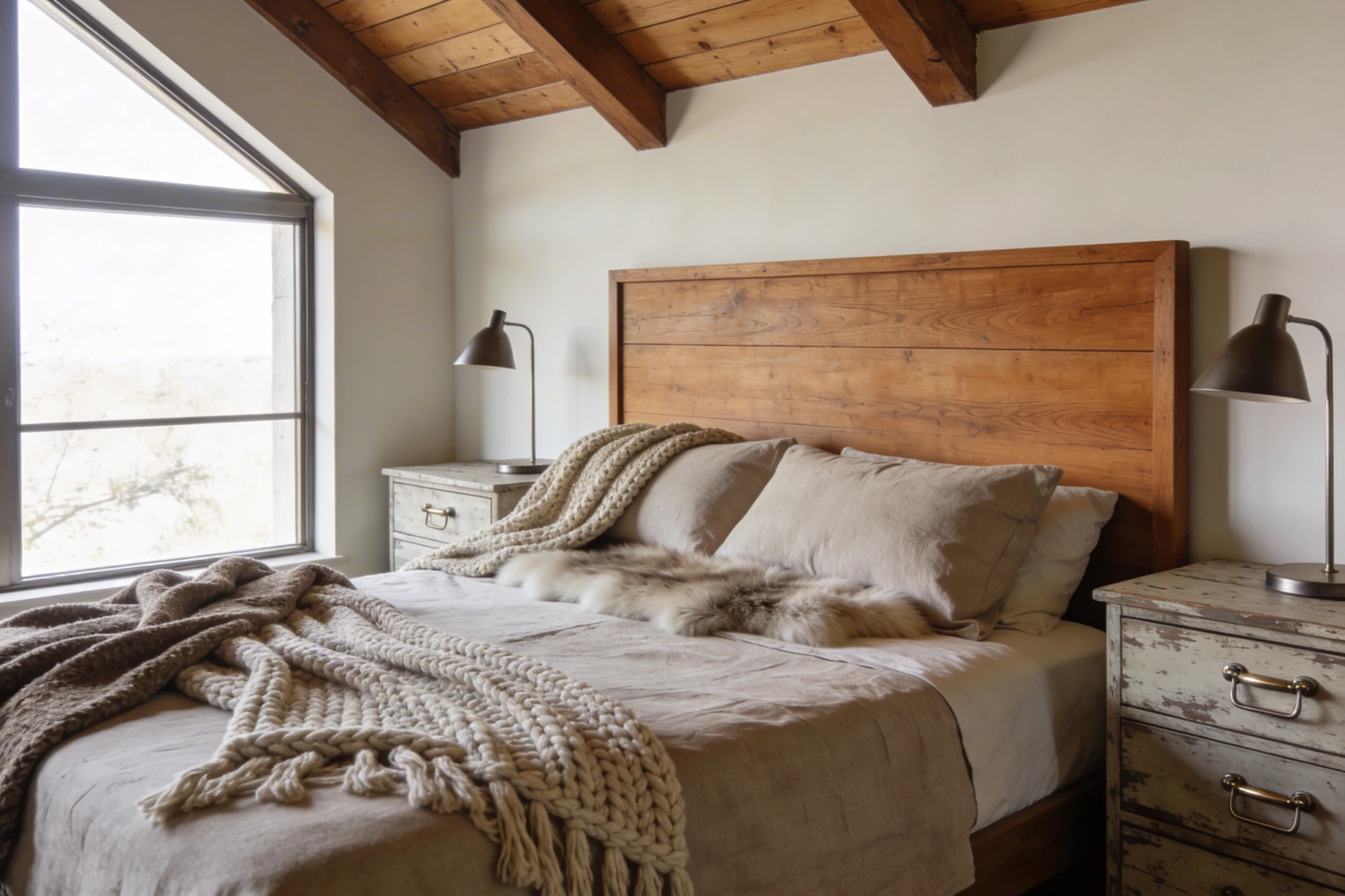
8 Rustic Modern Bedroom Ideas for Chic Spaces
Rustic modern bedroom ideas usually go wrong in one of two directions: too much reclaimed wood and antler decor, so the room ends up looking like a ski lodge, or too much polish, so the “rustic” part disappears entirely and you’re just left with a beige minimalist room. The style actually works when you pick one or two raw, textured elements and let everything else stay quiet around them. If you’d rather see how this compares to a softer, more lived-in take on the same idea, our modern farmhouse bedroom ideas guide is a useful side-by-side.
Below are eight ways to build a rustic modern bedroom design that reads intentional rather than accidental, with notes on where people usually overdo it and where they hold back too much.
Quick Reference: What Actually Moves the Needle
- One wood statement piece does more than five small wood accents scattered around the room.
- Texture matters more than color — a neutral palette in flat fabric reads cheap; the same palette in linen, wool, and jute reads expensive.
- Metal accents should stay matte, not polished chrome, or the rustic half of the equation disappears.
- Warm-white bulbs (2700K–3000K) keep wood tones looking warm instead of gray under LED light.
- Stop at two or three raw elements — the fourth “rustic” piece is usually the one that tips a room into theme-park territory.
1. Start With One Warm Wood Statement Piece
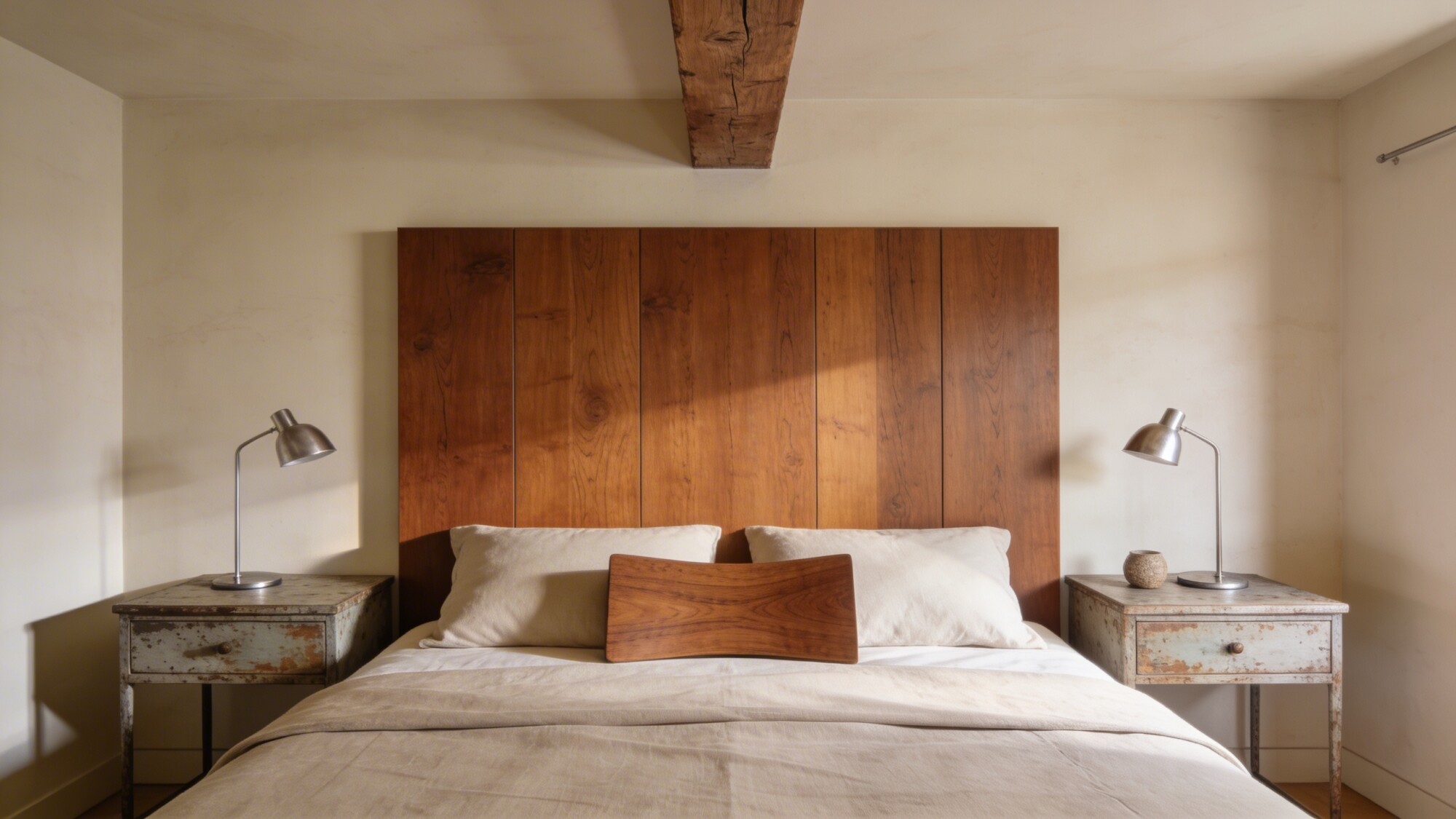
A rustic modern bedroom design almost always starts with wood, but the mistake most people make is treating every surface as an opportunity for it — wood bed frame, wood nightstands, wood dresser, wood shelf, all in slightly different tones. That’s how you end up with a room that feels busy instead of grounded. Pick one piece to carry the wood — typically the headboard or bed frame — and let the rest of the room go quieter.
Why a single piece works better than several
Wood grain and patina are already visually busy. When one piece — say, a cherry or oak headboard — carries that texture, your eye reads it as a deliberate focal point. Spread the same amount of wood across four or five smaller items and your eye can’t settle on any one of them, so the room feels cluttered even if it’s objectively tidy.
💡 Pro Tip: If you already own mismatched wood furniture (a cherry dresser next to an oak nightstand, for example), don’t refinish everything to match. Paint or whitewash the secondary pieces a flat neutral and let only the headboard show real wood grain. It reads more intentional than a forced match ever does.
If exposed wood ceiling beams are structurally part of your room, treat them as your statement piece and keep the furniture below simpler — you don’t need a wood headboard under a wood ceiling; that’s the one combination that consistently reads as too much.
2. Layer Textures Instead of Colors
This is the piece of modern rustic bedroom design that’s easiest to skip and does the most work. A neutral color palette on its own — cream walls, beige bedding, gray rug — can look flat and a little cold. The fix isn’t adding color; it’s adding texture within that same neutral range: a chunky knit throw over crisp linen sheets, a faux sheepskin at the foot of the bed, a jute or rope rug underfoot.
A simple layering formula that holds up
- Base layer: crisp linen sheets and duvet cover
- Mid layer: a knitted throw or chunky wool blanket folded at the foot of the bed
- Texture accent: a faux sheepskin or sherpa piece draped over one corner
- Ground layer: a jute, rope, or wool rug under the bed
- Metal accent: one matte bronze or matte black fixture (lamp base or drawer pulls) to keep it from feeling too soft
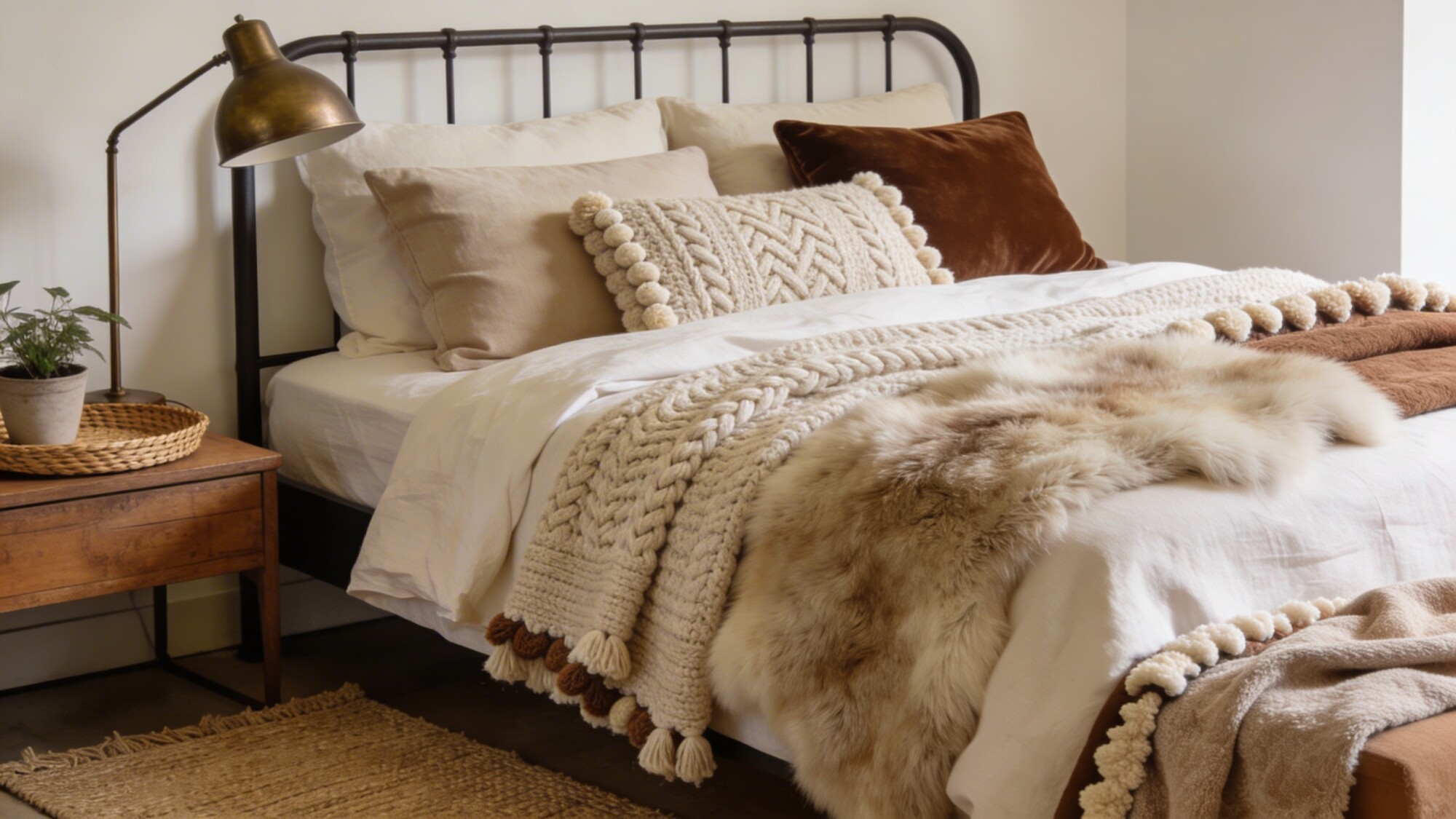
💡 Pro Tip: Buy your throws and rugs in person if you can. Photos flatten texture completely — a “chunky knit” throw that looks great online is sometimes thinner in person than a basic waffle-knit blanket. If you’re ordering online anyway, check the return policy before you commit to more than one piece from the same retailer.
The common mistake here is treating texture as decoration you add at the end. It works better as a planning step: decide your three or four textures before you shop for anything, then buy pieces that fit that plan instead of individually “nice” items that don’t relate to each other.
3. Add Industrial Accents in Small Doses
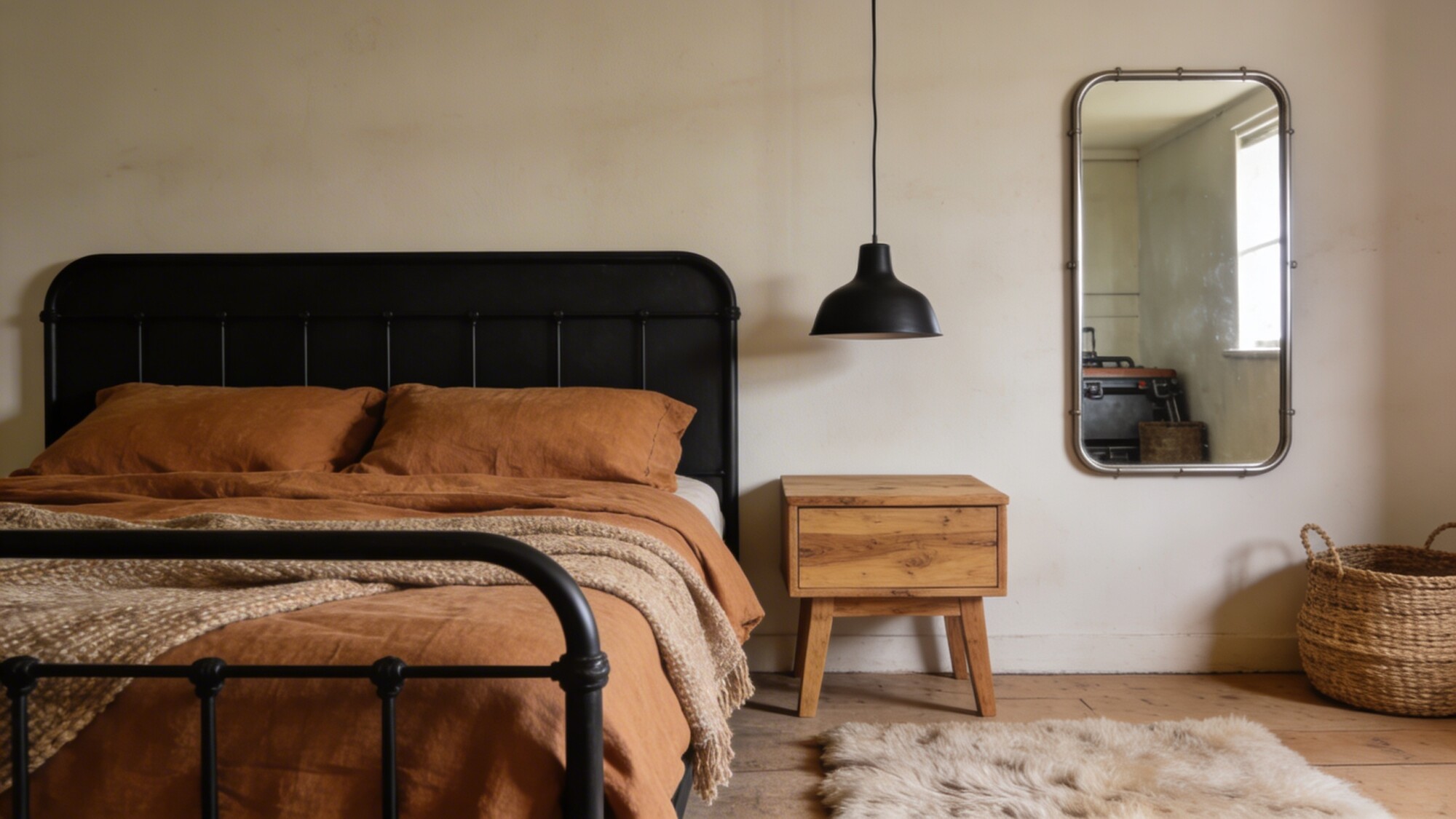
Exposed hardware, a black metal bed frame, or a slim metal-framed mirror can sharpen up a rustic modern bedroom aesthetic that’s leaning too soft or too country. The trade-off to understand here: industrial elements read as intentional in doses of one or two pieces, and read as a different style entirely — closer to loft or warehouse conversion — once you go past three.
Where industrial touches earn their place
- A matte black metal bed frame or headboard, paired with soft linen bedding to balance it
- Matte black drawer pulls, hinges, or lamp bases (avoid polished or chrome finishes — they push the room toward contemporary, not rustic)
- One industrial-style pendant light or wall sconce, rather than a full fixture set
If you’re deciding between a fully upholstered headboard and a metal-and-wood combination frame, our mid-century modern bedroom furniture guide covers a related frame style worth comparing before you buy.
4. Get the Lighting Temperature Right Before Anything Else
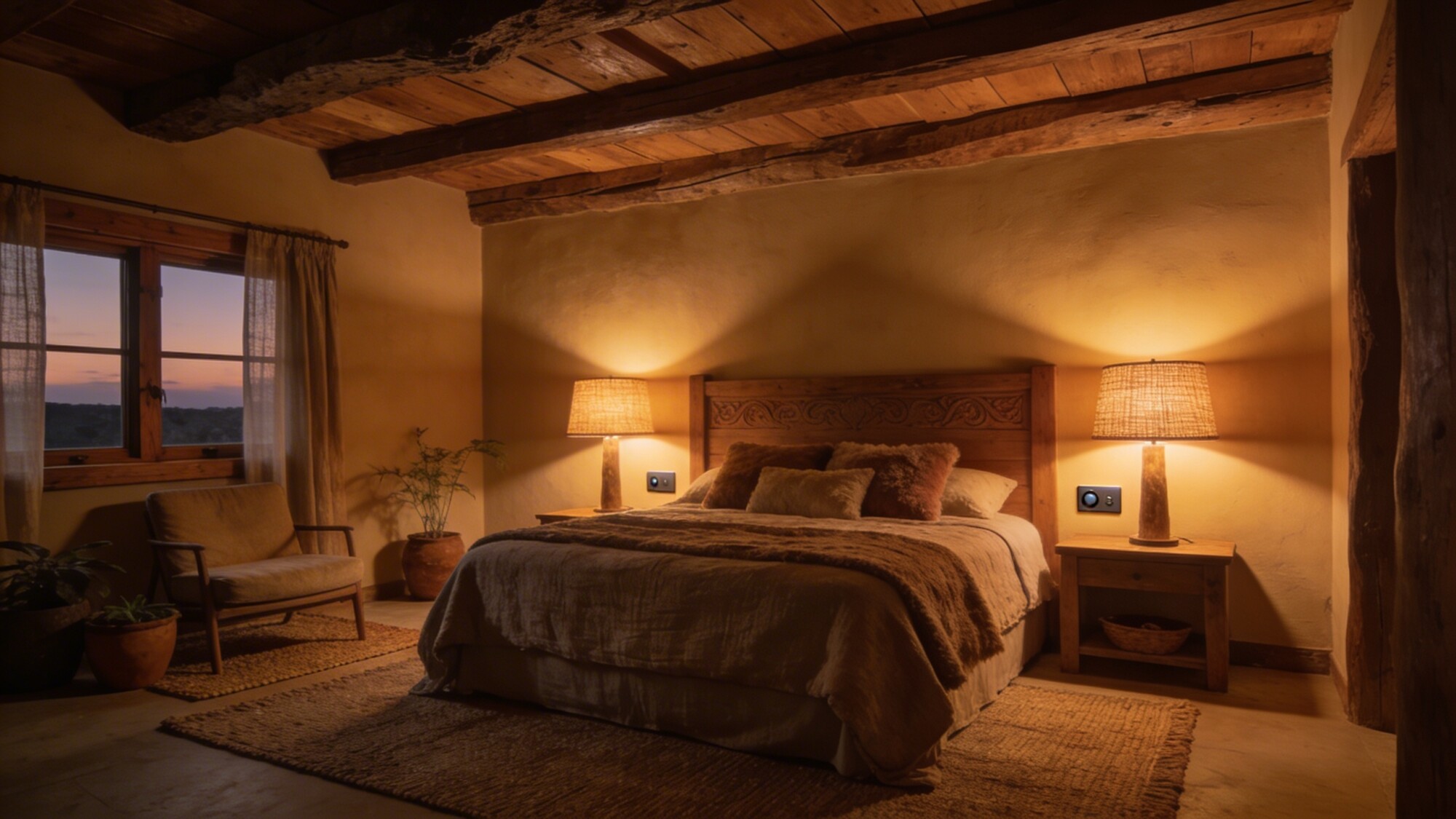
This is the step people skip because it feels less exciting than picking furniture, but it affects everything else in the room. Cool-white bulbs (4000K and up) make warm wood tones look gray and flat under lamplight, even if the wood itself is genuinely warm-toned in daylight. Warm white bulbs, in the 2700K–3000K range, are what keep the wood, linen, and rattan in a rustic modern bedroom looking the way they do in daylight photos.
A layered lighting plan
- Ambient: an overhead fixture or a pair of floor lamps for general room light
- Task: a reading lamp on each nightstand, ideally with a linen or rattan shade to diffuse the light rather than a bare bulb
- Accent: string lights or a single small accent lamp to soften the room after dark
💡 Pro Tip: Before buying new lamps, swap your current bulbs for warm-white ones and sit in the room after dark. Sometimes the “cold” feeling people blame on furniture is actually just the bulb temperature — it’s a five-dollar fix before a several-hundred-dollar one.
A dimmer switch is a small investment relative to the rest of a bedroom refresh, and it’s the difference between a room that only works at one brightness and one that adjusts from morning light to a low, relaxed glow at night.
5. Choose Window Treatments That Filter Light, Not Block It
Heavy blackout drapes are practical but tend to fight against the rustic modern bedroom decor you’ve built everywhere else in the room — they read heavy and formal against linen bedding and raw wood. Lighter treatments in natural fabrics do more for the aesthetic while still giving you privacy and some light control.
What tends to work
| Treatment | Best for | Trade-off |
|---|---|---|
| Flax or linen panels | Softening light without fully blocking it | Not ideal if you need full blackout for sleep |
| Roman shades in natural texture | Clean lines, minimal hardware | Less flexible for partial light control than curtains |
| Layered sheer + roman shade | Daytime softness with a blackout option at night | Higher cost, more hardware to install |
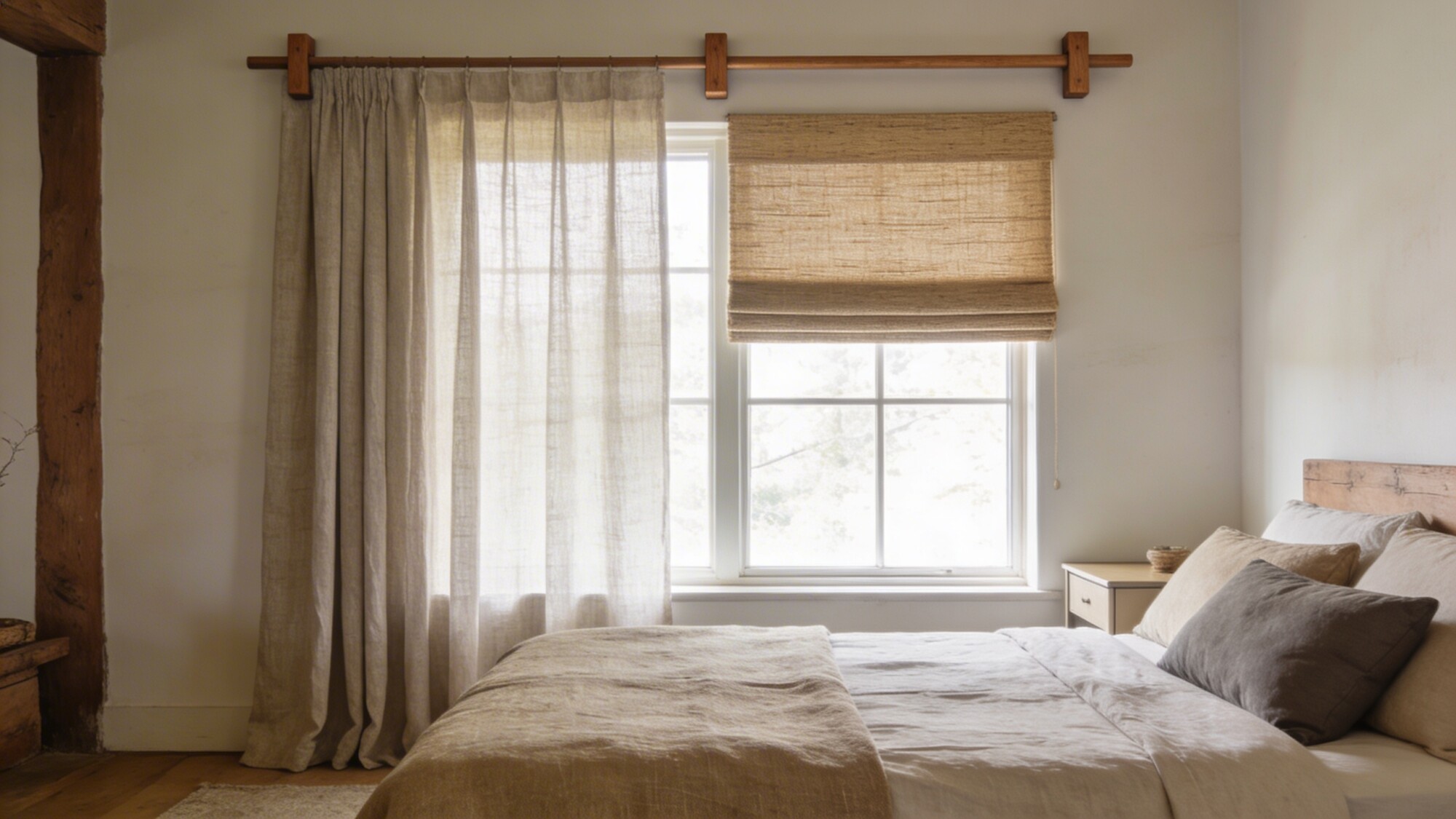
Wooden rings or simple minimal hardware keep the line at the top of the window clean, which matters more than people expect — an ornate curtain rod is one of the fastest ways to pull a room out of “modern” and back into “traditional.”
6. Let the Bed Frame Do the Design Work
The bed is the largest object in the room, so its lines set the tone for everything around it more than any accessory will. This is where the “modern” half of rustic modern bedroom design usually lives — the frame should be simple and low-profile, even if the material (wood, mixed wood-and-metal) is rustic.
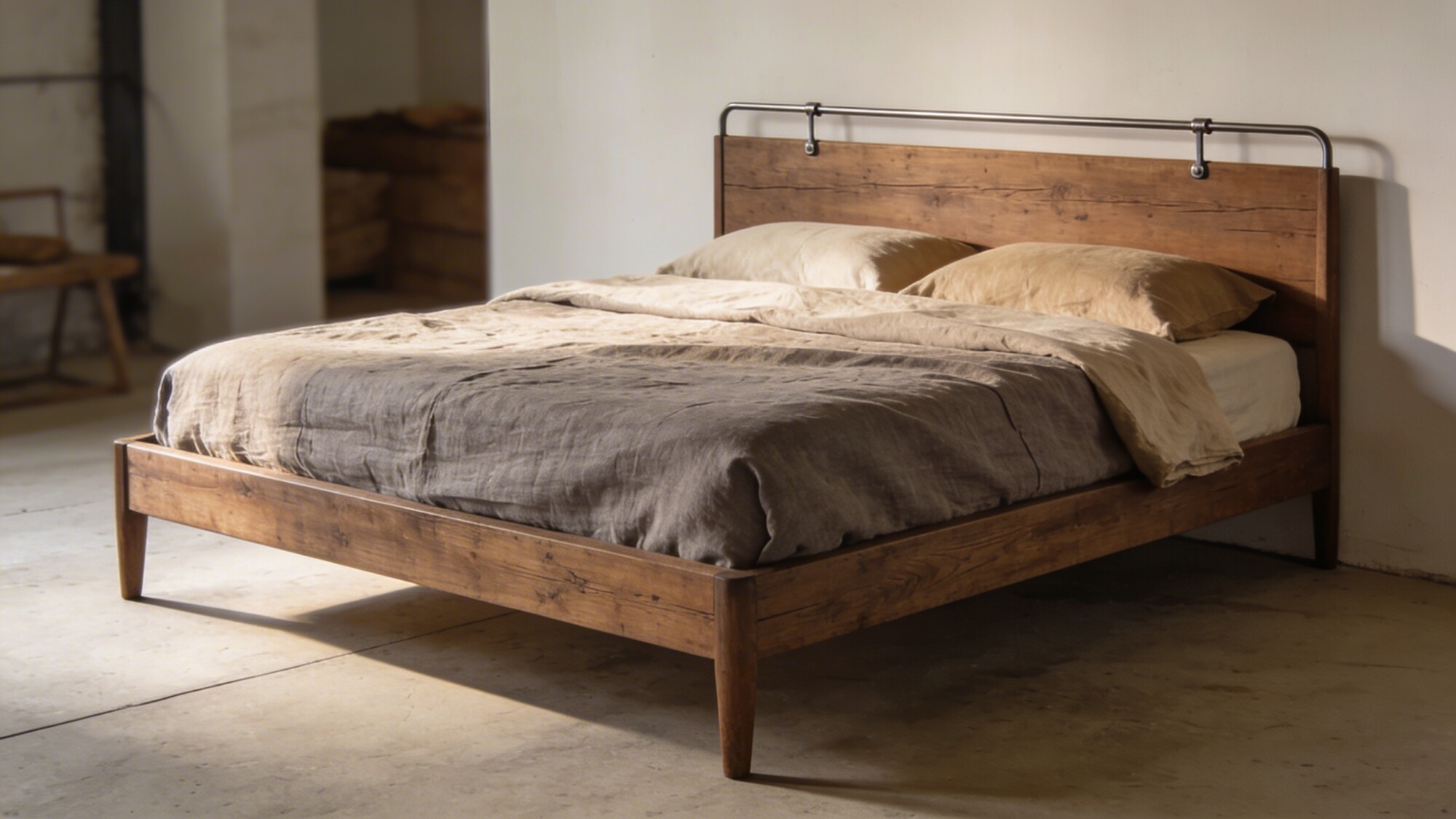
Comparing the three common frame approaches
| Frame type | Pros | Cons |
|---|---|---|
| Low-profile wood frame, straight headboard | Strong wood-grain focal point; widely available; usually the most budget-friendly of the three | Can feel plain without good bedding and lighting to support it |
| Upholstered headboard in linen | Softest option; comfortable to sit against; forgiving if your bedding changes over time | Can drift toward “contemporary” and lose the rustic feel if the frame below isn’t wood or metal |
| Wood-and-metal combination frame | Covers both halves of “rustic modern” in one piece; strong visual anchor | Usually the highest price point; harder to find secondhand |
If you like the idea of an upholstered piece but want it to still feel rustic rather than purely contemporary, pairing it with a reclaimed or antique wood nightstand is a workaround worth considering — our vintage bedroom pieces guide has more ideas along those lines.
💡 Pro Tip: Whatever frame you choose, resist patterned bedding on top of it. A busy duvet cover competes with the wood grain or upholstery texture instead of complementing it — solid, textured neutrals let the frame stay the visual anchor it’s meant to be.
7. Add Plants Where You’ll Actually See Them
Greenery softens the harder lines of wood and metal furniture, but the common mistake is placing a plant wherever there happens to be floor space, rather than somewhere it’s actually visible from the bed. A snake plant or pothos on a nightstand does more for the room than a large plant tucked in a corner you never look at.
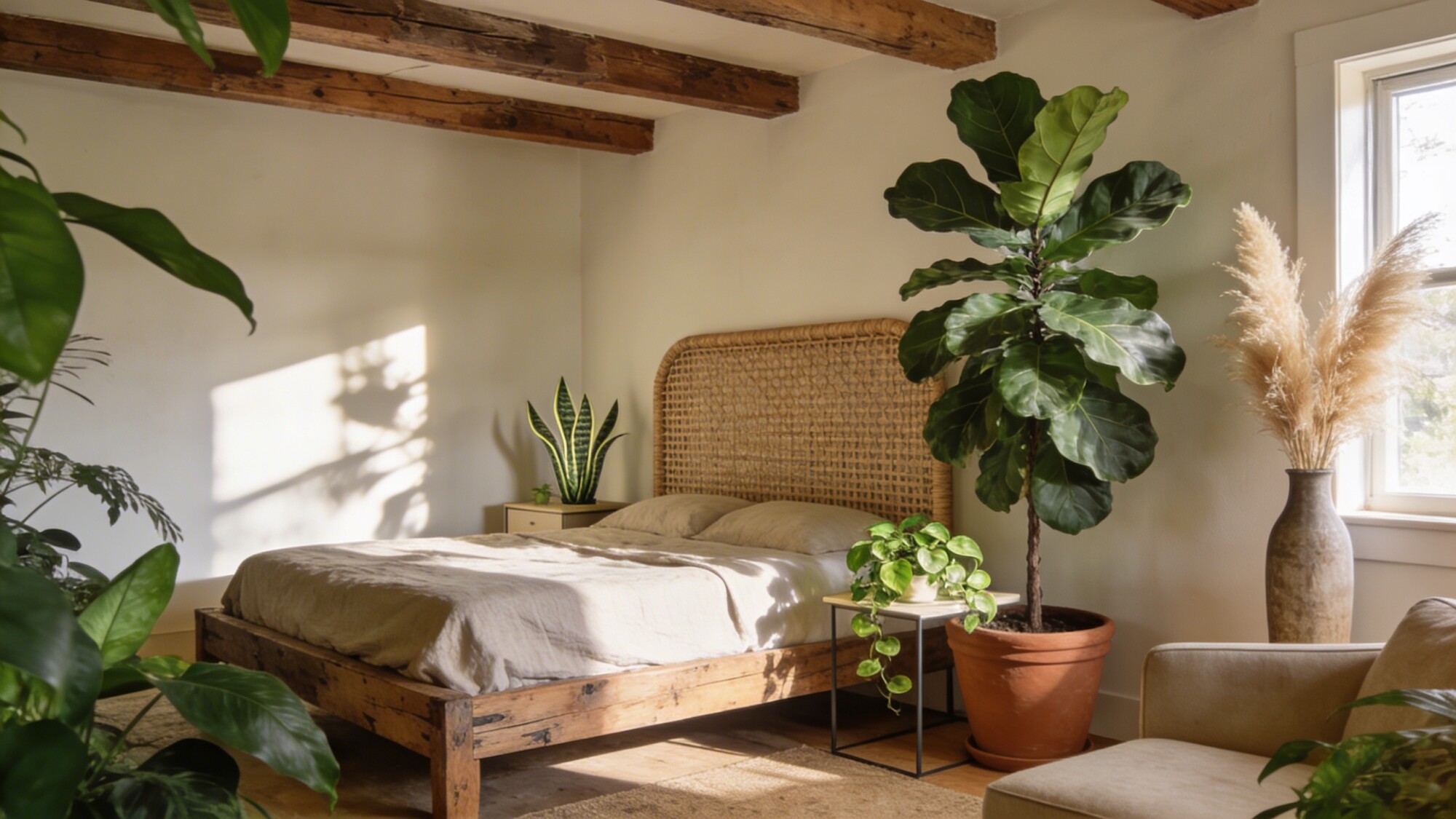
Low-maintenance options that fit the aesthetic
- Snake plant or pothos — tolerant of low light, a reasonable fit for most bedrooms
- Dried pampas grass or dried grasses in a tall vase, for a no-water option with a rustic texture
- A fiddle-leaf fig in a terra-cotta or woven basket planter, if you have a bright spot and are prepared to water it consistently
8. Add the Details That Only You Would Choose
The other seven ideas here could describe thousands of bedrooms. This is the one that makes yours look like it belongs to a specific person instead of a catalog page — a vintage trunk repurposed as a bedside table, a small gallery wall of black-and-white photos, a shelf you built yourself out of reclaimed wood. None of it needs to be expensive; it needs to be yours.
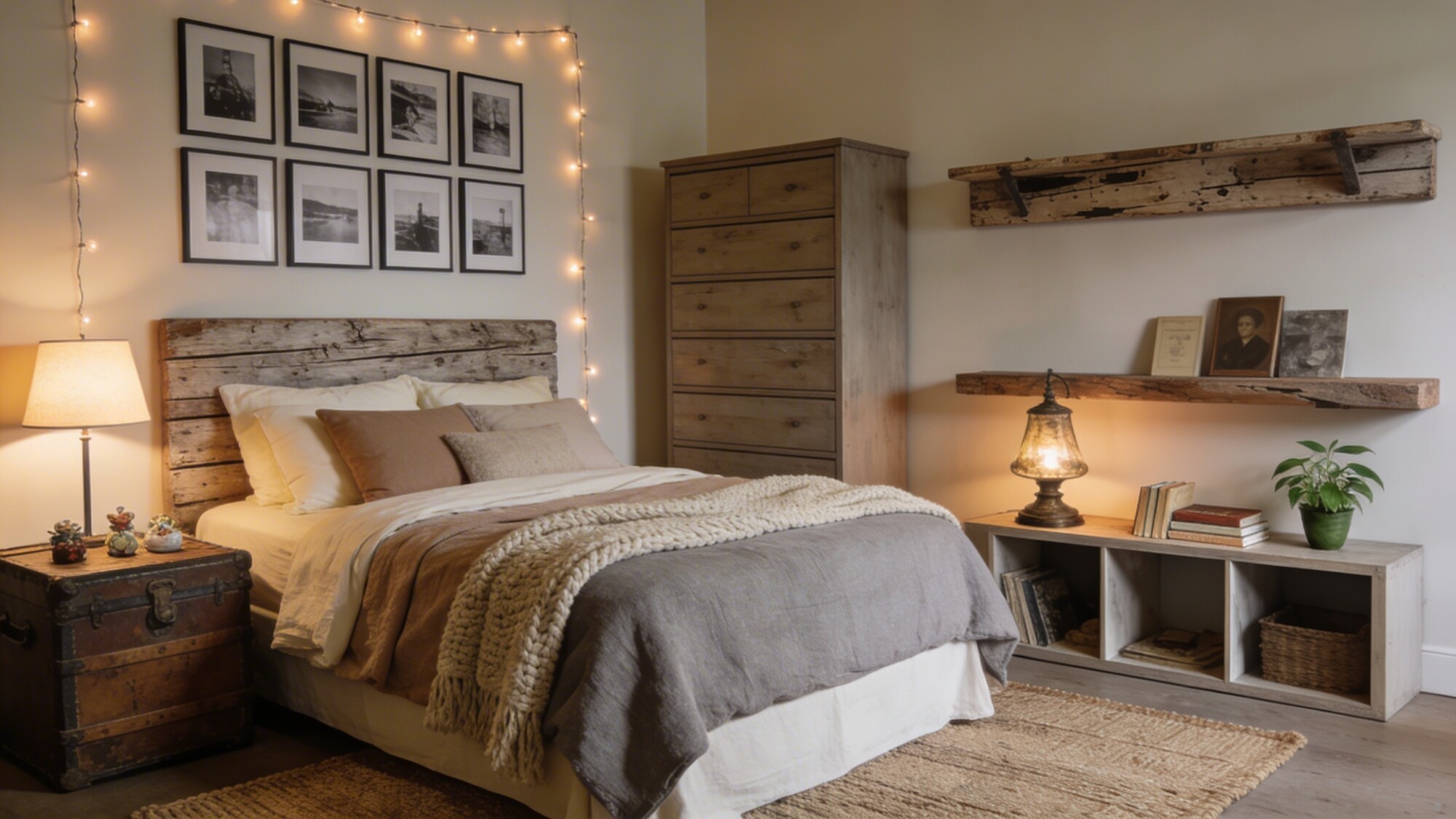
💡 Pro Tip: If you’re not sure where to start with personal touches, pick one object with a story — a piece from a relative, something from a trip — and build the room’s color palette around it, rather than trying to match a personal item to a room you’ve already finished. It reads more natural in that order.
If this kind of curated, collected-over-time look appeals to you more than a fully coordinated set, it’s worth browsing our cottage-style bedroom decor ideas, which lean even further into the personal, lived-in end of the spectrum.
Things to Consider Before You Start
- Do you have one piece of furniture that could become your wood statement piece, or does everything need replacing? Starting from an existing piece is usually cheaper than starting from zero.
- What’s your current bulb temperature? Check this before buying new lamps — it’s the cheapest fix on this list.
- How many raw or industrial elements do you already have in the room? If you’re at three or more, add texture and lighting before adding another accent piece.
- Is your budget better spent on one large piece (a bed frame) or several smaller ones (bedding, a rug, a lamp)? Both work, but they change the order you should shop in.
Frequently Asked Questions
What makes a bedroom “rustic modern” instead of just rustic or just modern?
It’s the combination of raw, textured materials (wood grain, linen, wool, rope) with clean, restrained lines (a low-profile bed frame, minimal hardware, an uncluttered layout). Purely rustic tends to include more ornate or heavily distressed pieces; purely modern tends to strip out the texture entirely. Rustic modern sits in between.
Do I need real wood, or can I use wood-look laminate?
Real wood shows grain and patina that laminate can’t fully replicate, and it’s usually what makes a statement piece read as genuinely rustic. That said, a single real-wood piece (like a headboard) paired with laminate secondary furniture is a reasonable budget compromise — just don’t try to mix multiple laminate “wood” pieces of visibly different tones, which is where it starts to look inconsistent.
How many rustic elements is too many?
As a general guideline, once you’re past three raw/rustic elements (exposed wood, distressed metal, heavy texture) without any clean modern counterpoint, the room starts to read as a full rustic or farmhouse style rather than rustic modern. Balance is the actual design principle here, not a specific item count.
What’s the fastest, cheapest way to start if I can’t redo the whole room?
Swap your bulbs to warm white (2700K–3000K), add one textured throw or rug, and add one small plant somewhere visible from the bed. All three are inexpensive and immediately shift the feel of a room without touching furniture.
Should I match all my wood tones exactly?
No — exact matching across every wood piece tends to look like a bought-as-a-set furniture showroom rather than a considered room. A little variation in tone is normal and even helps the room look collected over time rather than purchased all at once.
Our Take
Rustic modern bedroom inspiration photos can be misleading, because they show a finished room, not the order you’d actually build it in. If you’re starting from scratch, sequence matters: get your lighting temperature right first, add one wood statement piece second, then layer texture on top of that. Furniture and decor added before those two things are settled tend to get replaced later once you realize the room still doesn’t feel right.
If you’re ready to keep exploring this direction, our full collection of cozy modern bedroom ideas is a good next stop for more layering and lighting inspiration once you’ve got the basics of this list in place.