My teenage niece redid her bedroom last summer with a $25 LED strip kit from the internet, and honestly, it looked better than half the “professionally designed” bedrooms I’ve seen on Pinterest. That’s the thing about LED strip lighting ideas bedroom setups — they cost almost nothing compared to real electrical work, and the visual payoff is completely disproportionate to the effort. You stick a strip behind a headboard, plug it in, and suddenly your whole room reads different. Here are thirteen ways to actually do it well, instead of ending up with a rainbow disco strip stuck crookedly above your dresser (we’ve all seen that bedroom on someone’s Instagram). Table of Contents Toggle What Makes LED Strip Lighting Ideas Bedroom Setups Worth the HypeBehind-the-Headboard: The Classic LED Designs for Bedroom Glow1. A Single Strip Outlining the Headboard Shape2. Layered Strips for a Deeper GlowLED Strip Lighting Ideas Bedroom Ceilings Do Best3. Cove Lighting Along the Ceiling Perimeter4. A Ceiling Border Around a Tray or Coffered Section5. Star-Field Effect Along a Dark CeilingUnder-Bed and Furniture: Bedroom Strip Lights That Feel Like a Design Trick6. The Floating Bed Effect7. Dresser and Nightstand Toe-Kick Lighting8. Inside Open Shelving or a BookcaseLED Lighting Bedroom Setups for Desks, Mirrors, and Reading Corners9. Behind a Vanity or Full-Length Mirror10. Under a Floating Desk or Vanity Table11. A Reading Nook AccentColor-Changing vs. Warm White: Which LED Strip Lights Bedroom Style Fits You12. Two-Zone Setup for FlexibilityBedroom Design Ideas Aesthetic Pairings That Make Strip Lights Look Intentional13. Match the Glow to Your Room’s Existing PaletteA Few Practical Tips Before You BuyFinal Thoughts on LED Strip Lighting Ideas Bedroom Style What Makes LED Strip Lighting Ideas Bedroom Setups Worth the Hype Strip lights solve a problem that regular lamps can’t: they let you add light exactly where you want it, in a shape you choose, without a bulky fixture taking up space. You can hide the strip itself entirely and just let the glow show — behind furniture, inside a channel, tucked along a ceiling edge — so all you see is soft color spilling out from somewhere unseen. That’s the effect people are chasing when they save these Pinterest pins by the thousands. And they’re forgiving. Stick-on adhesive backing means renters can use them without losing a deposit, most kits run somewhere between $15 and $40 depending on length and features, and if you don’t like the placement, you peel it up and try again. Compare that to hardwiring a sconce into drywall, and it’s obvious why strip lighting has become the go-to for anyone wanting to test out bedroom design ideas aesthetic changes without commitment. Behind-the-Headboard: The Classic LED Designs for Bedroom Glow 1. A Single Strip Outlining the Headboard Shape This is probably the single most popular of all led designs for bedroom decor, and for good reason. Run a warm white or dimmable RGB strip along the back edge of your headboard, whether it’s upholstered, wood-framed, or just a flat panel mounted to the wall. The strip stays hidden, and what you see instead is a soft halo of light framing the whole shape of the bed. It photographs beautifully, which — let’s be real — matters if you’re doing this partly for the Pinterest-worthy shot. 2. Layered Strips for a Deeper Glow If a single strip feels too thin or flat once it’s installed (which happens more often than you’d think), try doubling it up — one strip closer to the wall, one slightly forward, angled a touch differently. The overlap creates depth instead of a single flat line of color, almost like the light has weight to it. I did this in a guest room once, purely by accident because I ran out of the first roll and grabbed a leftover from another project, and it ended up looking more intentional than my original plan. LED Strip Lighting Ideas Bedroom Ceilings Do Best 3. Cove Lighting Along the Ceiling Perimeter Cove lighting — where the strip sits in a recessed channel or behind a raised trim edge near the ceiling — is one of the more polished-looking LED strip lighting ideas bedroom ceilings can support, and it doesn’t require a full renovation if your ceiling already has crown molding or a step-up in the drywall. If you’re curious what this looks like done really well, these cove lighting ceiling ideas show just how much ambient warmth a hidden channel of light can add to a room. 4. A Ceiling Border Around a Tray or Coffered Section If your bedroom has (or you’re planning) a tray ceiling, a false ceiling detail, or any kind of raised center panel, running a strip around the inside edge of that shape turns it into a genuine focal point at night. It’s subtle during the day and dramatic after dark — the kind of detail that makes people ask “wait, what did you do to your ceiling?” For inspiration on pairing this with a broader ceiling design, these modern bedroom ceiling design ideas are worth a scroll. 5. Star-Field Effect Along a Dark Ceiling Pair a cool-toned or color-shifting LED strip with a matte black or deep navy ceiling, and you get something close to a planetarium effect — small pinpoints of light against a dark backdrop. It’s a bigger commitment than the other ideas here (you’re painting a ceiling, after all), but it’s genuinely one of the more striking bedroom design ideas aesthetic choices I’ve come across, and it works especially well in a room that already leans moody or dramatic in its color palette. Under-Bed and Furniture: Bedroom Strip Lights That Feel Like a Design Trick 6. The Floating Bed Effect Run a warm strip along the underside of your bed frame, angled so the light spills downward and outward onto the floor rather than shining straight out into the room. Done right, it genuinely makes the bed look like it’s hovering a few inches off the ground — especially at night with the overhead light off. This trick alone converts a plain platform bed into something that looks custom-built, and it’s one of those bedroom strip lights setups that costs under $20 but reads as a much bigger investment. 7. Dresser and Nightstand Toe-Kick Lighting If your dresser or nightstands sit slightly raised off the floor (most do, even if just an inch or two), a thin strip tucked into that gap creates a soft wash of light along the floorboards. It’s subtle, almost architectural, and it does double duty as a low-glare night light if you get up in the middle of the night without wanting to flip on a full lamp. 8. Inside Open Shelving or a Bookcase If you’ve got open shelving, a bookcase, or a display ledge in your bedroom, running a thin strip along the top edge of each shelf — pointed down, not out — makes whatever’s displayed underneath look intentional and gallery-lit instead of just sitting there. Books, framed photos, a small plant, whatever you’ve got. This is one of the easier led strip lighting ideas bedroom shelves respond to, since most strips come with an adhesive backing that sticks directly to wood or laminate without extra hardware. LED Lighting Bedroom Setups for Desks, Mirrors, and Reading Corners 9. Behind a Vanity or Full-Length Mirror A strip run around the back edge of a mirror creates that soft backlit-glow effect you see in hotel bathrooms and boutique dressing rooms — a halo of light around the frame instead of a direct beam into your eyes. It’s genuinely flattering, too, which matters if that mirror doubles as your getting-ready spot before work. 10. Under a Floating Desk or Vanity Table For anyone with a floating desk or vanity built into their bedroom setup, a strip tucked underneath the surface adds a soft under-glow that makes the furniture look like it’s barely touching the wall. It’s a small detail, but it’s exactly the kind of thing that separates a “nice bedroom” from one that looks like it was actually designed with intention. 11. A Reading Nook Accent If you’ve got a chair, a daybed, or even just a cozy corner with a floor cushion, a strip run along the baseboard or behind the seating creates enough ambient light to read a book without needing a harsh overhead lamp. Combine it with actual task lighting — a small clip lamp or an adjustable sconce — so you’re not straining your eyes trying to read a paperback by mood lighting alone. (Ask me how I know. Spoiler: I know because I tried it and gave myself a headache.) Color-Changing vs. Warm White: Which LED Strip Lights Bedroom Style Fits You This is probably the question I get asked most, so let’s actually break it down instead of dancing around it. Warm white strips (2200K–3000K) read as cozy, timeless, and closer to candlelight. They fit almost any bedroom style — Scandinavian, boho, farmhouse, minimalist — without clashing. Color-changing RGB or RGBIC strips let you switch between colors and even patterns via app or remote, which is fun for setting a specific mood (soft pink for a relaxed evening, deep blue for a moodier vibe) but can start to look a little juvenile or gamer-room if overused or left on a bright, saturated setting most of the time. Tunable white strips split the difference — they stay in the white-to-warm spectrum but let you adjust the temperature depending on time of day or activity. My honest opinion, and I know not everyone will agree: stick with warm white or tunable white as your everyday setting, and save the full-color RGB mode for occasional use — a birthday, a movie night, whatever. Running saturated color as your default nightly lighting tends to feel more like a novelty than an actual design choice a few months in. 12. Two-Zone Setup for Flexibility If you genuinely can’t decide, some kits let you split a single strip into zones controlled separately — warm white behind the headboard, color-changing under the bed, for example. It’s a nice middle ground if you want both the cozy, livable everyday look and the option to switch things up for a party or a lazy weekend in. Bedroom Design Ideas Aesthetic Pairings That Make Strip Lights Look Intentional 13. Match the Glow to Your Room’s Existing Palette The biggest mistake people make with led lighting bedroom projects isn’t the placement — it’s ignoring the rest of the room. A stark white-and-gray minimalist bedroom calls for a clean, cool-white or soft warm strip, nothing flashy. A boho or earthy room, full of rattan and warm wood tones, tends to look best with amber or soft peach tones rather than icy white or neon color. If your room already leans moody — dark walls, deep textiles — you can actually get away with a bit more saturated color without it looking out of place. For a broader look at how ambient lighting choices shape a room’s whole mood, this guide on high-end bedroom lighting is a good next stop, and if you’re leaning into a softer, more romantic look overall, these cozy bedroom aesthetic ideas with fairy lights pair really well alongside a strip-lit headboard for extra texture. A Few Practical Tips Before You Buy A handful of things I wish someone had told me before my first strip-light project, because I learned most of these the hard way: Measure twice. Strips are sold by length (16 feet, 32 feet, etc.), and running out mid-install because you underestimated a ceiling perimeter is more common than you’d think. Check the adhesive quality before committing to placement. Cheap adhesive backing peels off within a few months, especially in humid rooms — a few extra dollars for a stronger 3M-style adhesive strip saves a lot of frustration later. Plan your power source before you stick anything down. Strips need to reach an outlet, and an unsightly cord running across your floor undoes a lot of the polished look you’re going for. A cord cover channel (a few dollars at most hardware stores) hides this easily. Don’t skip the diffuser channel if you want a smooth glow instead of visible individual LED dots. Bare strips show distinct points of light up close; a plastic or aluminum channel with a frosted cover spreads it into one continuous line instead. None of this is complicated, exactly, but it’s the difference between a strip-light setup that looks like a finished design choice and one that looks like, well, a string of LEDs someone stuck to a wall. Final Thoughts on LED Strip Lighting Ideas Bedroom Style What I like most about these projects is how low-stakes they are. You’re not committing to a paint color you might regret in a year, or a piece of furniture that’s a pain to return. Most of these ideas cost under $50, take an afternoon at most, and can be completely changed or removed whenever you get bored — which, if you’re anything like me, might be sooner than you’d expect. Start with one — the headboard glow or the under-bed float, probably the two easiest wins — and see how it changes the way your room actually feels at night. Save this pin so you can come back to the full list when you’re ready to tackle the next one, and let me know in the comments which idea you’re trying first.
My teenage niece redid her bedroom last summer with a $25 LED strip kit from the internet, and honestly, it looked better than half the “professionally designed” bedrooms I’ve seen on Pinterest. That’s the thing about LED strip lighting ideas bedroom setups — they cost almost nothing compared to real electrical work, and the visual payoff is completely disproportionate to the effort. You stick a strip behind a headboard, plug it in, and suddenly your whole room reads different. Here are thirteen ways to actually do it well, instead of ending up with a rainbow disco strip stuck crookedly above your dresser (we’ve all seen that bedroom on someone’s Instagram).
Strip lights solve a problem that regular lamps can’t: they let you add light exactly where you want it, in a shape you choose, without a bulky fixture taking up space. You can hide the strip itself entirely and just let the glow show — behind furniture, inside a channel, tucked along a ceiling edge — so all you see is soft color spilling out from somewhere unseen. That’s the effect people are chasing when they save these Pinterest pins by the thousands.
And they’re forgiving. Stick-on adhesive backing means renters can use them without losing a deposit, most kits run somewhere between $15 and $40 depending on length and features, and if you don’t like the placement, you peel it up and try again. Compare that to hardwiring a sconce into drywall, and it’s obvious why strip lighting has become the go-to for anyone wanting to test out bedroom design ideas aesthetic changes without commitment.
Behind-the-Headboard: The Classic LED Designs for Bedroom Glow
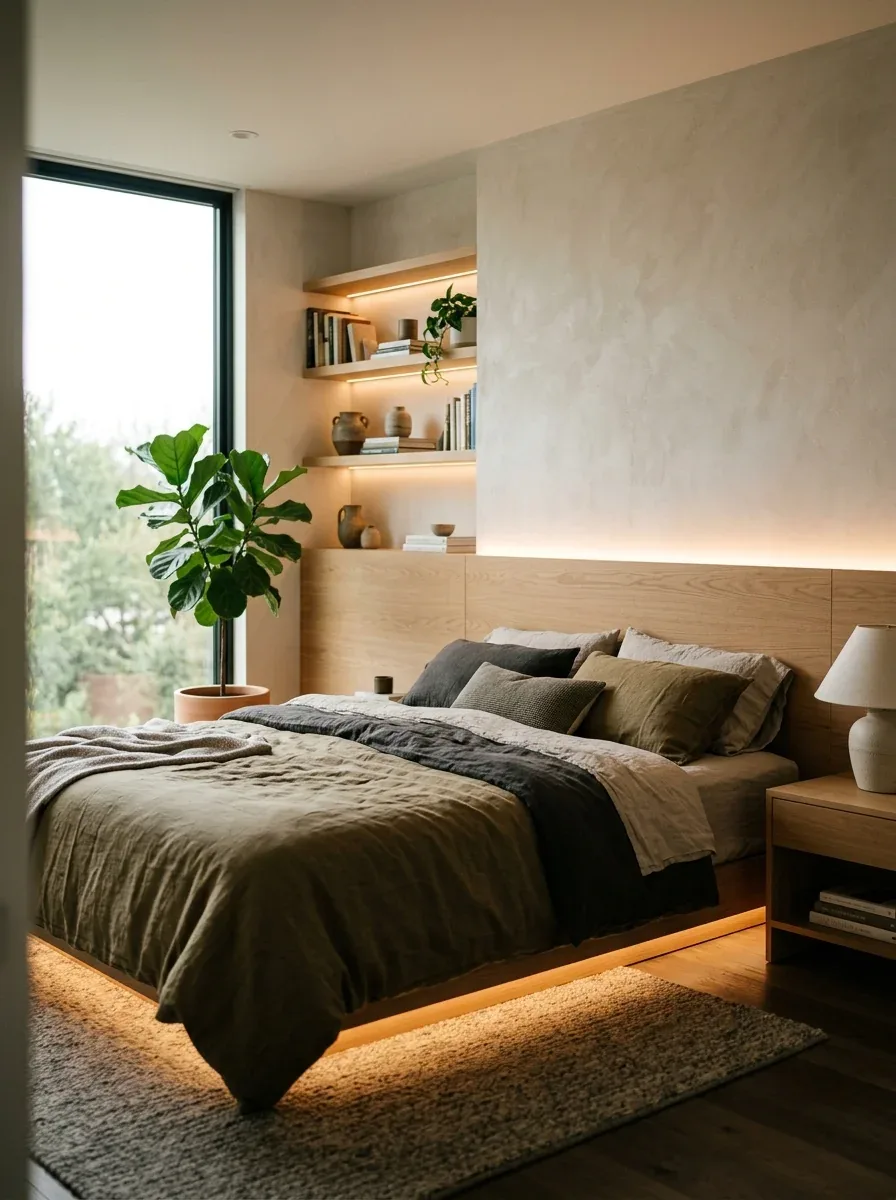
This is probably the single most popular of all led designs for bedroom decor, and for good reason. Run a warm white or dimmable RGB strip along the back edge of your headboard, whether it’s upholstered, wood-framed, or just a flat panel mounted to the wall. The strip stays hidden, and what you see instead is a soft halo of light framing the whole shape of the bed. It photographs beautifully, which — let’s be real — matters if you’re doing this partly for the Pinterest-worthy shot.
If a single strip feels too thin or flat once it’s installed (which happens more often than you’d think), try doubling it up — one strip closer to the wall, one slightly forward, angled a touch differently. The overlap creates depth instead of a single flat line of color, almost like the light has weight to it. I did this in a guest room once, purely by accident because I ran out of the first roll and grabbed a leftover from another project, and it ended up looking more intentional than my original plan.
Cove lighting — where the strip sits in a recessed channel or behind a raised trim edge near the ceiling — is one of the more polished-looking LED strip lighting ideas bedroom ceilings can support, and it doesn’t require a full renovation if your ceiling already has crown molding or a step-up in the drywall. If you’re curious what this looks like done really well, these cove lighting ceiling ideas show just how much ambient warmth a hidden channel of light can add to a room.
4. A Ceiling Border Around a Tray or Coffered Section
If your bedroom has (or you’re planning) a tray ceiling, a false ceiling detail, or any kind of raised center panel, running a strip around the inside edge of that shape turns it into a genuine focal point at night. It’s subtle during the day and dramatic after dark — the kind of detail that makes people ask “wait, what did you do to your ceiling?” For inspiration on pairing this with a broader ceiling design, these modern bedroom ceiling design ideas are worth a scroll.
Pair a cool-toned or color-shifting LED strip with a matte black or deep navy ceiling, and you get something close to a planetarium effect — small pinpoints of light against a dark backdrop. It’s a bigger commitment than the other ideas here (you’re painting a ceiling, after all), but it’s genuinely one of the more striking bedroom design ideas aesthetic choices I’ve come across, and it works especially well in a room that already leans moody or dramatic in its color palette.
Under-Bed and Furniture: Bedroom Strip Lights That Feel Like a Design Trick
Run a warm strip along the underside of your bed frame, angled so the light spills downward and outward onto the floor rather than shining straight out into the room. Done right, it genuinely makes the bed look like it’s hovering a few inches off the ground — especially at night with the overhead light off. This trick alone converts a plain platform bed into something that looks custom-built, and it’s one of those bedroom strip lights setups that costs under $20 but reads as a much bigger investment.
If your dresser or nightstands sit slightly raised off the floor (most do, even if just an inch or two), a thin strip tucked into that gap creates a soft wash of light along the floorboards. It’s subtle, almost architectural, and it does double duty as a low-glare night light if you get up in the middle of the night without wanting to flip on a full lamp.
If you’ve got open shelving, a bookcase, or a display ledge in your bedroom, running a thin strip along the top edge of each shelf — pointed down, not out — makes whatever’s displayed underneath look intentional and gallery-lit instead of just sitting there. Books, framed photos, a small plant, whatever you’ve got. This is one of the easier led strip lighting ideas bedroom shelves respond to, since most strips come with an adhesive backing that sticks directly to wood or laminate without extra hardware.
LED Lighting Bedroom Setups for Desks, Mirrors, and Reading Corners
A strip run around the back edge of a mirror creates that soft backlit-glow effect you see in hotel bathrooms and boutique dressing rooms — a halo of light around the frame instead of a direct beam into your eyes. It’s genuinely flattering, too, which matters if that mirror doubles as your getting-ready spot before work.
For anyone with a floating desk or vanity built into their bedroom setup, a strip tucked underneath the surface adds a soft under-glow that makes the furniture look like it’s barely touching the wall. It’s a small detail, but it’s exactly the kind of thing that separates a “nice bedroom” from one that looks like it was actually designed with intention.
If you’ve got a chair, a daybed, or even just a cozy corner with a floor cushion, a strip run along the baseboard or behind the seating creates enough ambient light to read a book without needing a harsh overhead lamp. Combine it with actual task lighting — a small clip lamp or an adjustable sconce — so you’re not straining your eyes trying to read a paperback by mood lighting alone. (Ask me how I know. Spoiler: I know because I tried it and gave myself a headache.)
Color-Changing vs. Warm White: Which LED Strip Lights Bedroom Style Fits You
This is probably the question I get asked most, so let’s actually break it down instead of dancing around it.
Warm white strips (2200K–3000K) read as cozy, timeless, and closer to candlelight. They fit almost any bedroom style — Scandinavian, boho, farmhouse, minimalist — without clashing.
Color-changing RGB or RGBIC strips let you switch between colors and even patterns via app or remote, which is fun for setting a specific mood (soft pink for a relaxed evening, deep blue for a moodier vibe) but can start to look a little juvenile or gamer-room if overused or left on a bright, saturated setting most of the time.
Tunable white strips split the difference — they stay in the white-to-warm spectrum but let you adjust the temperature depending on time of day or activity.
My honest opinion, and I know not everyone will agree: stick with warm white or tunable white as your everyday setting, and save the full-color RGB mode for occasional use — a birthday, a movie night, whatever. Running saturated color as your default nightly lighting tends to feel more like a novelty than an actual design choice a few months in.
If you genuinely can’t decide, some kits let you split a single strip into zones controlled separately — warm white behind the headboard, color-changing under the bed, for example. It’s a nice middle ground if you want both the cozy, livable everyday look and the option to switch things up for a party or a lazy weekend in.
Bedroom Design Ideas Aesthetic Pairings That Make Strip Lights Look Intentional
The biggest mistake people make with led lighting bedroom projects isn’t the placement — it’s ignoring the rest of the room. A stark white-and-gray minimalist bedroom calls for a clean, cool-white or soft warm strip, nothing flashy. A boho or earthy room, full of rattan and warm wood tones, tends to look best with amber or soft peach tones rather than icy white or neon color. If your room already leans moody — dark walls, deep textiles — you can actually get away with a bit more saturated color without it looking out of place.
A handful of things I wish someone had told me before my first strip-light project, because I learned most of these the hard way:
Measure twice. Strips are sold by length (16 feet, 32 feet, etc.), and running out mid-install because you underestimated a ceiling perimeter is more common than you’d think.
Check the adhesive quality before committing to placement. Cheap adhesive backing peels off within a few months, especially in humid rooms — a few extra dollars for a stronger 3M-style adhesive strip saves a lot of frustration later.
Plan your power source before you stick anything down. Strips need to reach an outlet, and an unsightly cord running across your floor undoes a lot of the polished look you’re going for. A cord cover channel (a few dollars at most hardware stores) hides this easily.
Don’t skip the diffuser channel if you want a smooth glow instead of visible individual LED dots. Bare strips show distinct points of light up close; a plastic or aluminum channel with a frosted cover spreads it into one continuous line instead.
None of this is complicated, exactly, but it’s the difference between a strip-light setup that looks like a finished design choice and one that looks like, well, a string of LEDs someone stuck to a wall.
Final Thoughts on LED Strip Lighting Ideas Bedroom Style
What I like most about these projects is how low-stakes they are. You’re not committing to a paint color you might regret in a year, or a piece of furniture that’s a pain to return. Most of these ideas cost under $50, take an afternoon at most, and can be completely changed or removed whenever you get bored — which, if you’re anything like me, might be sooner than you’d expect.
Start with one — the headboard glow or the under-bed float, probably the two easiest wins — and see how it changes the way your room actually feels at night. Save this pin so you can come back to the full list when you’re ready to tackle the next one, and let me know in the comments which idea you’re trying first.
Listen to this article 10 10 0:00 / 0:00 Speed 0.75×1×1.25×1.5×2× I redid my bedroom lighting three times before I got it right. Three times. The first attempt was one sad flush mount in the middle of the ceiling, the kind that makes every room look like a waiting room at the DMV. So if…
Listen to this article 10 10 0:00 / 0:00 Speed 0.75×1×1.25×1.5×2× If you’re chasing a bedroom that feels dreamy without trying too hard, you’re in the right spot. These fairy light ideas are charming, affordable, and surprisingly versatile. FYI, once you try one, you’ll be hooked. 1. String Them Across the Ceiling for a Starry…