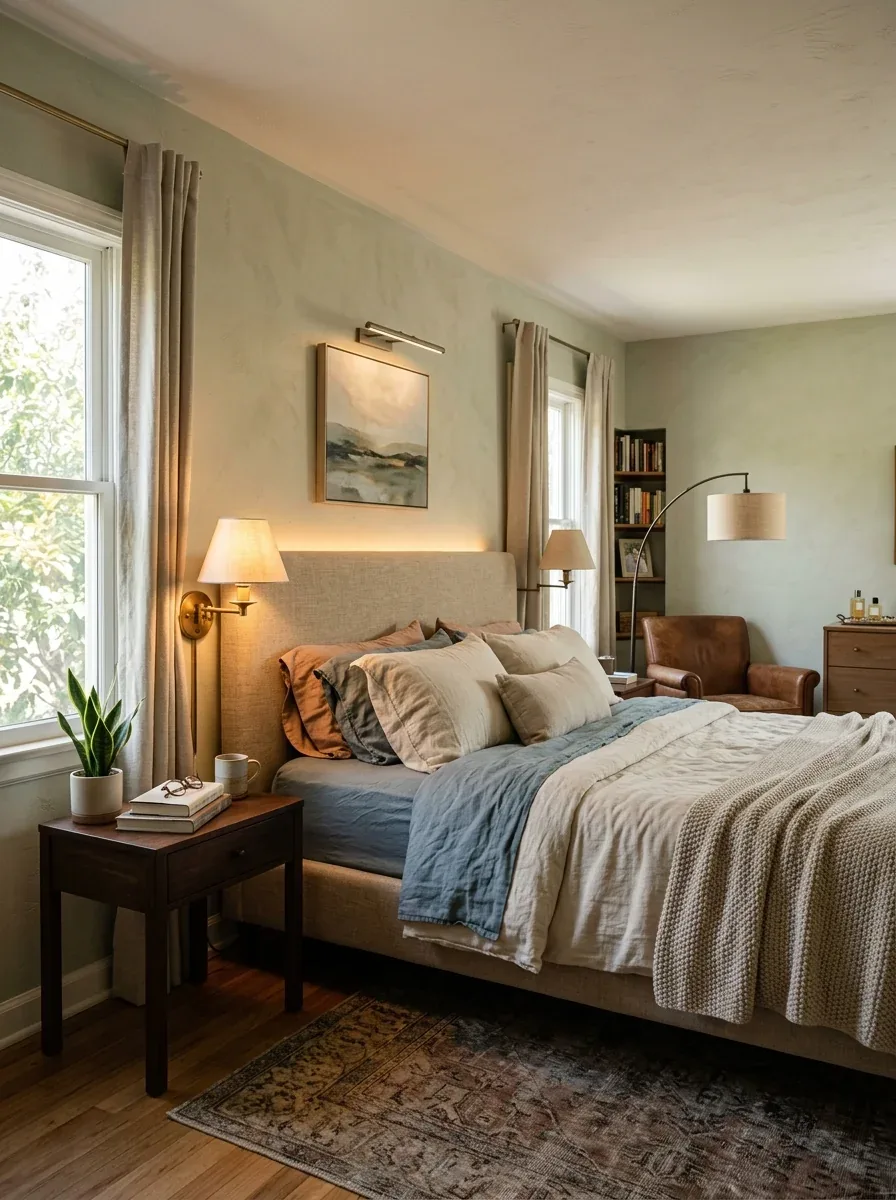
I redid my bedroom lighting three times before I got it right. Three times. The first attempt was one sad flush mount in the middle of the ceiling, the kind that makes every room look like a waiting room at the DMV. So if you’re hunting for bedroom lighting inspiration because your current setup feels flat, harsh, or just… off, I’ve made every mistake already and I’m going to save you the trouble. Table of Contents Toggle Why One Overhead Light Is Never EnoughModern Bedroom Lighting Ideas That Don’t Feel ColdLuxury Bedroom Lighting: What Actually Makes It Feel ExpensiveMinimalist Bedroom Lighting for a Calmer SpaceBedroom Ceiling Lighting: Getting the Overhead Layer RightBedroom Pendant Lighting: My Favorite Underused TrickBedroom Lamp Design: Small Choices That Change EverythingBedroom Lighting Ideas for Small or Awkward LayoutsLayering It All Together: A Simple FrameworkFinal Thoughts Here’s the thing nobody tells you when you’re scrolling design accounts at midnight: good bedroom lighting isn’t about finding one gorgeous fixture. It’s about layering several light sources so the room can shift from “get ready for work” bright to “reading in bed at 9pm” soft without you having to squint or fumble for a dimmer that doesn’t exist. Let’s get into it. Why One Overhead Light Is Never Enough I’ll be blunt — a single ceiling fixture is the single biggest reason bedrooms feel like hotel conference rooms instead of retreats. One source of light casts one type of shadow, at one intensity, from one direction. Your face looks weird in the mirror. The corners of the room stay dark no matter how bright the bulb is. And you’re stuck choosing between “blindingly on” or “totally off,” which is a terrible choice to have at 11pm when you just want to read for twenty minutes. Designers talk about three layers of light for a reason, and it’s not just industry jargon: Ambient light — your general, whole-room illumination (ceiling fixtures, flush mounts) Task light — focused light for specific jobs (reading lamps, vanity lighting, closet lighting) Accent light — mood and atmosphere (sconces, LED strips, fairy lights, uplighting) Skip any one of these and the room feels unfinished, even if you can’t put your finger on why. I promise you, that nagging feeling that your bedroom “just doesn’t feel right” is very often a lighting problem, not a furniture problem. Modern Bedroom Lighting Ideas That Don’t Feel Cold A lot of modern bedroom lighting goes wrong because people confuse “modern” with “sterile.” Clean lines don’t have to mean clinical brightness. The trick is picking fixtures with warm-toned finishes — matte black, brushed brass, warm bronze — instead of chrome or stark white, and pairing them with warm bulbs (2700K to 3000K, if you want the actual number to look for on the box). A few combinations that read modern without feeling like an operating room: A single sculptural pendant light hung slightly off-center over a reading chair, paired with linear LED strips tucked behind the headboard for ambient glow Two matching brushed-brass wall sconces flanking the bed instead of nightstand lamps (frees up surface space, which — okay, I’m a little obsessed with clutter-free nightstands, that’s a whole other post) A slim flush mount with a fabric or frosted glass diffuser rather than bare exposed bulbs, which can feel more industrial-loft than cozy-bedroom if you’re not careful If your bedroom already has a striking ceiling design, the fixture should complement it, not compete with it. For rooms with tray ceilings or architectural detail, these modern bedroom ceiling design ideas show how the ceiling itself can become part of the lighting plan through recessed cove lighting or perimeter LEDs. Luxury Bedroom Lighting: What Actually Makes It Feel Expensive Here’s an honest confession — I used to think luxury lighting just meant “bigger chandelier.” It doesn’t. What actually reads as luxe is dimmability, layering, and warmth of tone, way more than the price tag on the fixture itself. A $60 dimmer switch will do more for the “expensive hotel” feeling than a $600 chandelier on a single switch ever will. That said, statement fixtures earn their place too. A low-hanging pendant or a small crystal-and-brass chandelier over a seating nook can genuinely transform a bedroom, especially in rooms with 9-foot-plus ceilings where a flush mount just looks lost up there, swallowed by all that empty air. If you want real examples of how this plays out in practice — not just theory — this roundup of high-end bedroom lighting ideas is worth a scroll, and it pairs nicely with these luxury master bedroom decor ideas if you’re doing a fuller room refresh rather than just swapping out a fixture. One thing I’d genuinely skip: oversized chandeliers in small bedrooms. It’s tempting because they photograph beautifully, but in a real 11×12 room, a big chandelier just eats headroom and makes the ceiling feel lower. Scale matters more than drama here. Minimalist Bedroom Lighting for a Calmer Space If maximalist chandeliers aren’t your thing (no judgment — my own bedroom is aggressively minimal), the good news is minimalist bedroom lighting has come a long way from “one bulb, one shade.” The goal is fixtures that disappear visually while still doing serious work. Think: Recessed can lights on a dimmer for ambient light, with zero visual clutter on the ceiling A single sculptural table lamp with a matte finish — ceramic, stone-look resin, or brushed metal — instead of anything glossy or ornate Slim linear LED strips along a floating nightstand or under a platform bed for that soft glow-from-nowhere effect Minimalist doesn’t mean boring, though. It just means restraint. One well-chosen lamp with an interesting silhouette does more for a calm bedroom than five mismatched light sources fighting for attention. Bedroom Ceiling Lighting: Getting the Overhead Layer Right Your ceiling fixture sets the tone for the whole room, so it’s worth slowing down on this decision instead of grabbing whatever’s on sale at the hardware store (I’ve done that, it shows). A few options depending on your ceiling height and style: Flush mounts work for lower ceilings (under 8 feet) where a hanging fixture would sit too close to head height. Look for ones with fabric or frosted shades — bare LED flush mounts can feel more like office lighting than bedroom lighting. Semi-flush mounts give you a little more visual interest without the hazard of a pendant swinging at forehead level. These work well in 8-9 foot rooms. Pendants and mini chandeliers need at least 9 feet of ceiling height to hang properly, ideally over a specific zone — a reading nook, a bench at the foot of the bed — rather than dead center over the mattress, where they can feel intrusive when you’re lying down and looking straight up at it (trust me, I made this mistake and regretted it every single night). If your ceiling itself needs a refresh before you even get to the fixture, these bedroom false ceiling design ideas show how a false ceiling with integrated lighting channels can solve both problems at once — better ceiling, built-in ambient light. Bedroom Pendant Lighting: My Favorite Underused Trick Okay, this is my genuine soapbox moment. Pendant lights hung on either side of the bed, instead of nightstand lamps, might be my favorite bedroom lighting move and almost nobody does it. Here’s why it works so well: it frees up your nightstand surface entirely (books, water glass, glasses case, whatever — actual usable space), it looks intentional and designed rather than “we grabbed lamps from the same store,” and it lets you position the light exactly at reading height instead of wherever a lamp happens to sit. The catch is you need an electrician for hardwired versions, or you can go the plug-in swing-arm route if rewiring isn’t in the budget this year. Either way, hang them so the bottom of the shade sits roughly at shoulder height when you’re sitting up in bed — any higher and you lose the direct reading light, any lower and you’ll bonk your head on it eventually (ask me how I know). Bedroom Lamp Design: Small Choices That Change Everything Lamps are the workhorse of any layered lighting plan, and honestly the easiest place to experiment because swapping a lamp is a lot less commitment than rewiring a ceiling fixture. A few things I’d actually pay attention to: Shade material matters more than people think. Linen and fabric shades diffuse light softly and warmly. Glass and metal shades throw more direct, sometimes harsher light. If your room already runs cool or clinical, fabric shades warm it up instantly. Base height should put the bulb roughly at eye level when you’re sitting up in bed, so the light falls on your book, not directly into your eyes. Dimmable bulbs in every single lamp. This is non-negotiable at this point for me. A $8 dimmable smart bulb does more for your bedroom’s mood range than almost any other single purchase. For rooms leaning into a cozier, more layered feel at night — especially if you like reading before bed the way I do — this piece on creating a cozy bedroom aesthetic with soft lighting gets into exactly this kind of small-detail thinking. Bedroom Lighting Ideas for Small or Awkward Layouts Small bedrooms and weird layouts (slanted ceilings, no overhead outlet, a bed jammed against a window) need a little more problem-solving, but they’re not a dead end. A few workarounds that have genuinely saved me: Plug-in wall sconces with a cord cover kit let you get the sconce look without any electrical work — just an outlet near the bed frame. Battery-operated puck lights or wireless sconces are a lifesaver in rentals or rooms with no wiring where you need it. Vertical floor lamps with an arced or adjustable head can substitute for a nightstand lamp when there’s no surface space at all, and they add height to a room that otherwise reads flat. Layering It All Together: A Simple Framework So how do you actually put this together instead of just buying five random fixtures and hoping? I use a rough three-question framework whenever I’m planning a room’s lighting: What’s my ambient source, and is it on a dimmer? (If the answer is no, stop and fix that first — it’s the cheapest, highest-impact upgrade you can make.) Where do I actually read, work, or get dressed, and does that spot have dedicated task light? What’s my accent layer for the nights I just want the room to feel soft and moody rather than fully lit? Answer those three honestly and you’ll usually land on something like: dimmable flush mount or recessed lighting for ambient, a pendant or lamp pair for task light by the bed, and either LED strips or a small accent lamp on a dresser for mood. That’s it. That’s the whole formula, and it scales whether your bedroom is 90 square feet or a sprawling primary suite. If you’re also rethinking the ceiling design itself as part of this — because a genuinely great lighting plan often starts with the ceiling, not the fixture — this guide to luxury false ceiling designs pairs nicely with everything above, especially if you’re doing a fuller renovation rather than a fixture swap. Final Thoughts Bedroom lighting is one of those things that’s genuinely cheap to get wrong and genuinely cheap to fix — a $12 lamp shade swap or an $8 dimmer bulb can change how a whole room feels at night, no contractor required. Start with the layer you’re missing most (for most people, honestly, it’s the dimmer — go check right now if your overhead light even has one) and build from there. You don’t need to do all of this in one weekend. I certainly didn’t. If this gave you some direction, save this pin for later — bedroom lighting is one of those projects that’s way easier to tackle in stages than all at once, and you’ll want this list handy when you’re standing in the lighting aisle trying to remember what actually matters.
I redid my bedroom lighting three times before I got it right. Three times. The first attempt was one sad flush mount in the middle of the ceiling, the kind that makes every room look like a waiting room at the DMV. So if you’re hunting for bedroom lighting inspiration because your current setup feels flat, harsh, or just… off, I’ve made every mistake already and I’m going to save you the trouble.
Here’s the thing nobody tells you when you’re scrolling design accounts at midnight: good bedroom lighting isn’t about finding one gorgeous fixture. It’s about layering several light sources so the room can shift from “get ready for work” bright to “reading in bed at 9pm” soft without you having to squint or fumble for a dimmer that doesn’t exist. Let’s get into it.
I’ll be blunt — a single ceiling fixture is the single biggest reason bedrooms feel like hotel conference rooms instead of retreats. One source of light casts one type of shadow, at one intensity, from one direction. Your face looks weird in the mirror. The corners of the room stay dark no matter how bright the bulb is. And you’re stuck choosing between “blindingly on” or “totally off,” which is a terrible choice to have at 11pm when you just want to read for twenty minutes.
Designers talk about three layers of light for a reason, and it’s not just industry jargon:
Ambient light — your general, whole-room illumination (ceiling fixtures, flush mounts)
Task light — focused light for specific jobs (reading lamps, vanity lighting, closet lighting)
Accent light — mood and atmosphere (sconces, LED strips, fairy lights, uplighting)
Skip any one of these and the room feels unfinished, even if you can’t put your finger on why. I promise you, that nagging feeling that your bedroom “just doesn’t feel right” is very often a lighting problem, not a furniture problem.
Modern Bedroom Lighting Ideas That Don’t Feel Cold
A lot of modern bedroom lighting goes wrong because people confuse “modern” with “sterile.” Clean lines don’t have to mean clinical brightness. The trick is picking fixtures with warm-toned finishes — matte black, brushed brass, warm bronze — instead of chrome or stark white, and pairing them with warm bulbs (2700K to 3000K, if you want the actual number to look for on the box).
A few combinations that read modern without feeling like an operating room:
A single sculptural pendant light hung slightly off-center over a reading chair, paired with linear LED strips tucked behind the headboard for ambient glow
Two matching brushed-brass wall sconces flanking the bed instead of nightstand lamps (frees up surface space, which — okay, I’m a little obsessed with clutter-free nightstands, that’s a whole other post)
A slim flush mount with a fabric or frosted glass diffuser rather than bare exposed bulbs, which can feel more industrial-loft than cozy-bedroom if you’re not careful
If your bedroom already has a striking ceiling design, the fixture should complement it, not compete with it. For rooms with tray ceilings or architectural detail, these modern bedroom ceiling design ideas show how the ceiling itself can become part of the lighting plan through recessed cove lighting or perimeter LEDs.
Luxury Bedroom Lighting: What Actually Makes It Feel Expensive
Here’s an honest confession — I used to think luxury lighting just meant “bigger chandelier.” It doesn’t. What actually reads as luxe is dimmability, layering, and warmth of tone, way more than the price tag on the fixture itself. A $60 dimmer switch will do more for the “expensive hotel” feeling than a $600 chandelier on a single switch ever will.
That said, statement fixtures earn their place too. A low-hanging pendant or a small crystal-and-brass chandelier over a seating nook can genuinely transform a bedroom, especially in rooms with 9-foot-plus ceilings where a flush mount just looks lost up there, swallowed by all that empty air.
If you want real examples of how this plays out in practice — not just theory — this roundup of high-end bedroom lighting ideas is worth a scroll, and it pairs nicely with these luxury master bedroom decor ideas if you’re doing a fuller room refresh rather than just swapping out a fixture.
One thing I’d genuinely skip: oversized chandeliers in small bedrooms. It’s tempting because they photograph beautifully, but in a real 11×12 room, a big chandelier just eats headroom and makes the ceiling feel lower. Scale matters more than drama here.
If maximalist chandeliers aren’t your thing (no judgment — my own bedroom is aggressively minimal), the good news is minimalist bedroom lighting has come a long way from “one bulb, one shade.” The goal is fixtures that disappear visually while still doing serious work.
Think:
Recessed can lights on a dimmer for ambient light, with zero visual clutter on the ceiling
A single sculptural table lamp with a matte finish — ceramic, stone-look resin, or brushed metal — instead of anything glossy or ornate
Slim linear LED strips along a floating nightstand or under a platform bed for that soft glow-from-nowhere effect
Minimalist doesn’t mean boring, though. It just means restraint. One well-chosen lamp with an interesting silhouette does more for a calm bedroom than five mismatched light sources fighting for attention.
Your ceiling fixture sets the tone for the whole room, so it’s worth slowing down on this decision instead of grabbing whatever’s on sale at the hardware store (I’ve done that, it shows). A few options depending on your ceiling height and style:
Flush mounts work for lower ceilings (under 8 feet) where a hanging fixture would sit too close to head height. Look for ones with fabric or frosted shades — bare LED flush mounts can feel more like office lighting than bedroom lighting.
Semi-flush mounts give you a little more visual interest without the hazard of a pendant swinging at forehead level. These work well in 8-9 foot rooms.
Pendants and mini chandeliers need at least 9 feet of ceiling height to hang properly, ideally over a specific zone — a reading nook, a bench at the foot of the bed — rather than dead center over the mattress, where they can feel intrusive when you’re lying down and looking straight up at it (trust me, I made this mistake and regretted it every single night).
If your ceiling itself needs a refresh before you even get to the fixture, these bedroom false ceiling design ideas show how a false ceiling with integrated lighting channels can solve both problems at once — better ceiling, built-in ambient light.
Bedroom Pendant Lighting: My Favorite Underused Trick
Okay, this is my genuine soapbox moment. Pendant lights hung on either side of the bed, instead of nightstand lamps, might be my favorite bedroom lighting move and almost nobody does it. Here’s why it works so well: it frees up your nightstand surface entirely (books, water glass, glasses case, whatever — actual usable space), it looks intentional and designed rather than “we grabbed lamps from the same store,” and it lets you position the light exactly at reading height instead of wherever a lamp happens to sit.
The catch is you need an electrician for hardwired versions, or you can go the plug-in swing-arm route if rewiring isn’t in the budget this year. Either way, hang them so the bottom of the shade sits roughly at shoulder height when you’re sitting up in bed — any higher and you lose the direct reading light, any lower and you’ll bonk your head on it eventually (ask me how I know).
Bedroom Lamp Design: Small Choices That Change Everything
Lamps are the workhorse of any layered lighting plan, and honestly the easiest place to experiment because swapping a lamp is a lot less commitment than rewiring a ceiling fixture. A few things I’d actually pay attention to:
Shade material matters more than people think. Linen and fabric shades diffuse light softly and warmly. Glass and metal shades throw more direct, sometimes harsher light. If your room already runs cool or clinical, fabric shades warm it up instantly.
Base height should put the bulb roughly at eye level when you’re sitting up in bed, so the light falls on your book, not directly into your eyes.
Dimmable bulbs in every single lamp. This is non-negotiable at this point for me. A $8 dimmable smart bulb does more for your bedroom’s mood range than almost any other single purchase.
For rooms leaning into a cozier, more layered feel at night — especially if you like reading before bed the way I do — this piece on creating a cozy bedroom aesthetic with soft lighting gets into exactly this kind of small-detail thinking.
Bedroom Lighting Ideas for Small or Awkward Layouts
Small bedrooms and weird layouts (slanted ceilings, no overhead outlet, a bed jammed against a window) need a little more problem-solving, but they’re not a dead end. A few workarounds that have genuinely saved me:
Plug-in wall sconces with a cord cover kit let you get the sconce look without any electrical work — just an outlet near the bed frame.
Battery-operated puck lights or wireless sconces are a lifesaver in rentals or rooms with no wiring where you need it.
Vertical floor lamps with an arced or adjustable head can substitute for a nightstand lamp when there’s no surface space at all, and they add height to a room that otherwise reads flat.
So how do you actually put this together instead of just buying five random fixtures and hoping? I use a rough three-question framework whenever I’m planning a room’s lighting:
What’s my ambient source, and is it on a dimmer? (If the answer is no, stop and fix that first — it’s the cheapest, highest-impact upgrade you can make.)
Where do I actually read, work, or get dressed, and does that spot have dedicated task light?
What’s my accent layer for the nights I just want the room to feel soft and moody rather than fully lit?
Answer those three honestly and you’ll usually land on something like: dimmable flush mount or recessed lighting for ambient, a pendant or lamp pair for task light by the bed, and either LED strips or a small accent lamp on a dresser for mood. That’s it. That’s the whole formula, and it scales whether your bedroom is 90 square feet or a sprawling primary suite.
If you’re also rethinking the ceiling design itself as part of this — because a genuinely great lighting plan often starts with the ceiling, not the fixture — this guide to luxury false ceiling designs pairs nicely with everything above, especially if you’re doing a fuller renovation rather than a fixture swap.
Bedroom lighting is one of those things that’s genuinely cheap to get wrong and genuinely cheap to fix — a $12 lamp shade swap or an $8 dimmer bulb can change how a whole room feels at night, no contractor required. Start with the layer you’re missing most (for most people, honestly, it’s the dimmer — go check right now if your overhead light even has one) and build from there. You don’t need to do all of this in one weekend. I certainly didn’t.
If this gave you some direction, save this pin for later — bedroom lighting is one of those projects that’s way easier to tackle in stages than all at once, and you’ll want this list handy when you’re standing in the lighting aisle trying to remember what actually matters.
Listen to this article 10 10 0:00 / 0:00 Speed 0.75×1×1.25×1.5×2× My teenage niece redid her bedroom last summer with a $25 LED strip kit from the internet, and honestly, it looked better than half the “professionally designed” bedrooms I’ve seen on Pinterest. That’s the thing about LED strip lighting ideas bedroom setups — they…
Listen to this article 10 10 0:00 / 0:00 Speed 0.75×1×1.25×1.5×2× If you’re chasing a bedroom that feels dreamy without trying too hard, you’re in the right spot. These fairy light ideas are charming, affordable, and surprisingly versatile. FYI, once you try one, you’ll be hooked. 1. String Them Across the Ceiling for a Starry…